


A forest source isn’t automatically a responsible source. Chaga mushroom sourcing ethics depend on clear origin records, careful harvesting, and evidence that ecological and community needs are considered.
It’s reasonable to look beyond a “wild-harvested” label. Chaga grows slowly, and a harvested conk can take 20 years or more to regrow to its original size. That makes the way it is gathered, and the forest conditions behind it, important parts of the story.
This guide explains how to assess cultivated and wild-harvested Chaga, interpret supplier certificates, trace raw material to its origin, and recognize signs of resource pressure. It also covers controlled-forest sourcing, including access agreements, consent, and meaningful benefit-sharing with local communities. A clear view of the supply chain helps you distinguish detailed sourcing information from a reassuring label.
Key Takeaways
- Assess cultivation and wild-harvest practices in context: responsible sourcing should account for local ecology and avoid taking more than the forest can sustain.
- Look for batch-level evidence, including a lot-specific certificate of analysis and testing for contaminants relevant to the intended market.
- Trace the raw material to its producing site, and distinguish a clear origin statement from a claim that one region guarantees higher quality.
- Read signs of resource pressure alongside harvest practices, since slow-growing Chaga can be vulnerable to intensive collection.
- Consider whether controlled-forest agreements protect consent, share value with communities, and support ecological and cultural continuity.
1. Chaga cultivation to reduce pressure on wild populations
Chaga, or Inonotus obliquus, forms a dark, irregular growth on birch trunks. It can also grow on alder, aspen, and elm. This relationship matters when assessing a source: “wild” describes how material was gathered, not whether collection was appropriate for the forest. Responsible chaga mushroom sourcing ethics begin with the growing site, the harvest method, and the condition of host trees.
Wild Chaga grows slowly. A harvested conk can take 20 years or more to regain its original size. In 2023, several northern regions of Canada and Russia reported reduced availability linked to environmental stress and unsustainable collection practices. Those pressures make a simple supply claim less informative than a description of local conditions. Look for details about collection limits, rest periods, and how harvesters avoid damaging the tree or surrounding habitat. Scarcity is a reason to examine practice, not proof that every wild harvest is harmful.
Cultivated and wild material raise different sourcing questions. For cultivated Chaga, useful evidence identifies the production site, growing method, and species. For wild material, it explains where it was gathered and how harvesting accounts for ecosystem health. A responsible supplier should describe whether local species face pressure and how collection stays within what the habitat can sustain. Powder from either source still needs traceable origin and handling information. “Cultivated” alone does not establish quality or ecological care.
On U.S. public lands, permission depends on the land manager and the specific parcel. Identify the responsible agency before collecting, then follow its current rules for personal or commercial harvesting. A general claim that public land is open does not establish permission to remove Chaga.
There is no single fair price for sustainably sourced Chaga in the United States. Price depends on origin, collection effort, material form, testing, and whether purchasing terms support harvesters fairly. Compare the evidence behind the price, including traceability and responsible collection practices, rather than treating a premium or low price as proof of ethics.
Harvesting a conk removes fungal material attached to the birch and can injure its bark. This does not mean every harvest kills the tree, but neither is every method harmless. The outcome depends on the tree’s condition and the extent of the injury. A careful sourcing account explains how collectors limit damage and allow the forest to recover.
Wild and cultivated methods should be assessed in relation to ecology. Fungi Natur describes wild Chaga as scarce and says it must be harvested responsibly. Wildcrafting considers ecosystem health, threatened species, sustainable collection, and leaving the mycelium intact where possible.
2. Supplier verification and batch-level certificates
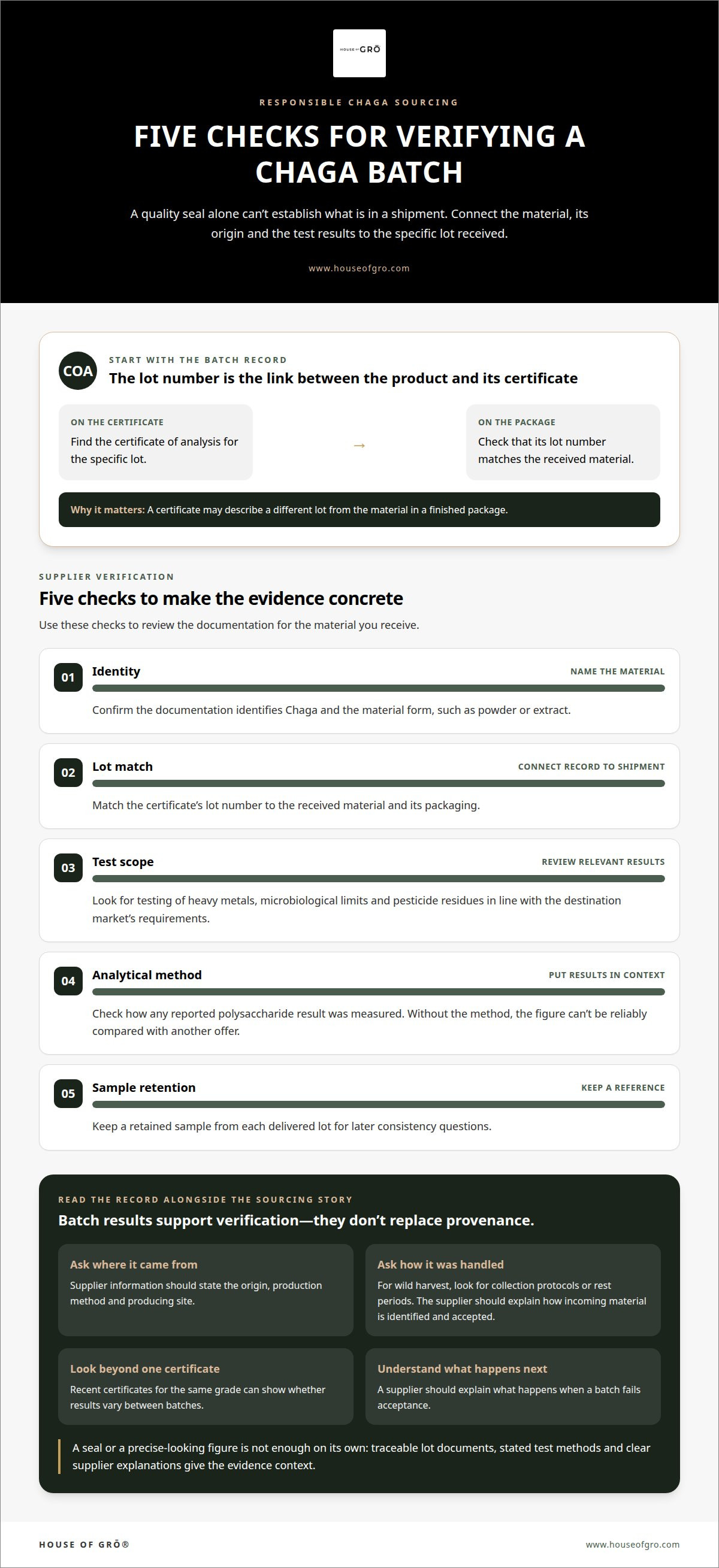
A supplier’s name or quality seal can’t establish what is in a specific Chaga shipment. Verification connects the material and its origin to test results for the lot received. Start with the supplier’s explanation of how incoming fungal material is identified and accepted. It should name the species and material, state the origin and production method, and explain wild-harvest protocols or rest periods. These details make a sourcing claim more concrete, while still leaving the evidence to assess.
Batch testing matters because a certificate may describe a different lot from the material in a finished package. A certificate of analysis should identify the specific lot, and its lot number should match the packaging. Testing should address heavy metals, microbiological limits, and pesticide residues in line with the destination market’s requirements. Comparing recent certificates for the same grade can show whether results vary between batches. One document offers less context about consistency.
- Identity: Confirm that the documentation names Chaga and the material form, such as powder or extract.
- Lot match: Connect the certificate’s lot number to the received material and its packaging.
- Test scope: Look for results covering heavy metals, microbiological limits, and pesticide residues.
- Analytical method: Read how any reported polysaccharide result was measured.
- Sample retention: Keep a retained sample from each delivered lot for later consistency questions.
A polysaccharide figure without its analytical method can’t be reliably compared with another offer. The method gives context to the result. Treat a precise-looking figure without that context cautiously: it is not a dependable basis for comparison or review.
Certificates support verification, but they don’t replace a sourcing relationship. A supplier should explain where material comes from, how it enters production, and what happens when a batch fails acceptance. Those answers connect paperwork to an actual process. A seal alone cannot describe harvesting practices or show how incoming fungal material is identified.
Small-batch packing is another detail to interpret carefully. Loose-leaf botanicals may be packed in small batches, but that phrase alone says nothing about Chaga’s origin, testing, or lot consistency. Treat it as a packing detail, then assess Chaga through its own batch records. Traceable lot documents, stated test methods, and clear supplier explanations offer a more useful picture than a broad quality claim.
3. Chaga raw material provenance and origin statements
Chaga is the common name for Inonotus obliquus, a fungus that forms a dark, irregular mass on tree trunks, especially birch. It grows naturally across Northern Europe, Russia, Siberia, Canada, Alaska, Minnesota, and parts of New England. A place name is a starting point, not a quality ranking. Provenance helps establish where material came from and how it entered the supply chain.
A useful origin statement connects the mushroom to its source and producing site. It should identify the Chaga material, name its geographic origin, and say whether it was wild-harvested or cultivated. It should also link that origin to the relevant lot. “Northern forest” is less informative than a specific region and a clear account of who supplied the raw material. The goal is traceability, not a claim that one location automatically produces better Chaga.
For a clear provenance record, look for details that answer these questions:
- What is the material? The record should identify Chaga as Inonotus obliquus and state whether it is whole material, powder, or another form.
- Where did it come from? The origin should name a region or producing site, rather than relying only on broad terms such as “northern” or “wild.”
- Who supplied it? Identify the mushroom provider and how the raw material moved from its source into production.
- Who governs access? Clarify who has authority over access to the material and associated knowledge.
- Who benefits? Describe how value is shared and what supports ecological and cultural continuity.
These questions make origin more than a map label. For example, naming Canada without identifying the supplier or producing site leaves important links unclear. A stronger record connects the region, supplier, production method, and lot. It also recognizes that knowledge associated with a source can involve people and place, not only the mushroom. That context matters when evaluating chaga mushroom sourcing ethics.
Ingredient declarations offer another kind of evidence, but answer a different question. One listed Chaga extract contains Chaga fruiting body, purified water, and alcohol. The Chaga and alcohol ingredients are marked as from organic farming. This describes the ingredients and their stated farming status; it does not, by itself, establish the raw material’s geographic origin or who governed access.
Read each statement for what it is meant to show. An origin record traces place and supply relationships. An ingredient list describes composition. A certificate may identify a batch. When these records connect clearly, the material’s story is easier to follow, without treating a regional name as proof of quality.
4. Chaga availability and resource depletion
Chaga supply can look steady until buyers consider how slowly the fungus develops. A stable ingredient flow does not, by itself, show that wild populations are recovering. Availability reflects harvest pressure, local growing conditions, collection practices, and the time needed for new growth. A short-term shortage may signal a supply disruption; repeated scarcity from the same origin warrants closer attention.
Market size adds context, not a direct measure of forest health. The global Chaga mushrooms market was valued at USD 1.14 billion in 2024, while North America accounted for 41.69% of global Chaga mushroom market revenue in 2024. Those figures describe commercial activity. They don’t show how much wild Chaga was collected, whether particular forests are depleted, or how harvesters manage local resources. Keep market demand separate from ecological evidence.
Watch for changes in the supply story over time. A supplier might shift from naming a region to giving a broad description, or offer material from a new source without explaining the change. These shifts don’t prove depletion, but make continuity harder to assess. A useful record connects each supply period with its origin and production method, helping buyers distinguish a planned sourcing change from a claim of consistent supply.
Resource pressure can also show up in purchasing patterns. Large or rapidly expanding orders may put different demands on a wild source than a limited, steady supply. Ask how the supplier balances expected demand with local harvesting practices and recovery. For cultivated Chaga, focus on the production site and method. For wild material, look at collection limits, rest periods, and local ecosystem conditions.
- Compare supply statements: Note changes in region, production method, or material form across purchasing periods.
- Read availability claims carefully: “In stock” describes a seller’s current inventory, not forest abundance or responsible harvesting.
- Separate demand from ecology: Market revenue describes commercial activity, not the condition of a particular Chaga habitat.
- Look for continuity: A clear explanation of sourcing changes helps distinguish supply planning from unexplained shifts.
A product marked out of stock is only one inventory signal. It does not establish whether Chaga is scarce across a region or whether a source is under pressure. Likewise, ready availability does not prove that collection is sustainable. Interpret either signal alongside origin and harvesting information.
For a grounded view of resource depletion, connect supply changes to their causes. A seasonal interruption, a shift to cultivated material, and repeated pressure on one wild source mean different things. Chaga sourcing is more credible when those distinctions remain visible, rather than being reduced to a promise of uninterrupted availability.
5. Ethical sourcing from controlled forests
A controlled forest is not automatically an ethical source. The key question is whether access, harvesting, and benefits follow clear, accountable agreements. For Chaga, agreements can specify who governs access, who collects the material, which areas and practices are covered, and whether consent can be withdrawn if terms are breached. This framework makes a sourcing claim more meaningful than “forest sourced” alone.
In the United States, Chaga grows naturally in Alaska, Minnesota, and parts of New England. Applicable local harvesting rules and conservation concerns depend on the specific forest and land manager. Assess sourcing against the exact harvesting location rather than assuming a regional rule or conservation status applies to every site.
Community participation should extend beyond permission to collect. Fair sourcing can share value with communities for their knowledge, not only for the mushrooms. A written agreement can explain who receives benefits and how they are delivered. Possible arrangements include community-governed funds linked to sales, supporting conservation or cultural continuity. These are examples of benefit-sharing, not evidence of a relationship unless the terms and outcomes are clearly described.
Consent also needs to remain active. An agreement can give a community the right to withdraw consent if its terms are breached or the intended use changes materially. This matters if raw Chaga is later used in a different product or extracts are marketed in a new way. The agreement should make the intended use understandable and explain how changes are handled. Cultural references in supplier communications should connect to consent and concrete benefit pathways, not serve as decorative marketing.
- Define access: Identify who governs forest access and who is authorized to collect Chaga.
- Describe boundaries: Record the harvesting location and practices covered by the agreement.
- Set consent terms: Explain how consent is maintained and how withdrawal works after a breach or material change in use.
- Make benefits legible: State how value reaches communities, including for knowledge, and how conservation support is directed.
- Keep claims aligned: Match product descriptions and cultural references to the agreed use and benefit pathways.
This approach makes controlled sourcing a relationship, not simply a forest label. A credible account connects the collection site, decision-making authority, intended use, and community benefits. If one link is missing from the story, the sourcing claim says less about accountability. For a daily ritual centered on Chaga and botanicals, explore Chaga-infused skincare as one way to bring that ingredient into a considered routine.
House of GRŌ®
House of GRŌ® uses wild-harvested Chaga from Northern Maine in its skincare. Its range includes At Dawn Rejuvenating Daytime Oil, After Dark Restorative Night Serum, Touch Hydrating Body Serum, and Eye Detox Brightening Oil, offering options for different parts of a skincare routine.
For a routine rooted in botanicals and intentional care, explore the products that suit your day. Keep the sourcing principles from this guide in view: origin, harvesting practices, and clear supply information all contribute to a more thoughtful relationship with natural ingredients.
Contact House of GRŌ® to continue the conversation.
Carry thoughtful sourcing into your next choice
Let your standards guide future choices, not just one purchase. A sourcing claim becomes more meaningful when it stays clear as ingredients, suppliers, or product uses change. The principles behind chaga mushroom sourcing ethics can also inform a broader wellness practice: choose transparency, respect for source communities, and care for the ecosystems that make natural ingredients possible.
House of GRŌ® offers skincare as a way to bring botanical ingredients into everyday self-care. If you’d like to learn more about its approach to sourcing, a conversation can help you explore how ingredient origins connect with the products you choose. Keep asking for clarity, and let that care become part of your routine.
Contact House of GRŌ® about sourcing to continue the conversation.
Frequently Asked Questions
How is wild chaga harvested, and what harvesting practices are sustainable?
Wild Chaga is collected from tree trunks, and responsible harvesting takes the condition of the local forest into account. A practical sourcing account explains how collectors assess ecosystem health, consider whether local species face pressure, and limit collection to what the habitat can sustain. It should also describe how they preserve the mycelium structure where possible. These details reveal more than a “wild-harvested” label alone.
What are the ecological impacts of commercial chaga harvesting?
Commercial harvesting can increase pressure on local Chaga populations when collection exceeds what a forest can sustain. The ecological effect depends on harvest intensity, habitat conditions, and whether collection practices protect the growing environment. Environmental stress can add pressure beyond harvesting. A regional supply claim therefore needs context: rising commercial demand alone doesn’t show whether a particular forest is recovering or being depleted.
How can consumers verify chaga is ethically and sustainably sourced?
Look for a clear source account alongside product-specific testing. For an extract, useful added detail includes whether extraction uses water, alcohol, or both, and whether the supplier states the method in writing. Consumers can favor brands that disclose sourcing and extraction methods and third-party testing. These disclosures help distinguish a traceable ingredient story from general sustainability language.
What certifications or traceability standards apply to chaga products?
No single certificate should stand alone as proof of ethical sourcing. Read a certification according to what it actually covers, then consider whether the supplier can explain the sourcing relationship and intended use. For example, an organic farming claim describes a farming attribute; it does not, by itself, explain who gathered wild Chaga or how forest access was governed. Traceability depends on connected records and meaningful supplier communication.
How does wild-harvested chaga compare with cultivated chaga for sustainability and quality?
Neither method guarantees better quality or sustainability by itself. Wild material depends on the health of its source forest and collection practices; cultivated material depends on its production method and site. To compare them fairly, consider the same factors for both: species identity, origin, production method, and testing. A wild label isn’t a quality grade, just as cultivation alone doesn’t prove responsible production.
What risks include contamination, adulteration, or mislabeling in chaga products?
Potential concerns include contaminants, incorrect identification, and unclear material composition. Batch testing can address heavy metals, microbiological limits, and pesticide residues. Identity and ingredient records help clarify whether a product contains Chaga and which material form it uses. For extracts, a stated polysaccharide result is difficult to interpret without its analytical method. These checks support careful assessment without assuming every product has a problem.