


A better skincare routine may begin with fewer layers, not more. It’s easy to second-guess whether a serum goes before moisturizer, where an oil fits, or whether certain products work well together. Learning how to properly layer skincare starts with a simple principle: apply products from lighter textures to richer ones, then keep only the steps your skin needs.
Order matters, but complexity isn’t the goal. A thoughtful routine should feel clear and comfortable, not like a daily test of your skin’s limits. A few practical guidelines can help you place each product and avoid adding steps that leave your skin feeling unsettled.
This guide covers a useful application order and ways to shape it into morning and evening routines. You’ll also learn when to pause between layers, how to introduce products gradually, and when to simplify or ask a board-certified dermatologist for advice. Think of it as a calmer approach to skincare, one intentional layer at a time.
Key Takeaways
- Learn how to properly layer skincare with a clear sequence, while choosing optional steps according to your needs and comfort.
- Shape morning and evening routines around their different purposes, with sunscreen as the final step in your morning routine.
- Introduce treatments and oils thoughtfully. Follow product directions and add new products one at a time.
- Use a simple checklist to choose essentials, review directions, and make routine changes gradually.
- Build a routine you can maintain. Consistent, comfortable steps matter more than a crowded lineup.
How to Properly Layer Skincare: Start With the Purpose of Each Step
What goes first, and what can be left out? Think of skincare layering as applying the products you choose in a considered order, while following each product’s directions. The goal isn’t to fit in every possible step. It’s to help the products you use work comfortably together.
Skincare order is about sequence, not quantity. A routine can have just a few well-chosen steps and still be thoughtfully layered. Cleansers, toners, serums, and moisturizers each have different roles, as a broad overview of Cosmetics illustrates. Choose products that suit your needs, then use them as directed.
What does the thin-to-thick skincare rule mean?
As a general guide, apply lighter, more fluid formulas before richer creams and oils. A watery serum, for example, often goes before a thicker moisturizer. This sequence can help you layer products without putting a heavier texture over a lighter one too early.
Texture is a guide, not a guarantee. Formulas differ, and a product’s intended use may affect where it belongs. Read the label and follow its instructions if they differ from the usual thin-to-thick order. That’s a practical way to decide how to properly layer skincare without treating one rule as universal.
Which basic skincare steps do most routines need?
A simple routine can start with cleansing, followed by treatment products only if they address a need and your skin tolerates them. Moisturizer can be a useful step for skin comfort, while daytime sunscreen completes a morning routine. The exact products and order may vary, so use their directions as your guide.
- Cleanser: Removes surface buildup and prepares skin for the next steps.
- Treatment products: Serums and other targeted formulas are optional. Choose them for a specific need, not simply to add another layer.
- Moisturizer: Adds a moisturizing step suited to your routine.
- Daytime sunscreen: Completes the morning routine. Follow its label for application instructions.
You don’t need every category at every application. If several products overlap or leave your skin uncomfortable, pare the routine back to its essentials. A few considered steps are easier to maintain than a long lineup, and make it easier to notice how your skin responds.
The Correct Skincare Layering Order, Step by Step
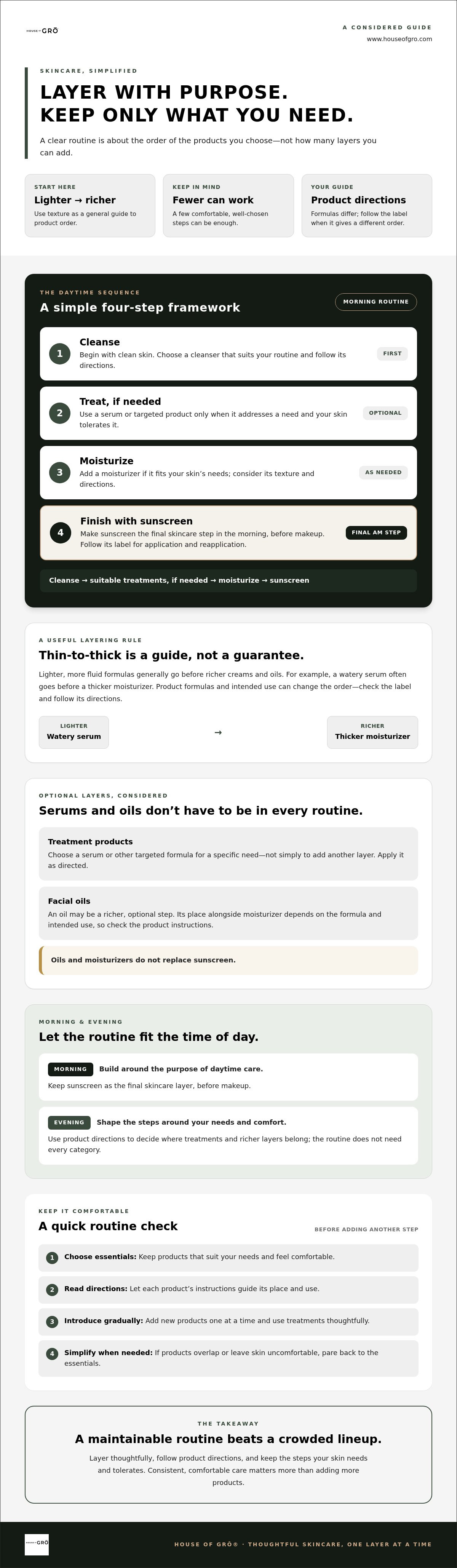
A clear sequence can make your routine easier to follow. Use this daytime order as a starting point, then adjust for product directions and what your skin tolerates. Not every step needs a separate product.
- 1. Cleanse. Begin with clean skin. Choose a cleanser that suits your routine and follow its directions.
- 2. Apply suitable treatment products. If a serum or other treatment addresses a specific need, apply it as directed. This step is optional. A product doesn’t belong in your routine simply because there’s room for another layer.
- 3. Moisturize. Use a moisturizer if it fits your skin’s needs. Its texture and directions can help you decide how it sits alongside other products.
- 4. Apply sunscreen. In the morning, sunscreen is generally the final skincare step before makeup. Follow the label for how much to apply and when to reapply.
In short: cleanse, apply suitable treatments if needed, moisturize, then finish your daytime routine with sunscreen. Harvard Health Publishing also outlines a simple skincare routine built around washing, moisturizing, and sun protection. Use the steps that make sense for you instead of adding products just to make your routine longer.
Where do serums, moisturizers, and facial oils go?
Texture offers an initial clue: lighter, more fluid products generally go before richer layers. A serum may come before a cream, while a facial oil may be used as a richer step. But the order of an oil and moisturizer can vary by formula and intended use. Check the product instructions rather than assuming every oil goes last. Neither a serum nor an oil is essential for every routine.
If you use an oil, treat it as an optional skincare layer, not as a substitute for sunscreen. For a considered approach to skincare, explore House of GRŌ®’s skincare offerings. Check each product’s current directions before deciding where it fits.
When should sunscreen go in a morning routine?
Apply sunscreen after your other skincare steps and before makeup. Keep it distinct from facial oils and moisturizers: those products don’t replace sun protection. Follow the sunscreen label for application amount and reapplication guidance, and leave it as the final skincare layer of your morning routine.
Morning vs. Evening Skincare: How the Layers Change
Your morning and evening routines can share a few essentials, but they serve different purposes. Morning care often centers on preparing skin and applying sun protection. Evening care begins with removing the day’s products and buildup, then leaves room for suitable products you use overnight. The right sequence depends on your skin’s needs, your tolerance, and each product’s directions.
| Step | Morning role | Evening role |
|---|---|---|
| First step | Cleanse, or choose another appropriate start for your skin. | Cleanse to remove the day’s products and buildup. |
| Treatment products | Optional. Use only products that suit your needs and follow their directions. | Optional leave-on products, chosen and applied according to their instructions. |
| Moisturizer | Use if it fits your routine and your skin’s needs. | Use if it fits your routine and your skin’s needs. |
| Sunscreen | Finish your skincare routine with sunscreen. | Not typically part of an evening routine. |
How to build a simple morning skincare routine
Start with cleansing if it feels appropriate for your skin. Next, apply any optional treatment products, paying attention to texture and label directions. Add moisturizer if it belongs in your routine, then finish with sunscreen before makeup. The basic sequence is simple: prepare, choose only the layers you need, and protect your skin during the day.
Keep the routine comfortable instead of trying to include every product category. For more inspiration for a morning ritual, explore our related guide to radiant skin. A clear sequence makes how to properly layer skincare easier to put into practice, but product directions should guide the details.
How to build an evening routine without over-layering
In the evening, begin by cleansing to remove the day’s products and buildup. Then apply only the leave-on products that suit your needs and that your skin tolerates. Follow each label for placement and use. Don’t assume a product belongs at night just because it’s a serum or oil. A moisturizer can follow if it’s part of your routine.
Think of evening care as a chance to reset, not a reason to add extra steps. Our related article on a restorative night skincare regimen offers another perspective on building a calmer nighttime routine. Whether it’s morning or evening, let your skin’s response and product directions shape the layers.
How to Layer Actives and Oils Without Making Your Routine Complicated
Products designed to target specific concerns can make a routine feel more personal, but they call for care. Before combining treatments, check each product’s directions and consider its ingredients, concentration, and your skin’s tolerance. A sequence that works for someone else may not suit you.
Keep changes easy to track. Introduce one new product at a time, follow its label, and pay attention to how your skin responds before adding another. If you change several steps at once, it can be harder to tell which product may be causing discomfort. For additional guidance, see our guide to skincare for sensitive skin.
How to add exfoliants or retinoids to a routine
Follow the specific product label and begin cautiously. There’s no single schedule that suits every skin type or formula. Some combinations, such as retinoids and exfoliating acids in the same session, may be more irritating for some people. Don’t assume that two active products are suitable to use together. Check their directions or ask a qualified professional about ingredient concerns.
If irritation persists, stop experimenting with combinations and consult a dermatologist or another qualified healthcare professional. They can offer advice based on your skin and the products you’re using. A careful pace is more useful than adding several treatments at once.
How to decide whether a facial oil belongs in your routine
A facial oil is optional, not a required step. Consider whether it suits your routine and how it feels on your skin. Its place alongside moisturizer depends on the specific formulas, so follow both products’ instructions rather than relying on texture alone. If you’re trying an oil for the first time, introduce it on its own and observe your skin’s response.
House of GRŌ’s AT DAWN Rejuvenating Daytime Oil is one optional oil in the brand’s offerings. Check its current label for directions before deciding whether or where it fits into your routine. To explore the brand’s skincare offerings, visit House of GRŌ. The guiding principle behind how to properly layer skincare is simple: choose intentionally, make one change at a time, and let your skin’s comfort guide your routine.
Create a Skincare Layering Routine You Can Maintain
A routine should fit into your day and feel comfortable on your skin. A long product lineup isn’t automatically more thoughtful. Consistent, tolerable steps are easier to follow and help you notice how your skin responds. Use this checklist to shape a routine around your actual needs.
A quick checklist for choosing what to layer
- Identify your goal. Start with a concern or routine need you genuinely want to address. Avoid adding products without a clear purpose.
- Choose the essentials. Keep basic care steps distinct from optional treatments and oils. You may not need every category.
- Check directions. Read each product’s instructions before deciding where it belongs or whether it suits your routine.
- Introduce changes gradually. Add one new product at a time, then give yourself a chance to observe how your skin responds.
This approach makes how to properly layer skincare less about collecting steps and more about making deliberate choices. If your routine feels confusing, return to the essentials and set aside products that don’t serve a clear purpose.
How to make a new routine feel like a self-care ritual
Keep the rhythm simple. Set products in the order you use them, follow their directions, and take a quiet moment rather than switching formulas whenever a new trend appears. A repeatable routine can feel grounding. It also makes changes easier to track because you’re not adjusting several steps at once.
Optional products can have a place when they suit your needs. AT DAWN Rejuvenating Daytime Oil and AFTER DARK Restorative Night Serum are examples from House of GRŌ®’s offerings, but neither needs to be a required layer. Check each product’s current directions before deciding whether or how it fits your routine.
House of GRŌ® describes its approach as botanical-led and microbiome-friendly. Let that perspective encourage intentional choices, not extra layers your skin doesn’t need. A balanced routine is personal. Start with what feels manageable, and let comfort guide your next step.
Discover House of GRŌ® and explore its skincare offerings as you shape a routine that feels simple, considered, and your own.
Make Your Routine a Practice You Can Keep
The clearest answer to how to properly layer skincare is to follow a considered order, respect product directions, and choose only the steps that suit your skin. Keep your morning routine grounded in sunscreen. In the evening, cleanse and use only leave-on products your skin tolerates. Introduce changes gradually so your routine stays easy to understand and maintain.
Thoughtful skincare doesn’t need to feel like a checklist of endless layers. It can be a quiet daily ritual shaped by your needs and comfort. House of GRŌ® is a family-owned brand founded by siblings Irina Gottesman and Sam Kandhorov. The brand describes its approach as botanical-led and microbiome-friendly, and identifies wild-harvested Chaga from Northern Maine as a key antioxidant ingredient.
Explore House of GRŌ® and its skincare offerings as you shape a routine that feels right for you, one considered step at a time.
Frequently Asked Questions
What order should I apply skincare products in?
A typical routine moves from cleansing to optional treatments, moisturizer, and, in the morning, sunscreen. Lighter, more fluid products often go before richer formulas, but product directions take priority over a general texture rule. You don’t need every step. To decide how to properly layer skincare, choose products for your needs, check their labels, and leave out steps that don’t suit your skin or routine.
Does serum go before or after moisturizer?
Serum generally goes before moisturizer because it often has a lighter texture. However, formulas and directions differ, so check the product label before settling on an order. A serum is optional, not a requirement for a complete routine. If you’re using several treatments, introduce them gradually rather than adding them all at once. That makes it easier to notice how your skin responds.
Can I apply facial oil before moisturizer?
Sometimes, but the best order depends on the oil and moisturizer formulas and their directions. Texture can offer a starting clue: lighter products commonly come before richer ones. Still, don’t rely on texture alone if the label gives a different order. Facial oil is optional, and it doesn’t replace moisturizer or daytime sunscreen. If it’s new to your routine, introduce it on its own and observe your skin’s response.
Should sunscreen be the last step in my morning skincare routine?
Yes. Apply sunscreen as the final skincare step before makeup. Use the amount and reapplication instructions on its label, since directions can differ between products. Keep sunscreen separate from facial oils: an oil isn’t a substitute for sun protection. If you apply other skincare beforehand, follow those products’ directions too, and let each layer settle comfortably before moving on.
How long should I wait between skincare layers?
Let each layer settle before applying the next. A wait of about 60 seconds between most products is a useful starting point. Some active products, such as retinol, may call for a longer interval, so follow the label rather than applying a fixed wait time to every formula. If products tend to pill, try giving layers more time to dry and applying a lighter amount.
Can I use retinol and exfoliating acids in the same routine?
It’s generally not recommended to layer retinoids with exfoliating acids such as AHAs or BHAs in the same session, because the combination may increase the risk of irritation. Product strengths and individual tolerance vary, so follow label directions and don’t assume a combination is suitable for you. If you’re unsure how to use these ingredients, or irritation persists, ask a dermatologist or other qualified professional for personalized guidance.
What should I do if my skincare products pill?
If products form small balls on your skin, pause and simplify your routine. Try using less product, applying layers gently, and allowing more time for each one to settle before adding the next. Review the labels to make sure you’re following the recommended amount and order. If pilling continues, remove one optional layer at a time to see whether the routine feels smoother without it.