


What if the very rituals meant to polish your skin are actually dismantling its sanctuary? You feel the uncomfortable tightness after a simple cleanse. The persistent redness. The lingering heat. It's a quiet distress. Identifying the signs of a damaged skin barrier is the first step toward reclaiming your balance. Often, the confusion over which active ingredient caused the disruption leads to more layers. More noise. More irritation. Your skin isn't failing; it's communicating a need for intentional stillness.
You deserve a return to equilibrium. Learn to interpret the subtle signals of barrier disruption and move beyond the cycle of reactive care. This guide reveals the intentional rituals needed to restore your skin's natural resilience. We explore a simplified, effective healing path that prioritizes biological harmony over artificial layers. Prepare to transition from immediate relief to long-term barrier strength. Quality over quantity. Substance over flashiness. It's time to heal.
Key Takeaways
- View your skin barrier as a biological sanctuary. Its integrity is the foundation of a healthy, radiant complexion.
- Recognize the subtle signs of a damaged skin barrier, such as persistent tightness after cleansing or an unnatural, plastic-like shine on dry skin.
- Simplify your daily practice. Strip back harsh actives and surfactants to allow your skin’s natural microbiome to recover.
- Embrace adaptogenic restoration. Use wild-harvested Chaga mushrooms to provide deep antioxidant support and neutralize environmental stressors.
- Integrate intentional rituals with AT DAWN Rejuvenating Daytime Oil and AFTER DARK Restorative Night Serum to strengthen and support your barrier.
Understanding Your Skin Barrier as a Biological Sanctuary
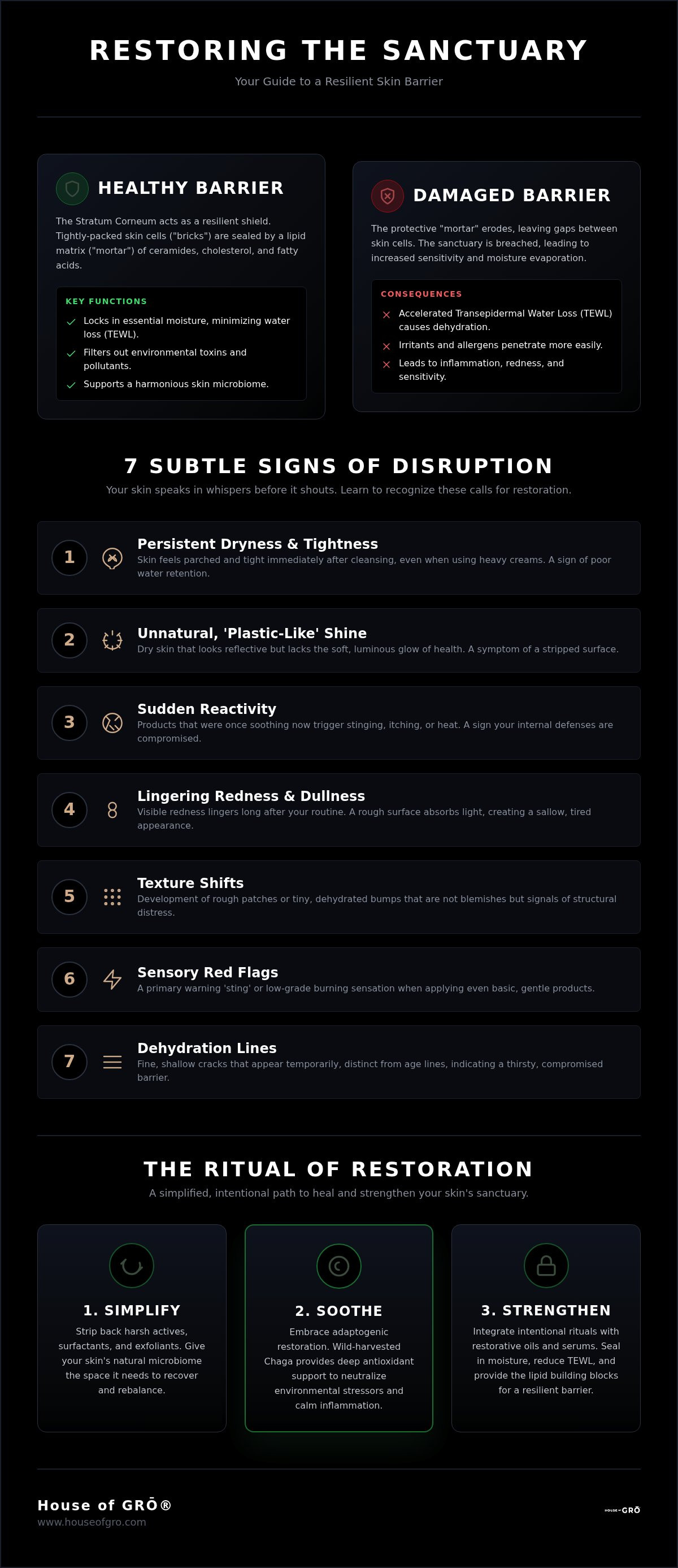
Your skin is a living border. It's a sanctuary. The Stratum Corneum serves as your primary protector. It's the outermost layer of the epidermis. Think of it as a resilient shield. It keeps essential moisture locked within while filtering out environmental toxins. This barrier is the silent intersection where your internal biology meets the external environment.
A healthy barrier isn't just a physical wall. It's a precise, multi-dimensional balance. It requires a specific blend of ceramides, cholesterol, and fatty acids. These lipids act as the mortar between your skin cell "bricks." When this balance shifts, the sanctuary is compromised. You begin to notice the early signs of a damaged skin barrier. These signals are your skin’s way of requesting a return to simplicity. It's an invitation to pause.
The Role of the Skin Microbiome
Your skin is home to a vast, invisible ecosystem. This community of beneficial bacteria works in tandem with your physical cells. Microbiome harmony is essential for a resilient physical barrier. It's the living layer of defense. Many traditional routines ignore this biological partnership. They focus on stripping rather than supporting. True health requires a shift toward microbiome skincare. This approach treats your skin as a garden to be nurtured, not a surface to be scrubbed. When the microbiome flourishes, the barrier strengthens. It becomes a proactive shield rather than a reactive one.
Transepidermal Water Loss (TEWL) Explained
Water is the essence of your skin's resilience. Transepidermal Water Loss, or TEWL, is the process where moisture evaporates through the skin's surface. In a healthy state, this loss is minimal. However, when the barrier is disrupted, the seal breaks. High levels of TEWL lead to that hallmark feeling of tightness. It's one of the most common signs of a damaged skin barrier. Your skin feels parched even after applying heavy creams. This happens because the protective gate is ajar. Environmental factors like dry air or harsh wind accelerate this evaporation. Restoring the barrier means sealing this moisture back into the sanctuary. It requires intentional ingredients that mimic the skin's natural lipids. By reducing TEWL, you allow the skin to focus on deep, internal restoration rather than constant defense.
7 Subtle Signs of a Damaged Skin Barrier
Your skin speaks in whispers before it shouts. Recognizing the signs of a damaged skin barrier is an act of mindfulness. It requires looking beyond the surface. It demands a quiet assessment of how your skin responds to the world. When the sanctuary is breached, the signals are unmistakable. They are calls for restoration.
Persistent dryness is a hallmark. You apply heavy creams. You layer oils. Yet, the parched feeling returns within minutes. This isn't a lack of product. It's a lack of retention. Another subtle indicator is an unnatural, 'plastic-like' shine. Your skin may look tight and reflective, but it lacks the soft glow of health. This shine is a symptom of a stripped surface. Sudden reactivity often follows. Ingredients that once felt soothing now trigger heat. This heightened sensitivity means your internal defenses are down. Visible redness lingers long after your morning ritual. Texture shifts, too. You might notice rough patches or tiny, dehydrated bumps that disrupt the smooth landscape of your face. These are not always blemishes. Often, they are the skin's way of signaling structural distress.
Sensory Red Flags: Stinging and Tightness
The 'sting' is your primary warning. It often occurs when applying even the most basic moisturizers. This sharp sensation confirms that the stratum corneum is no longer intact. Tightness follows. It's a feeling of physical contraction immediately after contact with water. Your skin feels too small for your face. Itching or a low-grade burning sensation during your daily routine suggests deeper inflammation. Understanding how to repair your skin barrier involves acknowledging these sensory red flags as valid data points. They are evidence that your biological shield is compromised.
Visual Cues: Dullness and Fine Lines
Dullness is a common consequence of barrier disruption. When the skin's surface is rough, light is absorbed rather than reflected. The result is a sallow, tired appearance. Dehydration lines also emerge. These are fine, shallow cracks that appear when the skin is pulled tight. They are temporary signals of a thirsty barrier, distinct from permanent age lines. Reclaiming your glow requires a return to biological harmony. Discover the path to how to get radiant skin and restore your natural luminosity. For those seeking a return to equilibrium, the restorative essentials from House of GRŌ® offer a path to intentional healing.
The Modern Disruptors: Why Your Barrier Breaks
Modern living is often at odds with biological harmony. We push for immediate results. We sacrifice stillness for speed. The result is a compromised sanctuary. Understanding why these disruptions occur is as vital as recognizing the signs of a damaged skin barrier. When you identify the source of the friction, you can begin the journey back to balance.
Many daily routines are unintentionally aggressive. Over-exfoliation is a primary culprit. The excessive use of AHAs, BHAs, and physical scrubs creates microscopic tears in the stratum corneum. This removes more than just dead cells; it removes your protection. Harsh surfactants in cleansers further the damage. These foaming agents act like industrial degreasers. They strip the natural lipids that act as the mortar between your skin cells. Without these essential fats, the barrier cannot hold moisture or keep out irritants.
Mechanical friction from daily grooming is another often-overlooked disruptor of the skin's sanctuary. For those seeking to refine their practice with more sustainable and gentle tools, you can discover Reset Razor and their commitment to eco-friendly care.
Environmental stressors also play a significant role. Your skin is in a constant dialogue with its surroundings. Pollution particles are small enough to penetrate the surface, causing oxidative stress. UV rays degrade structural proteins. Extreme weather, from biting winter winds to intense summer heat, forces the skin into a state of constant defense. This exhaustion eventually leads to a breach in the sanctuary.
The Danger of 'Actives' Overload
When environmental factors lead to more acute damage, such as a painful sunburn or heat-induced irritation, Burn-Fix provides the immediate cooling and hydrogel protection needed to soothe the area and support the skin's recovery.
In the pursuit of perfection, more is often less. Using multiple high-strength serums simultaneously creates a chemical storm on the skin's surface. Retinoids are particularly demanding. While they support cell turnover, they can cause significant barrier thinning if not balanced with deep, intentional nourishment. A luxury skincare ritual should feel like a breath of air, not a battle. When you overload the skin with concentrated actives, you force it to prioritize survival over radiance. This shift is a common path toward a compromised state.
Environmental and Lifestyle Stressors
The Ritual of Restoration: How to Heal Your Barrier
Restoration is an intentional practice. It's a shift from aggression to nurture. If you recognize the signs of a damaged skin barrier, your first act should be stillness. Healing is not about adding more layers. It's about choosing the right ones. This is a return to biological sanctuary. It's a process of subtraction and support.
The path to recovery follows a disciplined sequence. First, strip back your routine. Healing requires a temporary pause. Remove all synthetic interventions. This allows your skin's microbiome to recalibrate without interference. Second, focus on hydration and lipid replenishment. You must seal the breach. This means providing the skin with the exact building blocks it's losing. Third, introduce adaptogenic support. Wild-harvested Chaga mushrooms are powerful allies. They offer deep antioxidant protection to calm inflammation. Finally, protect and repair. Use a shield during the day. Focus on deep renewal at night.
The Importance of Intentional Stillness
Give your skin a break from the complexity of modern skincare. Transition to a minimalist approach. Use a gentle, pH-balanced cleanser once a day. This reduces friction and preserves the few remaining natural lipids. Reframing your evening practice as a night skin care regimen is essential. It's during these quiet hours that the most significant repair happens. Stillness is not passive; it's the foundation of resilience.
Rebuilding with Lipids and Antioxidants
Seek out fatty acids and ceramides. These are the mortar of your skin's sanctuary. Natural oils are often more effective than water-based creams for barrier repair. They mimic the skin's sebum more closely. This allows for deeper penetration and a more durable occlusive seal. Antioxidants play a critical role in preventing further degradation. They neutralize the environmental stressors that cause ongoing irritation. By using high-performance botanicals, you provide the skin with the tools it needs to rebuild its own strength.
Support your skin’s natural healing process with a dedicated ritual. Protect your barrier during the day with AT DAWN Rejuvenating Daytime Oil. It acts as a biological shield against the world. At night, prioritize repair with AFTER DARK Restorative Night Serum. This ensures your nocturnal renewal cycle is supported by potent, all-natural ingredients. Explore the House of GRŌ® restoration collection to begin your journey back to balance.
Adaptogenic Care: The House of GRŌ® Approach to Resilience
Identifying the signs of a damaged skin barrier is only the beginning of your journey. The solution lies in biological harmony, not chemical complexity. We believe in the power of nature to restore what modern stress has dismantled. Our approach is rooted in adaptogenic science. It’s a commitment to all-natural, microbiome-friendly formulas. We avoid synthetic interventions. Instead, we harness the intelligence of the forest to rebuild your sanctuary from within. This is where nature meets sophisticated science.
Chaga: The King of Medicinal Mushrooms
At the heart of our restorative ritual is wild-harvested Chaga. Sourced from the pristine forests of Northern Maine, this medicinal mushroom provides unmatched skin-soothing properties. It is a biological powerhouse. Chaga works to neutralize the free radicals that lead to barrier breakdown. It offers a deep level of antioxidant protection that synthetic alternatives struggle to match. By supporting the skin's natural defenses, it helps calm the inflammation associated with a compromised sanctuary. This is high-performance wellness in its purest form. Explore the full spectrum of chaga benefits to understand its role in skin longevity.
The Synergy of AT DAWN and AFTER DARK
True resilience comes from a consistent, rhythmic practice. AT DAWN Rejuvenating Daytime Oil acts as your daily shield. It protects against the environmental stressors we've identified in previous sections. It seals in moisture while neutralizing urban pollution and UV-induced stress. As the sun sets, the ritual shifts to deep nocturnal renewal. Using a restorative night serum is vital for maintaining barrier integrity. AFTER DARK Restorative Night Serum supports the skin's natural repair cycle during sleep. It provides intensive care when your skin is most receptive to healing and lipid replenishment. It's an essential step for nocturnal restoration.
These two formulas work in perfect harmony. They represent a minimalist approach to high-performance, luxury skincare. You don't need a complex shelf of synthetic actives. You need intentional, effective ingredients that respect your skin's living microbiome. When you address the signs of a damaged skin barrier with adaptogenic care, you aren't just fixing a temporary problem. You are building a foundation of long-term resilience. You are reclaiming your biological sanctuary. Quality over quantity. Substance over flashiness. This is the House of GRŌ® promise.
Reclaiming Your Biological Balance
Your skin is a sanctuary. Protecting its integrity is a lifelong practice of mindfulness. When you recognize the signs of a damaged skin barrier, you're acknowledging a call for intentional stillness. Healing requires a departure from aggressive interventions. It demands a return to purity. Focus on the essentials. Prioritize deep hydration and lipid replenishment. Let your microbiome thrive in its natural state. It's about substance over flashiness.
At House of GRŌ®, we bridge the gap between nature and sophisticated science. Our New York-based, family-owned brand is dedicated to high-performance, all-natural restoration. We use wild-harvested Chaga mushrooms for deep antioxidant support. Our formulas are intentionally microbiome-friendly. They don't just mask damage; they support your skin's inherent resilience. This is luxury wellness with a conscience. It's a refined, better-balanced lifestyle.
It's time to simplify your routine. It's time to heal. Discover the Ritual of Restoration at House of GRŌ® and reclaim your radiance. Your skin's equilibrium is within reach. Embrace the quiet confidence of a restored and resilient sanctuary.
Frequently Asked Questions
How do I know if my skin barrier is damaged or just dry?
Dry skin simply lacks oil. A damaged barrier lacks the structural integrity to hold water. If your skin feels tight and stings when you apply simple products, those are clear signs of a damaged skin barrier. Dry skin is usually relieved by a rich cream. Damaged skin remains reactive and red even after moisturizing. It's the difference between needing a drink and having a leaky container.
Can I use vitamin C with a damaged skin barrier?
You should pause high-concentration vitamin C until your barrier is restored. Most vitamin C serums use L-ascorbic acid at a low pH. This acidity can further irritate a compromised sanctuary. Focus on calming botanicals instead. Once the stinging subsides and redness fades, you can slowly reintroduce antioxidants through gentle, all-natural formulas like AT DAWN Rejuvenating Daytime Oil. This provides protection without the risk of further disruption.
How long does it take to repair a damaged skin barrier in 2026?
Initial relief often occurs within 72 hours of simplifying your routine. Full structural restoration typically takes 28 to 45 days. This timeline aligns with your skin's natural cell turnover cycle. Consistency is the key to success. Using a dedicated ritual like AFTER DARK Restorative Night Serum ensures your skin has the lipid support it needs during its most active repair phase. Patience is an essential part of the healing process.
Is it okay to exfoliate while repairing my skin barrier?
No. You must stop all forms of exfoliation immediately. Both physical scrubs and chemical acids remove the very cells your body is trying to protect. Exfoliating during this time is like sanding a wound. It prevents the stratum corneum from rebuilding its natural shield. Wait until all signs of a damaged skin barrier have disappeared before considering a very gentle, infrequent return to any exfoliating practice.
Why does my face feel hot and red after washing?
This heat is a sign of inflammation and a broken seal. When the barrier is compromised, water and surfactants penetrate too deeply. This triggers a localized immune response. Your skin is essentially overreacting to the cleansing process. To find balance, switch to a pH-balanced, non-foaming cleanser. Follow immediately with a lipid-rich oil to trap moisture and soothe the underlying heat. Avoid hot water, as it further strips essential lipids.
What are the best ingredients for barrier repair?
Look for ingredients that mimic your skin's natural composition. Focus on these essentials:
- Fatty acids found in organic botanical oils.
- Adaptogenic Chaga mushrooms for deep antioxidant support.
- Squalane or jojoba to replicate natural sebum.
- Ceramides to act as the mortar between skin cells.
Our AFTER DARK Restorative Night Serum utilizes these elements to provide high-performance, all-natural restoration without synthetic interventions. It's about feeding the skin what it already knows.
Can stress actually cause my skin barrier to break down?
Yes. Chronic stress raises cortisol levels. This hormone slows down the production of natural lipids like ceramides and hyaluronic acid. It also disrupts the nocturnal repair cycle. When your internal wellness is out of balance, your skin loses its ability to maintain its biological sanctuary. Managing stress is a vital part of a holistic skincare ritual. True resilience requires both topical support and internal stillness to flourish.
Should I stop using retinol if my barrier is damaged?
Yes. Retinol should be paused immediately. It speeds up cell turnover. While beneficial for healthy skin, this process is too taxing for a compromised barrier. It can lead to further thinning and increased sensitivity. Allow your skin to return to a state of equilibrium first. Once your barrier is strong, you can reintroduce retinol slowly. Always buffer it with a nourishing layer of AT DAWN Rejuvenating Daytime Oil to maintain balance.