


What if your heavy creams are actually working against you? A 2023 study in the Journal of Cosmetic Dermatology found that nearly 50% of adults now report sensitive skin. Most find their complexion remains red and tight despite a shelf full of products. It's a frustrating cycle. You apply more, yet feel less hydrated. Your skin isn't failing; its barrier moisture is simply overwhelmed. We believe in a more intentional approach. A quiet confidence in your routine.
You deserve to understand the "why" behind your skin's health. It's time to move past the confusion of complex ingredient lists. We promise to help you cultivate a resilient, hydrated microbiome through simple, botanical rituals. This guide explores the essential science of your skin's defense system and offers a refined path to a calm, glowing complexion. Let's return to the essentials. Your skin knows the way.
Key Takeaways
- Master the "bricks and mortar" of your skin. Protect your living second skin for a resilient, lasting glow.
- Identify the hidden causes of water loss. Preserve your barrier moisture through intentional, protective care.
- Move beyond the "squeaky clean" myth. Shield your skin from the quiet damage of urban pollution and seasonal shifts.
- Shift your mindset from fixing to nourishing. Embrace a "less is more" ritual for restored balance and calm.
- Harness the power of botanical adaptogens. Discover why your most essential skin repair happens while you sleep.
Understanding Barrier Moisture: The Invisible Shield Your Skin Depends On
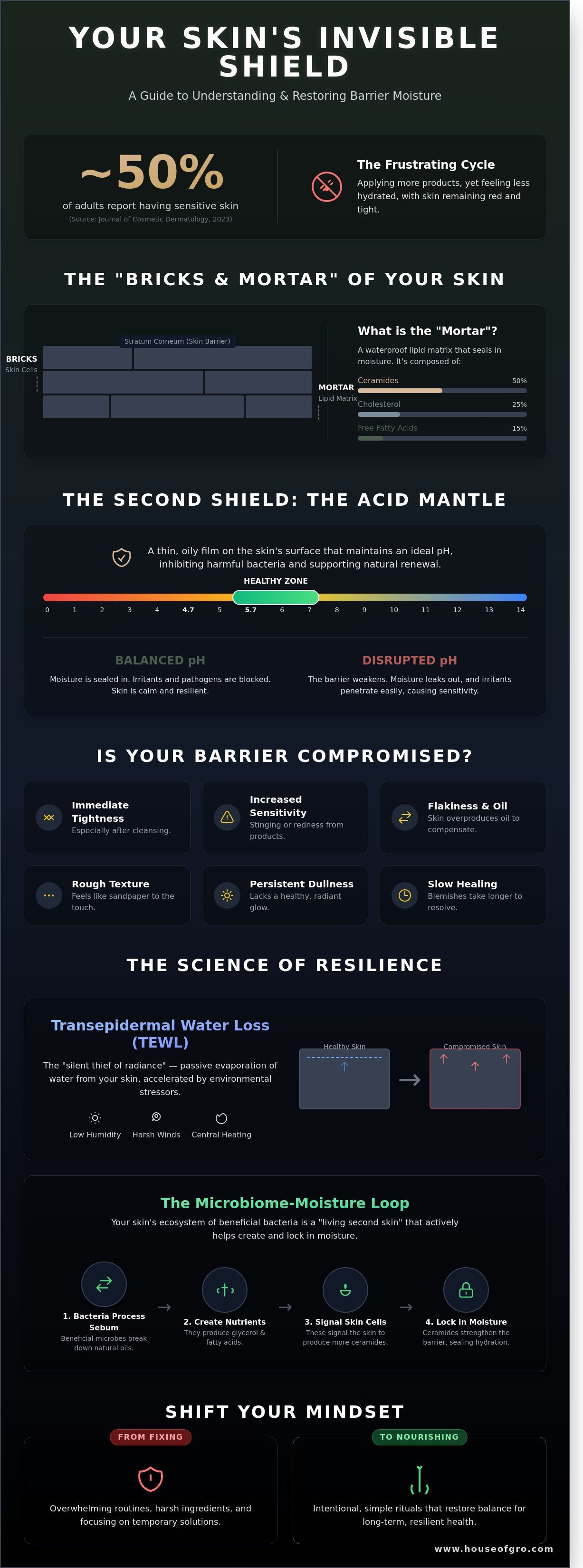
True radiance begins beneath the surface. It starts with barrier moisture. This is the essential hydration trapped within your skin's outermost layer. Scientists call this layer the stratum corneum. It consists of 15 to 20 layers of flattened, dead skin cells. These cells act as bricks. Lipids act as the mortar. This lipid matrix consists of 50% ceramides, 25% cholesterol, and 15% free fatty acids. Together, they create a waterproof seal. This seal prevents transepidermal water loss. It keeps your internal environment stable. A healthy barrier is not just about aesthetics. It's a biological necessity.
The acid mantle provides an extra layer of security. It's a thin, oily film with a pH between 4.7 and 5.7. This acidity is intentional. It inhibits the growth of harmful bacteria. It supports the skin's natural renewal process. When this pH is disrupted, the barrier weakens. Moisture leaks out. Irritants move in. You aren't just dealing with dry skin; you're facing a structural failure. Restoration requires a holistic approach to nourishment and protection.
The Vital Role of the Skin Barrier
Your skin is the primary interface between your body and the world. It filters out up to 90% of environmental pollutants. It manages internal temperature. It regulates hydration levels with surgical precision. This barrier protects delicate internal organs from pathogens and allergens. It's a living shield. It responds to every change in your environment. A resilient barrier means a resilient you. It's the foundation of a healthy ritual.
Signs Your Barrier Moisture Is Compromised
Recognition is the first step toward restoration. Notice how your skin feels after cleansing. Immediate tightness is a primary red flag. It suggests your cleanser stripped away essential lipids. You might notice increased sensitivity. Products that felt soothing six months ago now cause stinging or redness. This happens because the barrier no longer blocks irritants effectively. Tiny cracks allow chemicals to reach deeper, sensitive layers.
You may see both flakiness and excess oil simultaneously. This is a common paradox. Your skin overproduces sebum to compensate for the lost barrier moisture. It's a desperate attempt to seal the surface. Other signs include:
- Rough, sandpaper-like texture.
- Persistent dullness that doesn't respond to exfoliation.
- Slow healing times for small blemishes.
- Itching or burning during your daily routine.
When these symptoms appear, it's time to simplify. Your skin doesn't need more active ingredients. It needs rest. It needs essential lipids to rebuild its foundation. Think of it as a period of quiet recovery for your complexion. Focus on purity. Focus on efficacy. By respecting the skin's natural architecture, you allow it to return to a state of calm, balanced health.
The Science of Resilience: Microbiome, Lipids, and TEWL
Resilience begins at the microscopic level. It's a delicate dance of biology. Your skin is more than a surface; it's a living, breathing ecosystem. To understand how to preserve barrier moisture, one must look closer at the invisible forces at play. It's a balance of hydration, fats, and life.
What Is Transepidermal Water Loss (TEWL)?
TEWL is the passive evaporation of water through the skin. It's a silent thief of radiance. When environmental humidity drops below 30 percent, the air pulls hydration directly from your cells. This process accelerates in harsh winds or forced central heating. It's vital to distinguish between skin types. Dry skin lacks lipids or natural oils. Dehydrated skin lacks water. One is a genetic state; the other is a condition often caused by external stressors.
The Microbiome-Barrier Connection
Your skin hosts a diverse community of over 1,000 species of bacteria. This microbiome acts as a living second skin. It's an invisible shield. When this ecosystem is diverse, the barrier is resilient. Modern skincare often focuses on "sanitizing" the face. Harsh surfactants and foaming cleansers destroy the very microbes that protect us. Maintaining an acidic environment, ideally around pH 5.5, ensures these beneficial organisms flourish. A compromised skin barrier function leads to chronic inflammation and heightened sensitivity.
Moisture isn't just about what you apply. It's about what your skin produces. This is the Microbiome-Moisture Loop. Beneficial bacteria, such as Staphylococcus epidermidis, break down sebum into glycerol and fatty acids. These substances nourish the skin and maintain its acidic mantle. They also signal the skin to produce ceramides. These are the essential lipids that act as the mortar between your skin cells. Without this bacterial activity, the skin cannot seal in hydration. True barrier moisture relies on this biological partnership.
A healthy microbiome is a prerequisite for glow. When bacteria are balanced, lipids are abundant. When lipids are abundant, water stays locked within the dermis. It's a cycle of health. This synergy creates a plump, reflective surface that resists environmental aging. It's about working with nature, not against it. Elevating your daily botanical ritual ensures this loop remains unbroken.
- Lipids: The fats that prevent water from escaping.
- Microbes: The workers that produce and protect those fats.
- Hydration: The result of a perfectly functioning system.
The enemy of glow is depletion. We see it in the dullness of over-exfoliated skin. We feel it in the tightness of a winter morning. By focusing on the microbiome, we move beyond surface-level fixes. We embrace a holistic approach to skin health. It's a shift from correction to nourishment. This is the foundation of a refined, better-balanced lifestyle. Quiet confidence starts with a resilient shield.
Why Your Barrier Is Struggling: The Hidden Culprits of Moisture Loss
The ritual of cleansing should be a gentle embrace. Too often, it is an assault. Many believe that a tight, "squeaky clean" sensation signifies purity. It actually signals a depletion of essential lipids. According to a 2023 report by the Skin Health Alliance, over 50% of consumers use cleansers that are too aggressive for their specific skin type. This routine strips the very oils that keep you protected. You are left exposed. Your skin becomes a sieve. Moisture escapes. Irritants enter. This chronic stripping is the primary reason for a loss of barrier moisture.
City life takes a physical toll. In New York, PM2.5 levels often exceed World Health Organization guidelines by 15% or more. These tiny particles are 20 times smaller than human pores. They lodge deep. They trigger a cascade of oxidative stress. This breaks down the proteins holding your cells together. Hard water is another invisible culprit. It contains high levels of calcium and magnesium. These minerals bind to soaps to form a residue. This film clogs pores and disrupts your natural pH balance. It makes hydration nearly impossible.
Stress is a silent thief of skin health. High cortisol levels slow down the body's natural repair mechanisms. Research from 2022 indicates that psychological stress can delay skin barrier recovery by up to 48 hours. Your skin reflects your internal state. When you are overwhelmed, your skin lacks the resources to heal itself.
- Surfactant damage: Harsh sulfates dissolve the "glue" between skin cells.
- Seasonal shifts: Rapid humidity drops in autumn can shock the epidermis.
- Hard water minerals: Calcium deposits create a drying barrier on the surface.
- Oxidative stress: Urban pollution degrades the skin’s natural antioxidants.
The Over-Exfoliation Trap
The desire for instant results often leads to active ingredient fatigue. We layer acids. We apply high-strength retinol. We use physical scrubs. This creates a state of chronic inflammation. A 2022 clinical study showed that excessive use of AHAs can increase sun sensitivity by 18%. Signs of a "burned out" barrier include a persistent pink hue and a texture that feels thin or plastic-like. If your usual moisturizer stings, your barrier is broken. Embrace the ritual of rest. Use "skincycling" to give your skin 48 hours of pure recovery between active treatments. Nourish. Do not punish.
Environmental and Lifestyle Stressors
The modern world is demanding. Blue light from screens generates free radicals that penetrate deeper than UV rays. Indoor heating in winter is equally harsh. It can drop relative humidity to 15% in a matter of hours. This dry air aggressively pulls barrier moisture from your cells. Your gut health is also vital. A 2023 review in the Journal of Clinical Medicine highlighted how gut dysbiosis correlates with skin sensitivity. Sleep is the ultimate holistic botanical. During the hours of 11 PM and 4 AM, cell mitosis peaks. This is when your protection is rebuilt. Prioritize the ritual of rest for a resilient glow.
Restoring the Balance: A Ritual for Lasting Barrier Moisture
Skin isn't a project to be finished. It's a living, breathing landscape that requires consistent nourishment. We often approach skincare with a mindset of correction. We try to fix, scrub, or peel away perceived flaws. This aggressive stance often backfires. The stratum corneum, the outermost layer of your skin, is only 0.02 millimeters thick. It's delicate. It's vital. Shifting your perspective from a clinical task to a daily ritual changes everything. A ritual is intentional. It's a moment of quiet luxury that respects your biology. This approach focuses on sustaining barrier moisture through patience and high-quality botanical ingredients.
The modern world is demanding. Pollution, blue light, and harsh weather constantly challenge our equilibrium. A 2023 dermatological survey revealed that 62% of adults now identify as having sensitive skin. Much of this sensitivity stems from over-processing. We use too many actives. We cleanse too deeply. By embracing a minimalist philosophy, we allow the skin to regain its natural strength. We choose formulas that work with the microbiome rather than against it. This isn't just about beauty. It's about holistic health and the quiet confidence that comes from a balanced complexion.
Step 1: Gentle, Purposeful Cleansing
Cleansing shouldn't feel like stripping. If your skin feels tight after washing, you've gone too far. Use oil-based balms or non-foaming milks. These formulas respect the acid mantle. A 2022 study found that 75% of people use water that is too hot during their routine. High temperatures melt the essential lipids that hold your skin cells together. Keep your water at 37 degrees Celsius. This matches your body's natural temperature. When you finish, pat your face dry with a soft cloth. Never rub. Treat your skin with the reverence it deserves.
Step 2: Hydration Layering (The Humectant Phase)
Timing is everything. Apply your mists and serums while your skin is still damp. The International Journal of Cosmetic Science notes that skin is 10 times more permeable when hydrated. Botanical mists act as a vital bridge. They prep the surface for deeper absorption. Hyaluronic acid is a key ally here. It's a molecule that can hold 1,000 times its weight in water. By layering these humectants, you create a reservoir of barrier moisture. This prevents the "parched" feeling that leads to fine lines and irritation. It's about deep, meaningful saturation.
Step 3: Sealing with Nutrient-Dense Oils
Water evaporates if it isn't locked in. This loss is known as transepidermal water loss, or TEWL. Nutrient-dense oils provide the necessary seal. They mimic the skin's natural sebum to create a protective shield. Look for botanical blends rich in Omega-3 and Omega-6 fatty acids. A 2021 clinical trial demonstrated that specific botanical oil applications improved barrier function by 28% over 14 days. Use the press and glow technique. Warm three drops in your palms. Press them firmly into your cheeks, forehead, and neck. This method encourages circulation without tugging the tissue.
- Choose Purity: Prioritize cold-pressed oils to ensure phytonutrients remain intact.
- Microbiome Support: Look for fermented ingredients that feed beneficial skin bacteria.
- Consistency over Intensity: Daily gentle care beats weekly aggressive treatments every time.
- Sun Protection: Always finish your morning ritual with a mineral-based shield.
Ready to elevate your daily routine into a transformative experience? Discover how our botanical formulas support your skin’s natural rhythm and shop our ritual essentials today.
The House of GRŌ® Philosophy: Adaptogens for a Resilient Barrier
True resilience isn't found in a lab. It's found in the wild. At House of GRŌ®, we believe skin health is a reflection of internal harmony. Our philosophy centers on the Chaga mushroom, a botanical marvel often called the "King of Mushrooms." We treat skincare as a ritual rather than a chore. This is where modern science meets ancestral wisdom. We don't believe in aggressive treatments that strip the skin. Instead, we focus on nourishment. We prioritize the skin's natural ability to heal itself. By using adaptogens, we help the skin find its center. This approach ensures your barrier moisture remains intact despite the pressures of modern life. Purity. Efficacy. Ritual. These are our guiding lights.
The Power of Chaga for Barrier Defense
Chaga is the cornerstone of our barrier defense. It boasts an ORAC value that is roughly 50 times higher than blueberries. This mushroom contains a massive concentration of Superoxide Dismutase (SOD). This enzyme is vital. It neutralizes free radicals before they can degrade your skin's structural integrity. Adaptogens allow your skin to adapt to environmental shifts in real time. Our family has honored these traditions for generations, blending them with organic, wild-harvested purity.
Your Nightly Restoration Ritual
Repair is a quiet act. The AFTER DARK Restorative Night Serum aligns with your body's circadian rhythm. We suggest creating a digital sanctuary. Turn off screens 60 minutes before rest to lower cortisol levels. High cortisol can reduce barrier function by 15 percent. Using the serum nightly for 28 days aligns with the skin's natural renewal cycle. This consistency is the secret to lasting barrier moisture and refined texture.
The quality of an ingredient is determined by its origin. We choose wild-harvested, organic botanicals because they possess a higher nutrient density. Plants that grow in the wild must develop their own defense mechanisms to survive harsh conditions. When we apply these extracts to our skin, we're essentially borrowing that strength. For example, wild-harvested Chaga harvested from birch trees in cold climates contains higher levels of betulinic acid than lab-grown varieties. This compound is essential for supporting the lipid matrix of the skin. We don't use synthetic fillers or pesticides. These substances can cause micro-inflammation, which quietly erodes the skin barrier over time. By sticking to organic purity, we ensure every drop of our oil is active and beneficial.
We view our oils as the essential bookends of a healthy day. Think of them as a protective shield and a restorative blanket. The AT DAWN oil is formulated to guard against the oxidative stress of the morning. The AFTER DARK serum is formulated to mend the day's wear. Together, they create a comprehensive system for barrier health. This isn't just about looking better; it's about a lifestyle of intentionality. When you choose high-quality essentials, you declutter your routine and focus on what actually works. Our commitment to transparency means you know exactly what's touching your skin. We've seen how a dedicated ritual can transform not just the complexion, but the user's sense of well-being. It's a holistic cycle of care that starts and ends with the power of nature.
- Wild-Harvested Potency: Higher concentrations of active antioxidants compared to farm-grown alternatives.
- Circadian Alignment: Products designed to work with the body's natural 24-hour repair signals.
- Ancestral Wisdom: Formulas rooted in multi-generational wellness traditions.
- Clean Efficacy: Zero synthetic pesticides or disruptive chemicals.
Consistency is the final piece of the puzzle. The skin barrier doesn't recover overnight. It requires a steady supply of nutrients and a calm environment. By integrating these adaptogenic oils into your daily life, you provide the tools your skin needs to remain resilient. You aren't just applying a product; you're participating in a tradition of health. This is the House of GRŌ® way. It's a commitment to a better-balanced lifestyle, one ritual at a time.
Cultivate a Future of Radiant Resilience
Your skin's strength lies in its invisible defenses. A healthy microbiome and a robust lipid layer are the primary guardians against environmental stress. By addressing transepidermal water loss directly, you reclaim your natural glow. True skin health requires more than a quick fix; it demands a dedicated ritual. Sustainable barrier moisture is achieved through the synergy of botanical wisdom and clinical precision. Our formulations center on wild-harvested Chaga mushrooms gathered from the forests of Northern Maine. These adaptogens work to restore balance where it's needed most. Every product in our 2024 line is 100% dermatologist-tested and microbiome-friendly. We've eliminated the harsh synthetics found in traditional retail to offer a cruelty-free, all-natural luxury that aligns with your values. This is skincare for the modern minimalist. It's time to simplify your routine and focus on high-quality essentials that deliver results you can see. Trust in the science of nature. Embrace a lifestyle of quiet confidence and intentional beauty. Elevate your ritual with our microbiome-friendly collection.
Your journey toward a more balanced, nourished self starts today. Stay grounded in your care.
Frequently Asked Questions
How do I know if my skin barrier is damaged?
Your skin feels tight, sensitive, or looks visibly flushed. If products that usually feel soothing now cause a stinging sensation, your barrier is likely compromised. A 2022 study in the International Journal of Molecular Sciences identifies elevated Transepidermal Water Loss (TEWL) as a definitive sign of barrier disruption. Look for rough patches or persistent dryness. These are signals from your body. Listen to them. Return to a simple ritual.
Can I fix a broken skin barrier in 24 hours?
Complete barrier restoration cannot happen in 24 hours. While soothing balms provide immediate comfort, biological repair requires patience. Research from the Journal of Investigative Dermatology shows that the stratum corneum typically needs 14 to 28 days to fully renew its lipid structure. You might see reduced redness within 72 hours. Consistency is the foundation of this healing ritual. Focus on long-term health over instant fixes.
Is face oil better than moisturizer for barrier moisture?
Face oils and moisturizers work together to maintain barrier moisture rather than one replacing the other. Moisturizers contain humectants to draw water into the skin, while botanical oils act as occlusives to seal that hydration. A 2019 clinical review suggests that a ratio of 3:1:1 of ceramides, cholesterol, and fatty acids is optimal for repair. Apply your moisturizer first. Follow with a nourishing oil. This layering creates a protective seal.
What ingredients should I avoid if my barrier is compromised?
Avoid harsh surfactants like Sodium Lauryl Sulfate (SLS) and high-concentration exfoliating acids. These ingredients strip essential lipids and further weaken your defense. Clinical data indicates that glycolic acid at levels above 10% can be too aggressive for sensitized skin. Steer clear of synthetic fragrances and drying alcohols. These are unnecessary irritants. Choose purity. Focus on botanical extracts that calm and nourish.
Does drinking water help my skin barrier moisture?
Drinking water supports overall cellular health but does not directly restore barrier moisture on its own. A 2015 study published in Clinical, Cosmetic and Investigational Dermatology found that increasing water intake by 2 liters daily improved skin physiology, yet topical care remains essential. Internal hydration provides the foundation. External care provides the shield. Balance both for a holistic approach to wellness. Your skin reflects your internal state.
How often should I exfoliate if I have sensitive skin?
Limit exfoliation to once every 7 to 10 days to avoid over-stripping your skin. Sensitive complexions require a gentle touch and minimal intervention. Dermatologists often recommend PHA (polyhydroxy acids) over traditional scrubs because their larger molecular size prevents deep irritation. Watch for any signs of increased redness after treatment. If your skin feels reactive, pause the ritual. Less is more. Respect your skin's natural rhythm.
What is the difference between dry and dehydrated skin?
Dry skin lacks natural oils, while dehydrated skin lacks water. Dryness is a biological skin type you're born with, characterized by fewer sebaceous glands. Dehydration is a temporary condition caused by environmental factors or lifestyle. According to the Mayo Clinic, dehydrated skin can still produce oil but will feel tight or look dull. Treat dryness with rich lipids. Address dehydration with humectants. Understand the difference to nourish effectively.