


The most sustainable beauty gift may be a small, useful routine, not a larger collection of products. A clean beauty starter kit can focus on personal-care swaps the recipient will actually use, with thoughtful choices around ingredients, packaging and everyday needs.
It makes sense to want a gift that feels special without adding clutter or relying on vague “natural” claims. Clean beauty doesn’t necessarily mean entirely natural or organic, so start with clear priorities: what the recipient already uses, what they want to simplify and which product details matter to them.
This guide will help you decide which personal-care swaps to prioritize, what to look for in a sustainable beauty gift and how to build a simple kit on a budget. You’ll find a calm way to choose essentials, avoid buying more than needed and make each item feel like part of a thoughtful daily ritual.
Key Takeaways
- Start with the personal-care items used most often, then choose swaps that fit the recipient’s routine.
- Make a beauty gift feel considered by keeping it useful, simple and suited to the person receiving it.
- Build a starter kit gradually, choosing a few versatile essentials instead of filling it with products that may go unused.
- Keep a budget in mind by prioritizing what matters most and adding items over time.
- Look beyond “clean” or “natural” labels; ingredient transparency and personal preferences can guide a more thoughtful choice.
How to prioritize personal-care product swaps
Start with the products used most often, then choose additions that suit the recipient’s daily needs. A focused clean beauty starter kit begins with routine, preferences and practical use, not a long shopping list.
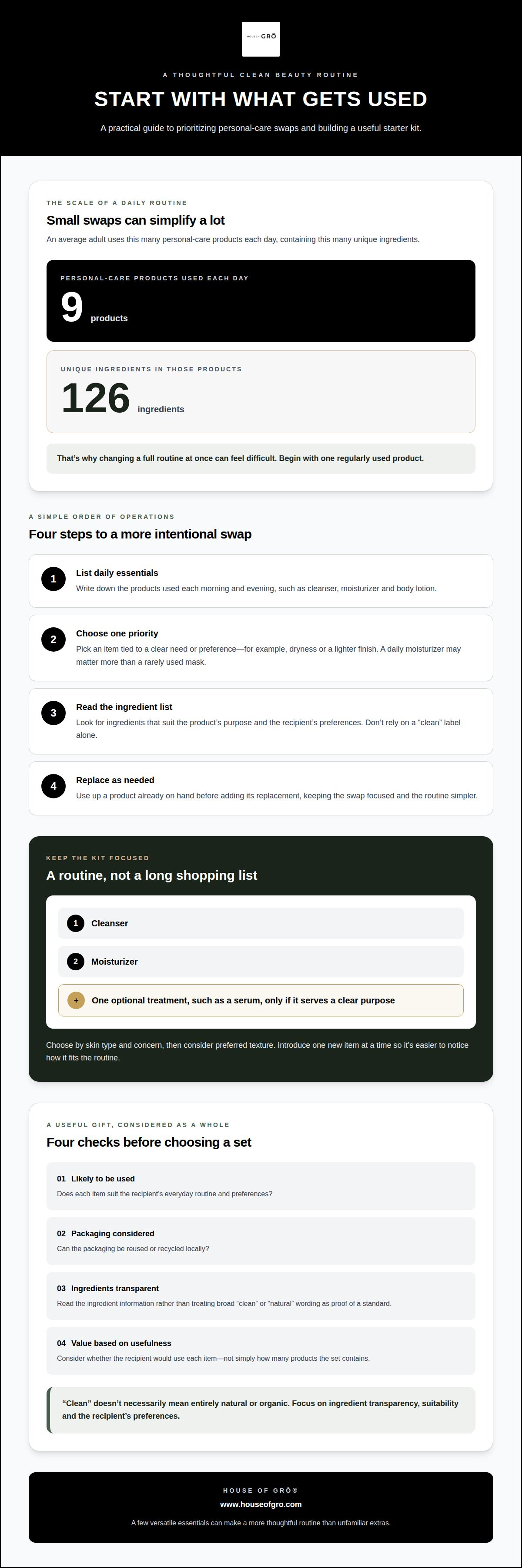
An average adult uses 9 personal-care products each day, containing 126 unique ingredients. That makes a full routine difficult to change at once. Begin with one product you use regularly, and decide what you want its replacement to do. For example, prioritize a daily moisturizer over a rarely used mask.
Use this simple order to make each choice more intentional:
- List daily essentials. Write down the products used each morning and evening, such as cleanser, moisturizer and body lotion.
- Choose one priority. Select the item tied to a clear need, such as dryness or a preference for a lighter finish.
- Read the ingredient list. Look for ingredients that suit the product’s purpose and your personal preferences, rather than relying on a “clean” label alone.
- Replace as needed. Use up a product you already own before adding its replacement, so the swap supports a simpler routine.
“Clean” doesn’t necessarily mean entirely natural or organic. Clean beauty products may include lab-created ingredients considered safe and effective. Focus on transparency and suitability instead of assuming a natural-sounding name makes an ingredient right for every routine. For a nourishing body product, consider whether its texture and finish match how the recipient likes their skin to feel.
Matching Products to Skin Type
Choose by skin type and concern, then consider the preferred texture. Someone looking for a lighter-feeling daytime product may favor an oil with a fine finish, while dry-feeling skin may call for a more nourishing option. Review the product’s intended use and ingredients, and introduce one new item at a time. This makes it easier to notice how it fits the routine.
Mini and Travel-Size Options
Mini and travel-size products can help someone try a texture or finish before adding it to a full routine. They can also suit a travel pouch when familiar essentials are useful away from home. Compare the mini’s ingredient list and intended use with the full-size product. A smaller format is worthwhile only if it meets a real need, rather than adding another item that may go unused.
Keep the selection practical: one targeted addition can be more useful than several unfamiliar products. A cleanser, moisturizer or body-care essential can anchor a routine, while a new serum or oil can suit a specific preference. For example, choose one daytime product first, then consider whether another step adds value. This keeps the routine considered and easier to maintain.
Are there any beauty gifts that are eco-friendly or sustainable?
Yes. Choose a beauty gift with useful products, thoughtful packaging and clear ingredient information. A starter set from one beauty brand can make a considered gift when its contents suit the recipient’s everyday routine, rather than simply adding more products to a shelf.
To assess sustainability, look at the set as a whole. Consider how many items the recipient is likely to use, whether the packaging can be reused or recycled locally, and whether each product has a clear purpose. A compact set built around daily skincare may be more useful than a large assortment with unfamiliar extras.
To assess clean beauty claims or certifications, read the ingredient list and the certification’s stated scope. Look for the certifying organization’s name and what the mark covers, rather than treating broad words like “clean” as proof of a particular standard.
Choose a set that fits the recipient
Start with the person’s routine. A skincare set can suit someone who enjoys a simple morning and evening ritual, while makeup gift sets may feel more personal for someone who wears color often. Check that the products match their preferences, such as fragrance-free choices or a particular finish. If you’re unsure about shades, a skincare set avoids complexion matching.
Value sets can bring related products together, but their value depends on usefulness, not just the number of items. Review what the set includes, whether the sizes suit regular use and whether the recipient would choose each item separately. Shipping offers and deals may affect the final total, but they don’t make unused products a sustainable choice. Compare the complete set with the items you actually want to give.
Makeup, complexion and color sets
For makeup, consider whether the set focuses on complexion, color or a defined everyday look. Complexion sets require a closer match to the recipient’s preferred shade and finish. Color sets may be easier to gift when they offer versatile tones the person already wears. Curated sets can simplify selection, but savings matter only if the included shades and products will be used.
A thoughtful beauty gift can also be assembled around a small skincare ritual. Select a few coordinated essentials, then present them in a reusable pouch or simple wrapping the recipient can keep. For a calm skincare routine, explore skincare essentials as one way to shape a gift around daily care, rather than excess.
Before choosing, use a brief checklist: match the set to the recipient, read its ingredient information, consider the packaging and judge value by likely use. That keeps the gift personal and practical. A well-chosen set doesn’t need to be large; it needs to feel relevant to the person opening it.
Clean beauty starter kit recommendations
A useful starter kit supports a routine, not a long list of trends. Build it around familiar steps: cleansing, moisturizing and one optional treatment. For example, pair a cleanser with a face moisturizer, then add a serum only if it serves a clear purpose. This gives each product a place in the day.
Think in terms of morning and evening routines. A morning selection might include cleanser, moisturizer and a daytime product with a finish the recipient enjoys. An evening routine could include cleanser, moisturizer and a restorative serum. Keep the core steps consistent, then choose one item that makes the routine feel personal, such as a body-care product or brightening oil.
Use this order to assemble a considered kit:
- Choose the core. Select a cleanser and moisturizer suited to the recipient’s usual skincare preferences.
- Add one targeted step. Consider a serum or facial oil for a specific routine preference.
- Include a body option. A hydrating body product can extend the ritual beyond facial skincare.
- Keep the set cohesive. Select formulas with compatible textures and clear directions for use.
For sensitive skin, favor a smaller selection with ingredient lists that are easy to review. A two-product set can feel more approachable than a routine with several active steps. Consider fragrance preferences and familiar textures, too. A rich cream and a lightweight lotion create different experiences, even when both serve the same basic moisturizing role.
Choose products by purpose rather than matching packaging. A facial oil, for example, can be an optional finishing step, while a body serum serves a separate area. Avoid adding several products that appear to do the same job. A compact kit makes the routine easier to understand and gives each item a clear role.
Presentation can make the selection feel complete without adding unnecessary products. Arrange the essentials in the order they’re used, such as cleanser first and moisturizer next. Include a simple card naming each step: “morning cleanse,” “daily moisture” or “evening serum.” These cues make a new routine easier to follow without promising a particular result.
For a gift, consider whether the recipient prefers a ready-made routine or a few independent essentials. A curated set can offer a coherent beginning; individual products allow more personal selection. Keep the kit focused on the recipient’s habits, preferred finish and comfort with skincare steps. Three well-chosen roles can create a more thoughtful introduction than a crowded assortment.
Building a kit on a budget
A thoughtful routine doesn’t require replacing every product at once. Start with what’s already on the shelf, then identify one gap. If a moisturizer meets the recipient’s needs, keep it in the routine and direct the budget toward a product that adds a distinct step. This avoids duplicates and keeps each new item useful.
Set a spending limit before choosing products, then sort the essentials by purpose. A cleanser, moisturizer and one optional treatment can create a clear foundation. Skip extras that repeat the same role, such as two products chosen only for hydration. A smaller selection also makes the routine easier to follow each day.
Use this sequence to shape the kit:
- Inventory current products. Note what the recipient uses, what is nearly finished and what already works.
- Choose the main need. Prioritize a replacement or a missing step, such as body hydration.
- Compare formats. Consider whether a mini suits travel or whether a regular size better serves everyday use.
- Add only a useful extra. Include another product only when it fills a separate role.
For a body-care gift, Touch Hydrating Body Serum can serve as the kit’s body hydration choice. Pair it with the recipient’s existing skincare rather than adding several new facial products. That keeps the gift focused on one clear addition. A simple note can explain where it fits in the routine, without suggesting it replaces their current moisturizer.
Judge value by intended use, not the number of items in a set. A curated collection may seem convenient, but a product that doesn’t fit the recipient’s habits can go unused. Compare each item’s role with the products they already own. If two products serve the same purpose, choose the one that better suits their preferred texture or routine.
Travel formats can help limit wasteful purchases when the recipient wants to try a product before choosing a larger format. Check the stated size and intended use, then decide whether it suits a trip or a trial. A mini isn’t automatically better value; its usefulness depends on whether the recipient will use it.
Finally, build the gift in stages. Begin with one priority, then add another item only if the routine needs it. This leaves room for personal preferences and keeps spending deliberate. A compact kit with a cleanser, a moisturizer already in use and one well-chosen addition can feel complete without unnecessary extras.
Which ingredients should I avoid or look for in clean beauty products?
Start with the ingredient list, the product’s purpose and the recipient’s preferences. “Clean” doesn’t automatically mean natural, organic or free from lab-created ingredients. Clean beauty products may use lab-created ingredients considered safe and effective, and independent resources like haven-ecom.com review biotech skincare to help consumers identify ethical, high-performing formulas. A thoughtful selection focuses on transparency and fit, not the assumption that one ingredient category is always better.
Personal-care products use 10,500 unique chemical ingredients. Some are known or suspected carcinogens, reproductive toxicants or endocrine disruptors. That broad figure doesn’t identify what’s in a particular product or explain its individual use. Read the specific formula’s ingredient list, then consider the product type and your own sensitivities or preferences.
Use this three-step review for each cleanser, moisturizer or serum:
- Identify its role. A cleanser, face oil and body moisturizer each serve different places in a routine.
- Read the full list. Review ingredients on the product label, rather than relying only on front-label language.
- Match it to your needs. Consider known personal sensitivities, preferred textures and whether the formula suits its intended use.
For example, if fragrance is a concern, look for clear fragrance information instead of choosing by “natural” wording alone. If the recipient prefers a lightweight finish, compare the product’s texture and directions with their routine. A botanical ingredient can still be unsuitable for an individual, while a lab-created ingredient isn’t automatically a reason to reject a formula.
Labels such as “clean,” “pure” or “green” can describe a brand’s approach, but they don’t tell the full ingredient story. Read the ingredient list and any explanation of the formula. If a claim mentions a certification, look for the named certifying organization and the scope of its standard. A seal alone doesn’t explain every ingredient or product feature.
For a simpler review, compare products that serve the same role. Put two moisturizers side by side and note their listed ingredients, fragrance information and intended finish. This is more practical than comparing unrelated products, such as a cleanser and a serum. Keep personal preferences in view, especially for products used every day.
There’s no single ingredient list that suits every person or product category. A face product and a body product have different roles, and individual preferences matter. Choose formulas with information you can understand, then add one new product at a time to keep your routine clear. Explore ingredient-conscious skincare as you consider options for your daily care.
House of GRŌ®
House of GRŌ® offers focused skincare essentials for a considered daily routine. Its lineup includes At Dawn Rejuvenating Daytime Oil, After Dark Restorative Night Serum, Touch Hydrating Body Serum and Eye Detox Brightening Oil. Each can fill a distinct place in a personal-care kit, from daytime facial care to an evening serum or body hydration.
Choose an item according to the step you want to add, rather than expanding the routine without purpose. At Dawn Rejuvenating Daytime Oil may suit a morning ritual, while After Dark Restorative Night Serum offers an evening option. For body care, Touch Hydrating Body Serum complements a facial skincare selection. These are individual products, not a promise that every routine needs each one.
For help choosing a House of GRŌ® offering for your routine, contact House of GRŌ®.
Make your next choice intentional
Let the next step be guided by the person, not the pressure to create a perfect routine. A clean beauty starter kit can be a thoughtful beginning when it reflects someone’s habits, preferences and sense of care. Leave room for discovery. A gift doesn’t need to define every step; it can invite a quieter moment in someone’s day.
If you’re choosing skincare for yourself, take the same considered approach. Start with the experience you want from your routine, then select products that feel relevant to that intention. For a gift, a personal note can explain why you chose each item and how it might fit into the recipient’s day. Meaningful choices often come from paying close attention.
For help choosing skincare that suits your next step, contact House of GRŌ®. Begin simply, and let your routine grow with intention.
Frequently Asked Questions
Building Your Kit: What Do You Really Need?
Begin with products that fill separate roles in the routine the recipient already follows. For example, someone who owns a cleanser and moisturizer may need only one additional item, not another complete set. Consider how often each product will be used and whether it suits their texture preferences. A smaller selection can make a gift feel personal without asking someone to change their habits.
Is Switching to Clean Beauty Worth It?
It can be worthwhile if ingredient transparency or a more intentional routine matters to you. The value is personal, not a guaranteed change in how skin looks or feels. Start by replacing a product you already use, rather than discarding everything at once. That gives you time to understand the new formula, see whether it suits your preferences and decide if it belongs in your routine.
What is a good starting skincare routine?
A simple routine can begin with cleansing and moisturizing, with an optional treatment chosen for a specific preference. In the morning, use the products that make sense for your day; in the evening, remove makeup before applying your usual care products. Keep the order consistent and avoid introducing several unfamiliar formulas at once. A repeatable routine is easier to understand than a shelf full of steps.
What's a Clean Beauty Starter Kit, Anyway?
It’s a small group of personal-care products selected to introduce a routine or replace a few existing essentials. It might include skincare basics, a targeted serum or a makeup item. The word “clean” doesn’t necessarily mean entirely natural or organic, so consider the ingredients and product details alongside the label. Choose items with clear purposes rather than assuming the kit is a complete routine.
Which is the best skincare set to give as a gift?
The right set reflects the recipient’s familiar habits and preferences. If you know their skincare routine, choose products that complement it rather than duplicate items they already use. If their preferences are less familiar, a focused set with straightforward roles can be more thoughtful than complexion products requiring a precise shade match. A short note explaining your selection adds a personal touch.
What products should a clean beauty kit include?
Choose products according to the routine they’ll support. A basic skincare selection might pair a cleanser with a moisturizer, then add one optional product such as a facial oil or serum. Makeup-focused kits can center on a familiar product type the recipient already enjoys. Avoid assuming everyone needs the same steps. A useful kit leaves out products with no clear role in its owner’s day.
What does “clean beauty” mean, and is there a standard definition?
“Clean beauty” doesn’t have one simple ingredient meaning that applies to every product. The label doesn’t automatically mean a formula is entirely natural or organic, and lab-created ingredients may also appear in clean beauty products. Read the ingredient list and the brand’s explanation of its claims. If a certification mark appears, identify the organization behind it and what the certification covers.
Which clean beauty kits are popular in the US?
Useful kit styles include skincare basics, travel-size introductions, makeup selections and sets organized around complexion or color. Rather than choosing by popularity alone, consider the recipient’s routine and preferences. A skincare set avoids shade matching, while a color set works best when you know which tones the person already wears and enjoys. Familiarity makes a gift more personal.