


There is no single rulebook for clean skincare in the United States. Because “clean” has no standardized legal definition for skincare, clean skincare standards vary by brand.
Choosing a product labeled clean can feel like a thoughtful step toward a more intentional routine. But the label alone doesn’t explain which ingredients a brand excludes, how it defines its standards, or whether a formula will suit your skin. Understanding what the words mean makes it easier to assess claims carefully.
This guide explains what clean skincare can mean, how brand standards and certifications differ, and what ingredient labels can reveal. It also explores testing for contaminants such as heavy metals, PFAS, and phthalates, so you can understand what testing does and doesn’t tell you. A clearer view of the language, labels, and evidence behind a product can help you make informed choices that reflect your priorities.
Key Takeaways
- “Clean” has no single standardized meaning for skincare in the United States, so look beyond the front-label claim to understand a brand’s ingredient philosophy.
- Fragrance-free and unscented aren’t interchangeable labels. Ingredient details can help clarify what a product’s claim means.
- Contaminant testing can vary by product and brand. Learn what substances a test covers before treating it as a complete picture.
- Certifications assess different standards, so a seal is most useful when you understand what it evaluates.
- Use ingredient lists and product claims as practical clues, while remembering that labels alone can’t predict how a formula will suit your skin.
Is "fragrance-free" the same as "unscented"?
Assess skincare claims by reading the full ingredient list, identifying fragrance terms, and reviewing the brand’s stated standards. For individual concerns, compare ingredients with known sensitivities and choose a formula that fits your routine. Neither “fragrance-free” nor “unscented” alone confirms that a product will suit everyone.
“Fragrance-free” generally means fragrance ingredients aren’t added for scent. “Unscented” describes the product’s smell, not necessarily the absence of fragrance ingredients. A formula may contain masking ingredients to reduce or cover an ingredient’s natural odor. Under many cosmetic regulations, “fragrance” or “parfum” can represent a blend without listing every component individually. The complete ingredient list is useful, though it may not identify each scent component.
For sensitive skin, fragrance can be a source of irritation. For example, someone who reacts to scented creams may prefer a fragrance-free moisturizer and introduce it cautiously. Skin concerns differ, so a label can guide a choice but cannot predict an individual reaction. Beauty claims also extend beyond skin. Packaging disposal, ingredient sourcing, and a brand’s explanation of environmental claims each relate to a different impact. A recyclable-packaging claim, for instance, says nothing about fragrance or skin compatibility.
MoCRA adds federal registration and listing requirements. According to the U.S. Food and Drug Administration, cosmetic facility registration on Form FDA 5066 must be renewed every two years. Cosmetic product listings on Form FDA 5067 must be updated annually. These filings are regulatory steps, not a “clean” label or a guarantee that a formulation suits a particular skin concern. The FDA doesn’t approve cosmetics as “clean.”
Safety information also depends on what a brand tests and tracks. The FDA doesn’t mandate a specific cosmetic testing panel, so testing claims should identify the substances and product samples evaluated. Lot and batch traceability can connect a product to its production record, making batch information useful when reviewing a safety concern. Retail standards may require brands to maintain traceability, but requirements differ.
California’s rules also shape ingredient decisions. According to California Legislature, California AB 496 adds 26 banned cosmetic ingredients effective January 1, 2027. This illustrates why a brand’s ingredient policy may change as regulations develop. To assess a clean beauty claim, look for the complete ingredient list, a clear explanation of fragrance terms, and specific details about testing and traceability. Then weigh those details against your skin’s needs and the claims that matter to you.
What does clean skincare mean?
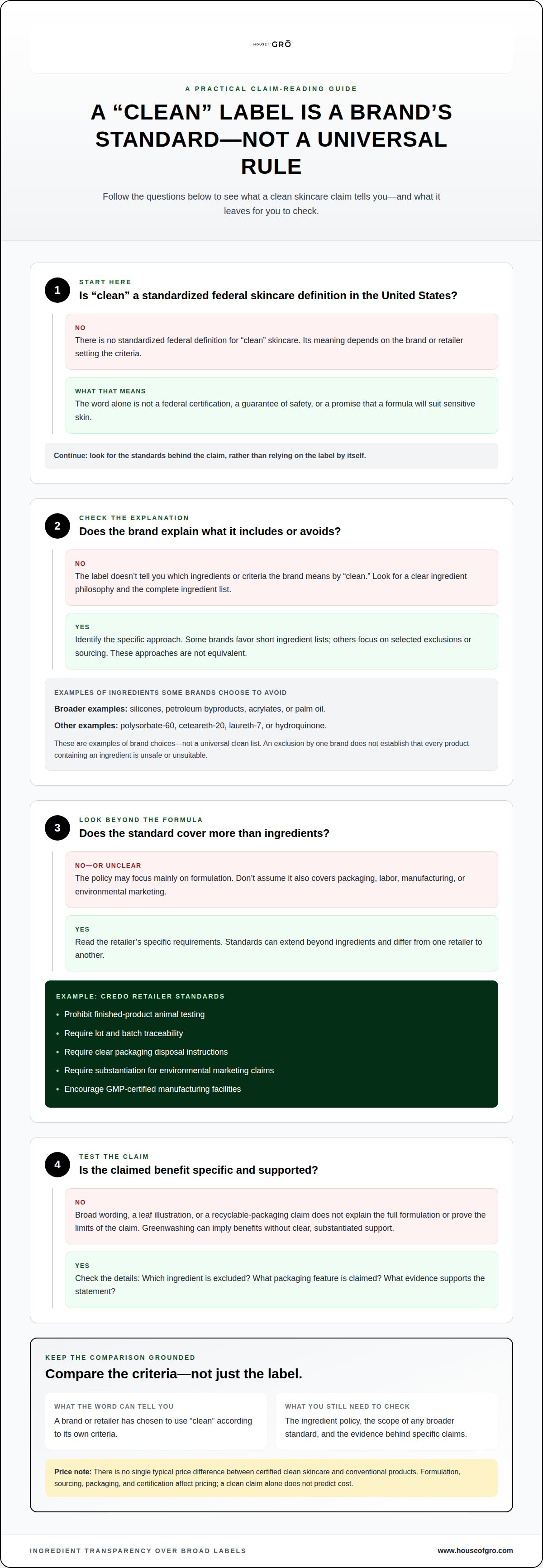
In the United States, “clean” has no standardized federal definition for skincare. Its meaning depends on the brand or retailer setting the criteria.
The Meaning and Limits of Clean Beauty
Clean beauty is an ingredient philosophy: a brand defines what it chooses to include or avoid and explains that approach to consumers. It isn’t a federal certification, a guarantee of safety, or a promise that a formula will suit sensitive skin. “Natural,” “green,” and “eco” also lack clear definitions in beauty marketing. The practical value lies in transparency, not the word itself.
Differences Between Clean Beauty Standards
Retailer standards can cover more than ingredients. Credo, for example, requires brands to prohibit finished-product animal testing, maintain lot and batch traceability, and provide clear packaging disposal instructions. It also requires substantiation for environmental marketing claims and encourages GMP-certified manufacturing facilities. Individual brands set their own ingredient policies, so two products called clean may follow different criteria. EU cosmetics rules use formal prohibited and restricted ingredient lists, unlike the undefined U.S. clean label.
Some brands favor short ingredient lists; others focus on selected exclusions or sourcing. These approaches aren’t equivalent. A retailer’s standard may also address labor, packaging, or manufacturing, while a brand’s policy may focus mainly on formulation. Compare the criteria, not just the label.
Commonly Avoided Ingredients
Some clean beauty brands exclude ingredients such as silicones, petroleum byproducts, acrylates, or palm oil. Others may avoid specific ingredients like polysorbate-60, ceteareth-20, laureth-7, or hydroquinone. These examples describe brand choices, not a universal clean list. One brand’s exclusion doesn’t establish that every product containing an ingredient is unsafe or unsuitable. For a practical comparison, identify the ingredients a brand names and the reason it gives for excluding them.
Misleading Clean Beauty Claims
Greenwashing occurs when packaging or marketing implies environmental or ingredient benefits without clear, substantiated support. A leaf illustration, “pure” wording, or recyclable-packaging claim doesn’t explain the full formulation or the limits of the claim. Look for specifics: which ingredient is excluded, what packaging feature is claimed, and what evidence supports it. Broad terms can suggest rigor without showing which standards a brand follows.
There’s no single typical price difference between certified clean skincare and conventional products. Formulation, sourcing, packaging, and certification affect pricing, so a clean claim alone doesn’t predict a product’s cost.
For a calm, ingredient-conscious routine, explore skincare formulated with botanicals.
Contaminant testing for heavy metals, PFAS, and phthalates
A clean ingredient philosophy doesn’t, by itself, show whether a finished cosmetic was tested for contaminants. Heavy metals, PFAS, and phthalates are distinct testing concerns. A statement that a product is “tested” has limited meaning unless it identifies what the testing covers. The ingredient list and testing evidence answer different questions: one describes the formula, while the other may address substances assessed in a sample.
Heavy-metal screening often focuses on a basic set of four, perhaps seven, metals. The United States does not mandate a specific cosmetic testing panel, so panels can differ. A broad claim such as “tested for heavy metals” doesn’t tell consumers which metals were included. Look for the scope: the substances named, the product or sample assessed, and whether the claim applies to that formulation or a particular batch.
PFAS and phthalates require separate attention. A heavy-metal panel doesn’t establish whether a product was assessed for either group. Nor does a long ingredient list alone show whether testing took place. For example, a brand might describe a product as PFAS-tested while saying nothing about phthalates. Read the claim literally: identify the substance named, the product covered, and the evidence provided. Don’t treat a test for one concern as a comprehensive screen.
- Heavy metals: Look for the specific metals named, rather than relying on a general screening claim.
- PFAS: Check whether the claim addresses PFAS directly, not just contaminants generally.
- Phthalates: Look for a distinct statement about phthalate testing or exclusion.
Testing details help evaluate a claim, but they don’t automatically establish that a product is risk-free. A report may cover a particular sample or batch, while marketing language may sound broader. Batch identification makes this distinction clearer: a traceable lot connects a claim to a defined product record. Without details about scope, consumers can’t tell whether “tested” means a single contaminant, a group, or a wider panel.
For a careful review, separate three questions: what the ingredient list says, what the testing claim names, and what evidence describes the test’s scope. A brand’s clean beauty philosophy may explain its ingredient choices, but testing provides different information. Compare claims such as “screened for lead” with “tested for contaminants”: the first names a substance, while the second leaves the panel unclear. Specific wording makes the evidence easier to evaluate.
EWG Verified, MADE SAFE, and B Corp certifications
EWG Verified, MADE SAFE, and B Corp are distinct labels, not interchangeable proof of one universal clean skincare standard. No single certifying body tests and verifies skincare products against a shared clean definition. First, identify what the label applies to: a specific formula, a company’s practices, or a broader environmental concern. That scope shapes what the certification can tell you.
EWG Verified and MADE SAFE are associated with product claims, while B Corp relates to a company rather than certifying each skincare formula as clean. A product-level mark can offer another reference point, but it doesn’t replace the ingredient list or explain every detail of a formula. A company-level credential may speak to broader business practices, yet it doesn’t establish whether a particular moisturizer contains an ingredient someone avoids.
Each program sets its own criteria. A certification’s meaning comes from the standards behind its label, not from the word “verified” or “safe” alone. For example, a shopper concerned about phthalates should check whether that specific concern appears in the certification’s criteria. A seal by itself doesn’t show whether phthalates were tested, excluded, or outside the program’s scope.
Use a simple reading sequence when comparing certified products:
- Identify the subject: Does the label refer to the finished product or the company?
- Read the criteria: Look for the program’s stated ingredient, chemical, or environmental requirements.
- Match the concern: Check whether a personal priority, such as avoiding a particular ingredient, is addressed.
- Keep the label in context: Compare it with the full ingredient list and the brand’s explanation.
These steps help distinguish certification from broad marketing language. A leaf symbol, for instance, may suggest an environmental benefit without naming a standard. EWG Verified or MADE SAFE identifies a program, but consumers still need to understand what it evaluates. B Corp should likewise be read as a company-level credential, not as evidence that every product meets an ingredient standard.
Certifications can support informed choices, especially when their criteria align with a specific concern. They don’t automatically indicate that a skincare product will suit sensitive skin, address every environmental issue, or match every clean beauty philosophy. Treat each label as a starting point: identify its scope, understand its criteria, then consider the formula alongside your own priorities. This approach clarifies the differences between these three names without asking any seal to stand for more than it assesses.
Meaning and variable standards of clean skincare
The meaning of “clean” shifts with the organization defining it. One retailer may focus on ingredient exclusions; another may add packaging, sourcing, or manufacturing criteria. A brand may build its philosophy around botanical ingredients, while another emphasizes avoiding selected chemicals, such as parabens. These approaches can share values without using the same test. The phrase clean skincare standards describes this variation, not one universal checklist.
That variation matters because a label can’t tell you every reason behind a brand’s choices. A retailer’s restricted-ingredient list reflects its own policy, while federal cosmetics rules establish separate requirements. The European Union maintains its own ingredient restrictions. These systems don’t translate into a single ranking of products. Different rules can reflect different regulatory approaches, while a brand’s “clean” policy may go further in selected areas.
Science asks more specific questions than a broad label can answer. An ingredient’s identity, concentration, role in a formula, and exposure context all affect how evidence is interpreted. For example, “paraben-free” tells you about an exclusion, but not why the brand made it or what alternatives it uses. When comparing two moisturizers, look beyond their shared claim and consider the full formulation and the brand’s explanation.
- Policy: Identify whether the standard comes from a retailer, certification program, or individual brand.
- Scope: Note whether its criteria cover ingredients, sourcing, packaging, or business practices.
- Evidence: Look for specific explanations supporting claims, rather than broad words such as “pure.”
These distinctions make transparency useful in a daily routine. If sensitive skin is your priority, an environmental packaging standard may not answer your ingredient question. If packaging waste matters most, a short ingredient list may not address that concern either. Set your priorities before comparing products, then match each claim to the question it actually answers.
Clean doesn’t automatically mean natural, non-toxic, more effective, or suitable for everyone. Those conclusions require different evidence. A claim about botanical sourcing, for instance, describes origin; it doesn’t establish how the finished product will work for an individual. Treat “clean” as a starting point for understanding a brand’s philosophy. The clearest standard explains its choices, defines its limits, and makes relevant information easy to find.
Explore a more intentional skincare routine through botanical skincare essentials.
House of GRŌ®
House of GRŌ® offers a considered skincare routine rooted in adaptogenic mushrooms and organic botanicals. If you’re looking beyond broad clean claims toward formulas that reflect a botanical ingredient philosophy, explore its skincare offerings. Choose AT DAWN Rejuvenating Daytime Oil or AFTER DARK Restorative Night Serum for facial care, TOUCH Hydrating Body Serum for the body, or EYE DETOX brightening oil for the eye area. Each offers a distinct way to bring intentional care into your day, without treating a “clean” label as a guarantee of individual suitability.
For a closer look at how House of GRŌ® fits your skincare priorities, contact House of GRŌ®.
Make your next skincare choice with intention
Let your priorities guide your next step. You might begin with a personal ingredient concern, a preference for environmental responsibility, or a routine that feels simple enough to sustain. Keep your focus specific. A clear question makes it easier to understand whether a brand’s philosophy aligns with what matters to you.
Clean skincare standards can help you compare products, but your choices remain personal. Consider what you want from your routine, what information helps you feel informed, and which claims matter to your needs. Thoughtful skincare doesn’t need to be complicated. It can begin with one deliberate choice and grow at your own pace.
If you’d like to explore how your skincare priorities connect with House of GRŌ®, share your questions with House of GRŌ®. Let your next step feel considered, calm, and your own.
Frequently Asked Questions
Is clean beauty actually safer?
Not by the label alone. Clean skincare standards don’t establish a universal safety rating or prove that a formula suits everyone. A fragrance-free product, for example, may match someone’s preference, but that claim doesn’t establish suitability for all skin. Consider the full formula, your own sensitivities, and the specific evidence behind any safety or testing claim.
What U.S. laws and FDA rules apply to skincare ingredient safety and labeling?
U.S. cosmetics are regulated by the FDA under the Federal Food, Drug, and Cosmetic Act, while the Modernization of Cosmetics Regulation Act (MoCRA) introduced additional requirements. For example, cosmetic facility registration on Form FDA 5066 must be renewed every two years, according to the U.S. Food and Drug Administration. Product listings on Form FDA 5067 must be updated annually. Ingredient labels and safety obligations are distinct from voluntary “clean” claims.
Are terms like “clean,” “natural,” and “non-toxic” regulated on skincare labels?
These terms don’t have a universal cosmetic definition in the United States. Clean skincare standards vary by brand: one may exclude selected ingredients, while another follows a different policy. “Natural” and “non-toxic” also aren’t standardized guarantees that a product is safer or suitable for your skin. Read the ingredient list and the brand’s explanation of each claim. Specific wording is more informative than a broad label.
Which clean skincare certifications and seals are reliable, and what do they require?
No single organization certifies every product against one shared clean-skincare standard. EWG Verified and MADE SAFE labels, and B Corp certification, should be understood through each program’s criteria and scope. Check whether a seal applies to a specific product or the company, then see whether its criteria address your concern, such as an ingredient exclusion or business practice. A seal’s name alone doesn’t explain every requirement.
What are the safety risks of replacing preservatives or using natural skincare ingredients?
Replacing a preservative without an effective alternative can leave a formula less protected from microbial contamination, particularly if the formulation and packaging don’t support product preservation. “Natural” doesn’t automatically mean suitable for everyone either. An ingredient’s origin alone can’t predict an individual response. Consider the complete formula, known sensitivities, and whether the brand explains its safety and testing approach.
Do clean skincare products have to be cruelty-free, vegan, or sustainably packaged?
No single clean definition makes those qualities automatic. A brand may choose cruelty-free practices, vegan ingredients, or packaging limits, but each is a separate claim. For example, Credo’s standards require finished-product brands not to conduct animal testing and address packaging materials and disposal instructions. Those are retailer requirements, not universal rules for every product called clean. Look for clear statements about the qualities that matter to you.