


Oil isn’t automatically the enemy of acne-prone skin. A natural face oil for acne-prone skin may fit into a routine when the formula and amount suit your skin. The key is understanding what a comedogenic rating can tell you, and what it can’t.
If you’re cautious about adding oil to skin that already feels congested, that instinct makes sense. Grapeseed and rosehip oils are often discussed for different reasons, including acne marks, inflammation, scarring, and skin-barrier support. Their linoleic acid content is another detail to consider.
Here, we’ll look at how these oils relate to acne-prone skin, how comedogenic ratings compare, and why a low rating isn’t the whole story. A thoughtful choice starts with the details, not simply the word “natural.”
Key Takeaways
- Facial oils can fit into an acne-prone skincare routine, but the oil type and amount matter. Learn which oils call for more caution.
- Grapeseed oil has a low comedogenic rating and is often discussed for oily skin and acne marks.
- Rosehip oil contains linoleic acid, which is associated with skin-barrier support and reduced inflammation.
- Comedogenic ratings offer a comparison, not a guarantee of how an oil will affect your pores.
- Explore how linoleic acid relates to acne-prone skin and what the available evidence says about its potential role.
1. Are Facial Oils Good for Acne-Prone Skin?
Yes, facial oils can suit acne-prone skin when you choose carefully and use a small amount. Jojoba, argan, sunflower seed, and hemp seed oils are often described as lightweight or non-comedogenic. A natural face oil for acne-prone skin is a personal skincare choice, not a substitute for cleansing or acne treatment.
Start with clean, damp skin and use a minimal amount. Jojoba oil can be applied as a moisturizer or blended into another skincare product. For oily skin, keep your routine gentle: washing twice per day is advised, while frequent washing or hard scrubbing can aggravate the skin. Oily skin can still feel dehydrated, so moisturizer remains important.
Tea tree oil is used for active breakouts, but it must be diluted with a carrier oil before application. A 2017 clinical trial reported a 55% reduction in total acne lesions, from 23.7 to 10.7 lesions. That finding describes the trial result, not a promise about what any one routine will do. Never apply undiluted tea tree essential oil directly to facial skin.
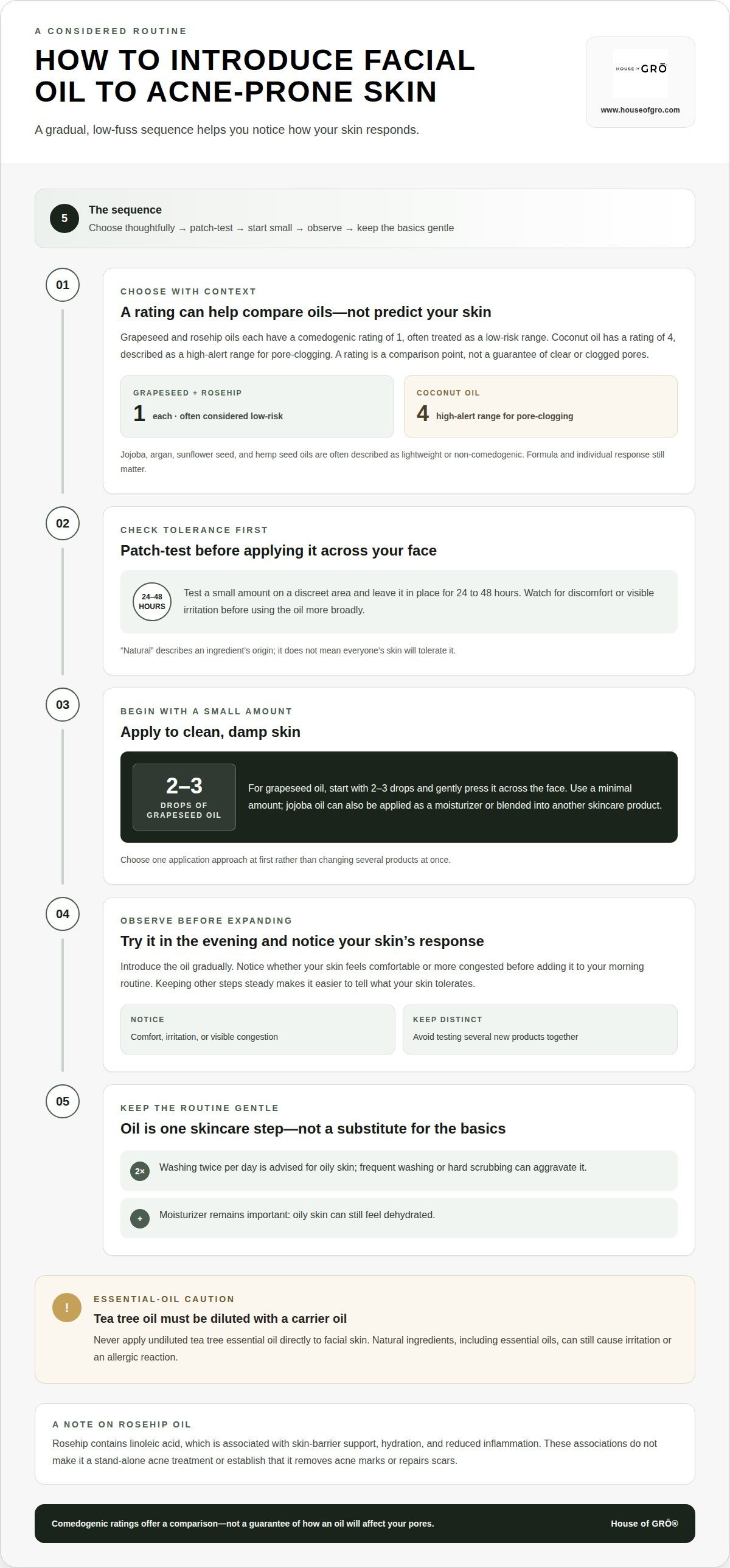
Rosehip and grapeseed oils each have a comedogenic rating of 1, often treated as a low-risk range. Squalane’s suitability depends on the formula and how your skin responds. Ratings can help narrow options, but they don’t predict every reaction. Try a small patch before adding a new oil across your face.
Use caution with richer oils. Coconut oil has a comedogenic rating of 4, which falls in the high-alert range for pore-clogging; olive oil is another option to introduce carefully if your skin is prone to congestion. A rating is a comparison point, not a guarantee of clogged pores or clear skin.
Essential oils need particular care. Ylang ylang and lavender appear in a face-oil recipe at 4 drops each, alongside carrier oils; that recipe is not a reason to apply them undiluted. Natural ingredients can still cause irritation or an allergic reaction. Patch-test facial oil and leave the test in place for 24 to 48 hours, watching for discomfort or visible irritation.
In the United States, there is no single price for a non-comedogenic natural face oil. Cost depends on factors such as the formula and product size, so compare product details rather than assuming “natural” means one price. To introduce an oil gradually, try a small amount in the evening and observe how your skin responds before adding it to your morning routine.
2. Grapeseed oil for oily skin and acne marks
Grapeseed oil is described as lightweight and moisturizing, with fatty acids, antioxidants, and vitamins C and E. These properties make it an option people consider for oily skin, which can still need moisture. Its light feel may suit a routine weighed down by richer products. But texture alone can’t predict how your skin will respond.
For application, start with clean, damp skin. Use 2-3 drops, then gently press the oil across the face. You can also massage grapeseed oil onto clean, dry skin or mix it with another skincare product. Choose one approach at first, rather than changing several products at once. That makes it easier to notice whether your skin feels comfortable or more congested.
Set realistic expectations for acne marks. Moisturizing the skin is different from showing that an oil fades discoloration or prevents scarring. Grapeseed oil contains antioxidants and vitamins, but those ingredients alone don’t establish a specific result for marks. Studies assess particular ingredients and outcomes, so a general antioxidant claim isn’t proof that grapeseed oil will clear marks. Keep your routine steady and consider each product’s purpose.
If you have sensitive skin, introduce grapeseed oil gradually. Apply a small amount to a discreet area first, then watch for irritation before using it across your face. “Natural” describes an ingredient’s origin, not how everyone’s skin will respond. If a formula contains fragrance or essential oils, those ingredients matter too. A simple formula can make it easier to identify what your skin tolerates.
Jojoba oil is another option people consider for oily skin. Apply a minimal amount to clean, damp skin as a moisturizer, or add it to another skincare product. A mask formulated with clay and jojoba oil may be used two to three times a week for mild acne and skin lesions. This differs from applying jojoba oil alone, so consider the full formula and your skin’s response.
Honey is sometimes used topically in acne-care routines. A honey mask for oily or acne-prone skin can stay on for approximately 10 minutes before rinsing. Keep this separate from an oil test at first. Trying honey, grapeseed oil, and jojoba together makes it harder to identify which step suits your skin.
Keep cleansing gentle. Wash oily skin twice per day, and cleanse after exercise or a hot day. Washing too often or scrubbing hard can aggravate the skin. Follow cleansing with moisturizer, since oily skin can still become dehydrated. For a considered botanical routine, explore plant-based skincare essentials while keeping each new step distinct.
3. Rosehip seed oil for inflammation and scarring
Rosehip seed oil is a plant oil valued in skincare for its linoleic acid. This omega-6 fatty acid is associated with strengthening the skin barrier, supporting hydration, and reducing inflammation. Those properties make rosehip relevant to acne-prone skin, where irritation and dryness can complicate a routine. They don’t make it a stand-alone acne treatment.
The skin barrier helps retain moisture and maintain a comfortable surface. A routine with cleansing, moisturizer, and a suitable facial oil can support basic skincare. Rosehip oil may add moisture while supplying linoleic acid. Treat it as one skincare step, not a replacement for cleansing or other acne treatments.
Inflammatory breakouts and acne marks are related, but they’re not the same concern. A mark is discoloration left after a blemish; a scar involves a lasting change in skin texture. Rosehip oil’s association with reduced inflammation may make it appealing after breakouts, but that does not establish that it removes marks or repairs scars. Keep the distinction in mind when choosing an oil for your routine.
There is also a specific finding about topical linoleic acid: it was associated with a 25% reduction in acne microcomedones after 4 weeks. Microcomedones are early, invisible precursors to some clogged pores. That result concerns topical linoleic acid, not every rosehip seed oil product or visible acne scar. An ingredient-level finding shouldn’t be treated as proof that a particular oil has the same effect.
For a simple introduction, apply facial oil at night after cleansing. Dampen your skin, then press in a few drops; a general starting amount for face and neck is 2-3 drops. If you use retinol or prescription topicals, rosehip oil can be applied at night over them. Keep the rest of the routine familiar so you can observe how your skin responds.
The full formula matters. Rosehip seed oil is not identical to a blend containing rosehip plus fragrance or essential oils. Read the ingredient list and introduce one new product at a time. If your skin feels irritated, pause the new step rather than adding more products to mask the discomfort.
Think of rosehip oil as a supportive skincare choice, not a shortcut for scarring. Pair it with gentle cleansing and consistent moisture. For acne marks, distinguish lingering discoloration from textured scars, then choose care with that specific concern in mind. Rosehip’s role is clearest as a source of linoleic acid and moisture, with potential barrier support and an association with reduced inflammation.
4. Comedogenic ratings and pore-clogging
A comedogenic rating estimates how likely an ingredient may be to clog pores. The scale runs from 0 to 5, but it’s a comparison tool, not a prediction for every face. Skin, formula, and amount all shape how an oil feels in your routine.
The general ranges offer a starting point: ratings of 0-1 indicate very low risk; 2-3 indicate low-to-moderate risk; and 4-5 signal high alert for pore-clogging. For example, argan oil is rated 0, while jojoba and sweet almond oil are rated 2. Grapeseed, rosehip, and castor oil are each rated 1.
Coconut oil appears at the higher end. Its rating is listed as 4, and some ratings place it at 4-5. That difference shows why a single score shouldn’t decide your whole routine. A higher rating suggests more potential for pore-clogging, not certainty that every use will cause breakouts.
Try a new oil in a small amount and make it the only change to your skincare routine. Notice whether your skin feels comfortable, seems more congested, or develops new breakouts. Don’t assume an oil has absorbed just because the surface looks dry; the formula and amount affect how it sits on skin.
For makeup and daily prevention, look for “non-comedogenic” on face products, including foundation and moisturizer. Check the ingredient list for fragrance if you want fragrance-free skincare. A label can guide your selection, while a comedogenic rating helps compare individual oils. Neither replaces observing how a product works in your routine.
Non-comedogenic makeup can fit alongside acne treatment, but it doesn’t treat acne by itself. Keep your routine simple: cleanse gently, use products suited to your skin, and avoid adding several new formulas at once. This makes it easier to identify which step may be contributing to congestion.
A healthy-looking complexion isn’t determined by one number. For instance, a rating of 1 for grapeseed or rosehip oil doesn’t guarantee that every formula containing either oil will suit you. Other ingredients, the amount applied, and your skin’s response matter. Use ratings to narrow your options, then pay attention to how the finished product performs over time.
5. Linoleic acid and acne-prone skin
Linoleic acid is an omega-6 fatty acid found in rosehip oil. Its relevance to acne-prone skin centers on the skin barrier, hydration, and inflammation. A balanced barrier helps skin retain moisture, while dryness can make a routine feel less comfortable. This makes linoleic acid worth understanding, not a shortcut for clearing breakouts.
Rosehip oil is one option, but it can appear in different skincare combinations. A product may pair rosehip seed oil with other plant oils, moisturizers, or fragrance. Those ingredients shape the overall formula. Read the full label rather than choosing based on one highlighted ingredient, especially if your skin reacts easily to new products.
Linoleic acid has also been studied in relation to acne microcomedones, early pore blockages that aren’t visible on the skin’s surface. Topical linoleic acid was associated with a reduction in these microcomedones after four weeks. That finding concerns a particular outcome. It doesn’t establish that every rosehip product prevents clogged pores or treats visible acne.
The practical takeaway is to distinguish ingredient potential from product performance. Rosehip oil contains linoleic acid, but the concentration and combination of ingredients can differ between formulas. A vitamin-rich label or botanical claim doesn’t tell you how a product will feel on your face. Consider the whole formula, including how it layers with moisturizer or acne treatment.
To introduce an oil containing linoleic acid, keep the rest of your routine steady. After cleansing, apply a small amount to damp skin and avoid adding another new product at the same time. This makes it easier to notice changes in comfort, dryness, or congestion. Rosehip oil is commonly applied at night over retinol or prescription topicals, but avoid changing multiple steps at once.
Linoleic acid’s role in barrier support may be relevant when acne care leaves your skin feeling dry. Still, hydration and acne treatment serve different purposes. An oil can support moisture, while an acne treatment addresses breakouts through its active ingredients. Don’t replace a treatment with rosehip oil simply because both appear in an acne-focused routine.
Keep expectations specific. Rosehip oil is a source of linoleic acid, and topical linoleic acid has been associated with fewer microcomedones over a study period of four weeks. Neither point proves that rosehip oil fades acne marks or repairs textured scars. Its clearest role is as a considered moisturizing step, chosen for its ingredients and fit within your routine.
House of GRŌ®
House of GRŌ® offers botanical skincare for a thoughtful daily routine. When choosing an oil for acne-prone skin, consider the formula, its ingredients, and how it fits alongside your existing care. The brand’s At Dawn Rejuvenating Daytime Oil and After Dark Restorative Night Serum offer distinct daytime and nighttime options. Neither replaces acne treatment, and an oil’s suitability depends on your skin and the full formula.
House of GRŌ® brings together organic botanicals and adaptogenic mushrooms in a considered approach to skin wellness. Explore the offerings when you’re ready to choose skincare with intention. For questions about the brand’s products, contact House of GRŌ®.
Choose your next skincare step with intention
Your routine doesn’t need another layer simply because an ingredient is popular. Start with the concern you want to address, then consider whether a face oil has a clear role alongside the products you already use. A focused routine makes each choice easier to understand and helps prevent constant experimentation.
Choosing a natural face oil for acne-prone skin is less about finding a perfect label and more about finding a formula that fits your preferences and daily habits. Take time to make a thoughtful decision. Keep your approach simple, and let consistency guide what stays in your routine.
House of GRŌ® offers a considered approach to botanical skincare. If you’d like to explore which direction feels right for your routine, connect with House of GRŌ®. A more intentional skincare practice can begin with one clear choice.
Frequently Asked Questions
Are Facial Oils Good for Acne-Prone Skin?
Facial oils can be part of acne-prone skincare when the formula suits your skin and you use a modest amount. Grapeseed or rosehip oil may be options to explore, while coconut oil has a higher comedogenic rating. Think of an oil as a moisturizing step, not an acne treatment. Introduce one product at a time so you can identify what works for you.
What Is the Best Face Oil for Acne?
There isn’t one face oil that’s best for everyone with acne. Grapeseed and rosehip oils have low comedogenic ratings, while jojoba is another commonly considered option. Choose based on your skin’s comfort, the product’s full ingredient list, and whether you want a simple moisturizing step. Start with a small amount and keep the rest of your routine stable as you observe your skin.
Which Facial Oils Contain Linoleic Acid?
Rosehip oil is a source of linoleic acid, an omega-6 fatty acid associated with skin-barrier support, hydration, and reduced inflammation. Check a product’s ingredient list to see whether it contains rosehip seed oil; a product name or marketing claim alone may not describe its complete formula. Linoleic acid’s presence doesn’t establish that a finished product will treat acne or fade marks.
Which natural face oils are least likely to clog pores?
On the comedogenic scale, argan oil is rated 0, while grapeseed, rosehip, and castor oils are each rated 1. These ratings place them in the very-low-risk range, but they don’t predict every person’s experience. If you’re comparing products, look at the complete formula and try only one new oil at a time. A low rating is a starting point, not a guarantee.
Is jojoba oil good for acne-prone skin, and what does the evidence show?
Jojoba oil is described as lightweight and non-comedogenic, and it may be used as a moisturizer on clean, damp skin. Its comedogenic rating is 2, within the low-to-moderate range. These details make it an option to consider, but they don’t establish jojoba oil as an acne treatment. Use a minimal amount and notice whether your skin feels comfortable or more congested.
Which natural oils are comedogenic or may worsen acne?
Coconut oil has a relatively high comedogenic rating, listed as 4 and also described in a range of 4-5. Olive oil is another oil to introduce cautiously if your skin is prone to congestion. A higher rating signals greater potential for pore-clogging, not a certain outcome. The finished formula and the amount applied also matter, so avoid judging an oil by its name alone.
How should you patch test and apply face oil to acne-prone skin?
Apply a small amount of the oil to a discreet patch of skin and leave it in place for 24 to 48 hours. Watch for irritation before using it across your face. For facial application, start with 2-3 drops on damp skin and press gently. Introduce that oil as the only new product in your routine, making changes easier to track.
Can face oils be used with benzoyl peroxide, retinoids, or salicylic acid?
Rosehip oil is commonly applied at night over retinol or prescription topicals, but that doesn’t establish how every oil works with every active ingredient. For benzoyl peroxide or salicylic acid, follow the acne treatment’s directions and avoid changing several routine steps at once. If you add an oil, use it as a separate step and observe how your skin responds.