


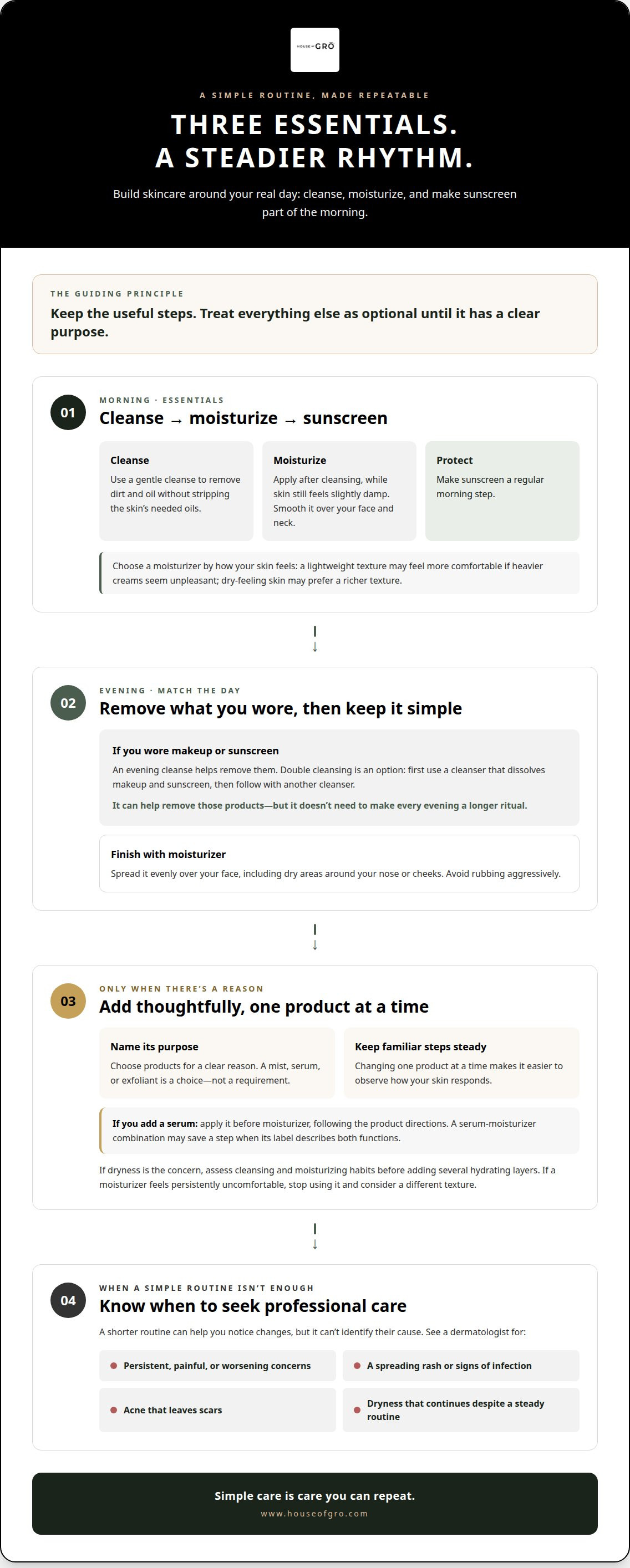
A simple routine can be enough: cleanse and moisturize, then apply sunscreen in the morning. Skincare for the lazy person works best when it’s easy to repeat, not another long list of tasks.
If elaborate routines leave you overwhelmed, you’re not alone in wanting a gentler approach. Learn how to keep the essentials manageable, choose a moisturizer that helps with dryness, and make sunscreen part of your morning. You can also add products thoughtfully and set realistic expectations for blemishes and fine lines. Fewer steps, a steadier rhythm, and more room for skincare to feel like a small act of care rather than a chore.
Key Takeaways
- Keep your routine easy to repeat: focus on gentle cleansing, moisturizing, and morning sunscreen rather than adding steps for their own sake.
- Choose a moisturizer that suits how your skin feels, and apply it as part of a simple, consistent routine.
- Look at ingredient claims with care. Add products for a clear purpose instead of expecting one ingredient to solve every concern.
- Make sunscreen a regular morning step and reapply it every 2-3 hours.
- Allow room for normal skin changes, including occasional blemishes and fine lines; a practical routine supports care without demanding perfection.
1. Benefits of a minimalist skin care routine
A minimalist routine is easier to remember and adjust. Skincare for the lazy person can start with a few purposeful steps instead of a crowded shelf. Simplicity also makes it easier to notice what suits you. If your cheeks feel tight after washing, for example, you can assess your cleanser and moisturizer without sorting through several new products.
Fewer steps can make a routine feel more manageable on busy mornings. A 12-step sequence may appeal to someone who enjoys a long ritual, but it can be hard to maintain when time is short. Choose products for a clear reason. If you can’t explain what a step contributes, leave it out for now and keep your routine focused.
For a basic routine, cleansing and moisturizing are useful foundations; add sunscreen in the morning. Other steps depend on what you wear and how your skin feels. The Centers for Disease Control and Prevention (CDC) advises washing your face with soap and clean, running water to remove dirt and oil. Treat extras such as a mist, serum, or exfoliant as choices, not requirements.
Consider your day when deciding how much cleansing to do. If you wore makeup or sunscreen, an evening cleanse helps remove them. Double cleansing means starting with a cleanser that dissolves makeup and sunscreen, then following with another cleanser. It can help remove those products, but it doesn’t need to turn every evening into a longer ritual.
See a dermatologist for persistent, painful, or worsening skin concerns rather than relying only on an at-home routine. A spreading rash, signs of infection, or acne that leaves scars also deserve professional attention. A shorter routine can help you notice changes, but it can’t identify their cause.
Changing one product at a time makes it easier to observe how your skin responds. Keep familiar steps steady, then introduce a new product only when it serves a specific purpose. For example, if dryness is your concern, assess your cleansing and moisturizing habits before adding several hydrating layers. This measured approach helps prevent a temporary concern from turning into an unnecessarily complex routine.
Think of skincare for the lazy person as a routine designed around your real day, not an ideal schedule. Place everyday products together, or keep morning essentials near the sink. If evenings are busy, make cleansing part of removing your makeup. A repeatable routine leaves room for the occasional missed step without making care feel like an all-or-nothing task.
One answer describes cleansing and moisturizing as the basic skincare routine for healthy skin, and recommends a gentle cleanser that removes dirt without stripping the skin's needed oils. The writer says 12-step skincare routines were popular a few years earlier.
A hydrating mist, a serum, and a moisturizer are suggested for the evening routine. The writer describes her nighttime routine as including four products, with micellar water listed as optional. This approach allows selected layers while keeping cleansing and moisturizing central.
2. Moisturizing for continuous hydration
Moisturizer helps prevent dry skin, making it a useful anchor in a pared-back routine. Apply it after cleansing, while your skin still feels slightly damp. That simple sequence gives you a clear moment to smooth it over your face and neck. If your cheeks feel tight after washing, notice whether a gentler cleanse or moisturizer changes that feeling. Skincare for the lazy person can begin with this easy-to-repeat comfort step.
Choose by how your skin feels, not by how many claims appear on the jar. A lightweight texture may feel comfortable if heavier creams seem unpleasant. Skin that feels dry may prefer a richer texture. Try a small amount on one area first, then notice whether it feels comfortable during your usual morning or evening routine. Keep the choice simple and consistent.
Moisturizing doesn’t require a complicated layering ritual. After cleansing, spread the product evenly over your face, including dry areas around your nose or cheeks. Avoid rubbing aggressively. If you use a separate serum, apply it before moisturizer, following the product directions. Moisturizer then remains an easy final step before morning sunscreen or bed.
A serum-moisturizer combination product can save a step when its label describes both functions. It may suit someone who wants a lighter routine and finds separate layers inconvenient. Read the directions and use the amount recommended on the package. If your skin still feels dry, the combination product may not provide the comfort you need. Adjust the moisturizer rather than adding several new products at once.
Keep face and body care distinct. The skin on your arms or legs may feel dry after bathing, so smooth a body moisturizer over those areas as you get dressed. For a serum step in body care, House of GRŌ® offers Touch Hydrating Body Serum. Use products according to their directions and keep the routine easy to repeat after a shower.
For evening facial care, a serum can be the single added step before moisturizer. AFTER DARK Restorative Night Serum can fit that place in a nighttime routine. It’s a practical choice for someone who wants to include a serum without turning the evening into a long sequence. Keep the rest of the routine familiar as you introduce it.
Notice how your skin responds over time. If a moisturizer leaves a persistent uncomfortable feeling, stop using it and choose a different texture. If dryness continues despite a steady routine, a dermatologist can help assess possible causes. That’s the appeal of skincare for the lazy person: a comfortable moisturizer and a simple habit can make care feel manageable.
3. Product ingredients and their advertised benefits
Ingredient lists can help you choose products with a clear purpose. Vitamin C is often used for brightening, while retinol is advertised to reduce fine lines. These claims describe common intended benefits, not a promise that every formula will work alike. For a streamlined routine, choose an ingredient based on one concern, then give that product a steady place in your routine before adding another.
A gentle cleanser is another useful choice. Look for one that removes dirt without stripping the skin’s needed oils. If washing leaves your face feeling tight, reconsider the cleanser before adding a corrective serum. For example, keep your cleanser and moisturizer unchanged while introducing one new product. That makes it easier to notice whether the new step feels comfortable.
For sensitive or acne-prone skin, choose simple products and introduce them one at a time. A gentle cleanser and a moisturizer suited to how your skin feels can form a restrained starting point. Follow each label’s directions and observe how your skin responds before adding another new formula. If a product causes persistent discomfort, stop using it instead of adding more products to counter it.
What is the best all-in-one moisturizer with SPF for daily use? Choose a moisturizer with broad-spectrum sunscreen protection that feels comfortable enough for your morning routine. A hydrating sunscreen can combine two useful steps, so choose one that feels comfortable in your morning routine.
Keep ingredient claims in perspective. A vitamin C product may be marketed for a brighter-looking complexion; retinol may be promoted for fine lines. Neither claim means you need both ingredients. Pick the one that aligns with your priority. Follow package directions and avoid adding several targeted products at once. If your goal is a calmer, simpler routine, one purposeful formula is easier to maintain than a shelf of overlapping claims.
Budget-conscious choices start with using what already serves a purpose. Before buying another serum, check whether your cleanser, moisturizer, and sunscreen cover your everyday needs. Compare product labels for their intended use rather than paying for several products with similar advertised benefits. A basic cleanser that removes dirt, a moisturizer that helps prevent dryness, and morning sunscreen can keep your routine focused.
To make a considered choice, write down one concern, such as dryness or uneven-looking tone. Match it to one product category, then follow the label consistently. For example, choose a moisturizer for dryness or a vitamin C product when brightening is your aim. Keep the rest of your routine stable as you assess the new step. This simple method makes ingredient choices more deliberate and helps prevent impulse additions.
One answer recommends exfoliating at most twice a week, while another recommends drinking 8 to 10 glasses of water every day. These are general suggestions to consider alongside product directions and your own comfort. Keep choices focused: an ingredient’s advertised benefit can guide selection, but the routine should remain manageable and should not depend on adding several products at once.
4. Daily sunscreen protection
Make sunscreen the final anchor of your morning routine. Apply it after cleansing and moisturizing, following the product label. Broad-spectrum sunscreen is recommended for daily use, and a hydrating formula may feel comfortable if you prefer fewer separate products. The simpler the step feels, the easier it is to remember before leaving home.
Reapplication matters, too. Broad-spectrum sunscreen should be reapplied every 2-3 hours. Build that interval into the day with a familiar cue, such as a lunch break or time outdoors. If you spend the morning at a desk, keep sunscreen somewhere visible before leaving for an afternoon walk. A routine cue can make reapplication less likely to slip your mind.
Sunscreen offers important protection and anti-aging benefits. Skipping it means missing that protective step, even if the rest of your routine feels complete. Think of it as a daily essential, not an occasional extra. A moisturizer with sunscreen can shorten the morning sequence, while separate products may suit someone who prefers to choose moisturizer and sun protection independently.
What are the risks of skipping sunscreen or sleeping with makeup on? Skipping sunscreen means missing its protective and anti-aging benefits. Sleeping in makeup leaves it on your skin instead of cleansing it away; cleansing removes dirt and helps clear clogged pores.
Make makeup removal easy at night. If you wore makeup or sunscreen, cleanse before bed rather than carrying the day’s residue into your sleep routine. For example, place your cleanser beside the sink or where you remove makeup. If one cleanse doesn’t remove makeup or sunscreen, double cleansing starts with a cleanser that dissolves them, followed by a second cleanser.
When choosing sunscreen, consider how it feels and where it fits in your routine. A hydrating sunscreen may be convenient if you want moisture and sun protection in one step. If its texture makes you avoid applying it, a separate moisturizer and sunscreen may be easier to use. Follow the label and keep the morning sequence clear: cleanse, moisturize if needed, then apply sunscreen.
Connect the habit to an existing morning action. For example, apply sunscreen after brushing your teeth and keep it near your daily essentials. For reapplication, pair broad-spectrum sunscreen with a midday pause. These small cues make protection a repeatable practice, not another elaborate skincare task. A steady morning step and regular reapplication help keep your routine practical through changing days.
5. Accepting occasional blemishes and fine lines
Healthy skin doesn’t have to look perfectly smooth every day. A woman over 30 may notice fine lines and dark circles, alongside occasional blemishes. Those details can exist even when someone cares for their skin consistently. A simple routine is a practice, not a promise of flawless-looking skin. Let it support comfort and care without turning each spot or line into a reason to add another product.
Try changing the goal from eliminating every mark to caring for your skin steadily. Keep the cleanser and moisturizer that feel comfortable, and follow your morning sunscreen step. Avoid adding multiple products after noticing one blemish. This keeps your routine easier to follow and helps you see whether a particular change in your skin continues.
A mirror can make small details feel more prominent, especially under bright bathroom lighting. Instead of inspecting your face repeatedly, choose an ordinary moment, such as evening cleansing, to notice how your skin feels. Is it comfortable after washing? Does a dry area need moisturizer? These practical observations offer more useful guidance than judging every pore.
Fine lines aren’t a reason to abandon a minimalist routine or chase every advertised ingredient. Retinol is promoted for reducing fine lines, but adding it isn’t compulsory. Consider whether a product matches your priorities and whether you can use it as directed. Keep other steps familiar while introducing a change, so your routine stays manageable rather than becoming a response to every new concern.
Occasional blemishes also don’t mean your entire routine has failed. Resist the urge to scrub harder or stack several products on one spot. Continue your usual gentle cleansing and moisturizing steps instead. If a new product seems connected to discomfort, stop using it and return to the routine you previously found comfortable. One visible blemish doesn’t require a complete shelf reset.
Set expectations around consistency, not perfection. A practical routine can support daily care, but skin naturally has texture and visible features. On a morning when a blemish catches your attention, apply sunscreen as usual and move on with your day. In the evening, cleanse and moisturize without turning the moment into a long corrective ritual.
If a quieter, intentional approach feels right, explore a thoughtful skincare ritual. Keep the focus on steps that feel useful and repeatable. A routine can be both simple and meaningful, even when fine lines or an occasional blemish remain. Your skin doesn’t need to meet an impossible standard for your care to matter.
House of GRŌ®: AT DAWN Rejuvenating Daytime Oil
At Dawn Rejuvenating Daytime Oil offers a considered addition to a simple morning ritual. House of GRŌ® makes it for people who want to include a daytime oil without building a long sequence of steps. Use it according to its directions, and keep sunscreen as a separate part of morning protection. An oil isn’t a replacement for sunscreen.
The formula reflects House of GRŌ®’s focus on adaptogenic mushrooms and organic botanicals, including wild-harvested Chaga from Northern Maine. The brand describes its formulas as microbiome-friendly, all-natural, and cruelty-free. Keep your routine centered on the essentials, then choose an additional step because it suits your preferences, not because you feel you need to correct every line or blemish.
For a closer look at AT DAWN Rejuvenating Daytime Oil, visit www.houseofgro.com.
Let your routine grow at your own pace
A skincare routine doesn’t need to become a project. Let skincare for the lazy person mean choosing a rhythm that fits your actual mornings and evenings, then giving yourself permission to keep it simple. If your needs change, adjust one step at a time. Your routine can be thoughtful without demanding constant attention.
For a quiet next step, explore what feels aligned with your personal approach to care. House of GRŌ® offers a considered range of skincare products for daily rituals. Choose a product that feels right for your routine, without turning it into a long checklist.
Contact House of GRŌ® to continue exploring. Keep your care gentle, realistic, and entirely your own.
Frequently Asked Questions
What is the simplest effective daily skincare routine for beginners?
Begin with a cleanser, moisturizer, and morning sunscreen, then keep the same sequence for several days. In the evening, cleanse away the day and moisturize if your skin feels dry. Keep products together near the sink so the routine is easy to remember. If you want to add an active ingredient later, introduce it on its own rather than changing several steps at once.
Can you use a cleanser, moisturizer, and sunscreen in one simple routine?
Yes. Use cleanser first, moisturizer next, and sunscreen as the final morning step. Think of them as three separate jobs, not necessarily one combination product: cleansing prepares your skin, moisturizer helps with dryness, and sunscreen provides daytime protection. If a moisturizer already includes sunscreen, follow its directions and consider whether its texture feels comfortable enough for regular use.
Is it better to use a morning routine, an evening routine, or both?
Both can serve different purposes, but a shorter routine you can maintain is more practical than an elaborate schedule you often skip. Make sunscreen a morning step. Use evenings to cleanse away makeup or sunscreen and leave your skin comfortable before bed. On especially busy days, prioritize the step that fits the moment instead of treating a missed product as a reason to abandon your routine.