


What if mushroom skincare is less about a miracle ingredient and more about the formula around it? If you’ve seen Reishi, Chaga, or Tremella on a label, you may wonder what are functional mushrooms in skincare and whether the claims apply to a cream or serum. The terminology can sound scientific, while claims about supplements and topical products are sometimes blended together. They aren’t interchangeable. A mushroom extract applied to skin has a different role from a mushroom taken orally, and neither guarantees a particular result.
Functional mushrooms are non-psychoactive mushroom ingredients used in cosmetic formulas. Some are studied for properties that may be relevant to skin, such as hydration or antioxidant activity, but evidence varies by mushroom, extract, and finished product. The ingredient name alone can’t tell you what a formula will do. This guide covers common mushrooms in skincare, distinguishes plausible topical benefits from claims that need stronger evidence, and offers a practical way to assess ingredient lists and introduce a product. The goal is informed curiosity, not another promise to chase.
Key Takeaways
- Understand what are functional mushrooms in skincare and why the term describes an ingredient category, not a promised result.
- Compare Chaga, Reishi, and Tremella without assuming they work alike or have the same level of topical evidence.
- Assess the full formula, your skin priorities, and your existing routine before choosing a product, then introduce it gradually.
- Explore House of GRŌ® as one mushroom-led skincare approach. The brand highlights wild-harvested Chaga from Northern Maine.
What are functional mushrooms in skincare, and why are they used?
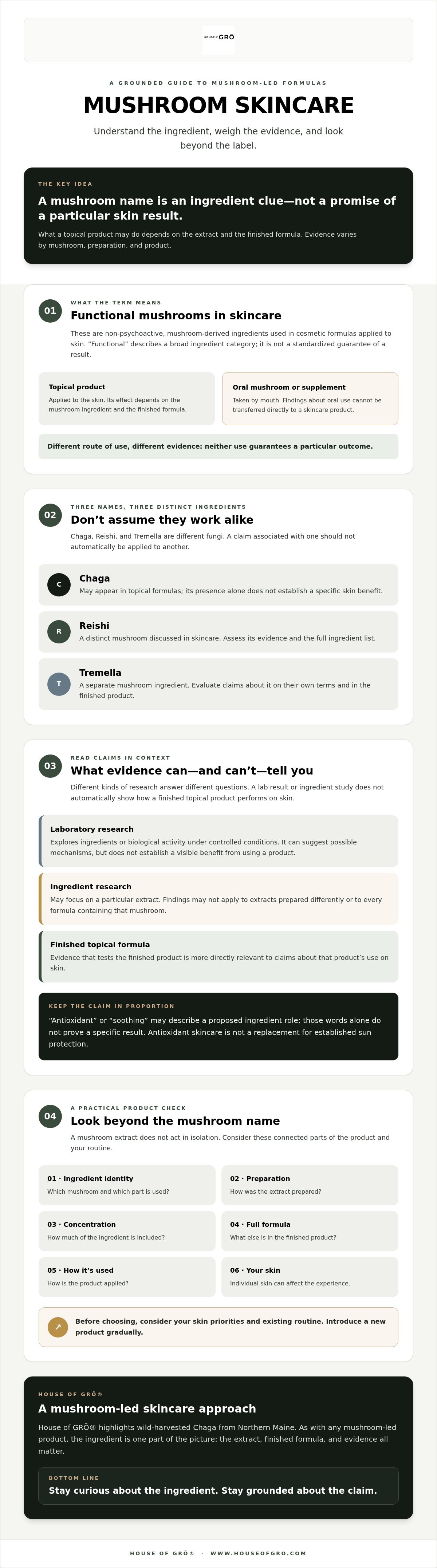
In skincare, functional mushrooms are mushroom-derived ingredients included in topical formulas for cosmetic purposes. “Functional” is a broad category, not a standardized promise that an ingredient will produce a particular result. It also doesn’t mean a product works like a mushroom eaten as food or taken as a supplement. A topical oil or serum is applied to the skin, and its effect depends on both the ingredient and the finished formula.
Functional mushrooms in skincare are fungi-derived ingredients used in products applied to the skin. Their value depends on the extract and the formula, not the label alone. The long history of human interest in fungi provides context for the category. Medicinal fungi offers a broad overview. Historical use, however, isn’t proof that a particular cosmetic product delivers a specific outcome.
What makes a mushroom ingredient functional in a skincare formula?
The term generally refers to selected fungi valued for their naturally occurring compounds. In cosmetics, an extract or another mushroom-derived ingredient may be added to a product such as an oil or serum. The ingredient’s identity is only one part of the picture. Its preparation, concentration, the rest of the formula, and how the product is used all matter. A mushroom name on a label alone doesn’t establish effectiveness.
This distinction helps keep expectations grounded. Research on an isolated compound or ingredient doesn’t automatically show how a finished topical product performs on skin. Findings about eating mushrooms or taking supplements can’t be transferred directly to a skincare formula either. Each use has a different route of exposure and needs relevant evidence.
Which mushrooms commonly appear in skincare discussions?
Chaga, Reishi, and Tremella are often mentioned in mushroom skincare conversations. They’re different fungi, not interchangeable versions of one active ingredient. The extract and the way it’s used in a formula matter, so don’t assume a claim associated with one mushroom applies to another.
- Chaga: A mushroom-derived ingredient that may appear in topical formulas. Its presence alone doesn’t establish a specific skin benefit.
- Reishi: Another distinct mushroom used in skincare discussions. Assess the full ingredient list and evidence, not just the familiar name.
- Tremella: A separate mushroom ingredient. Evaluate claims about it on their own terms and in the context of the finished product.
For a closer look at one ingredient, see our article on Chaga benefits. Use it as ingredient context, not as a guarantee about every product containing Chaga.
How might mushroom ingredients interact with skin?
A mushroom extract doesn’t act in isolation. Its effects in a finished product may depend on the mushroom and part used, how the extract is prepared, its concentration, the full formula, how it’s applied, and an individual’s skin. A result seen with one extract or product can’t automatically be expected from another.
Research on a mushroom taken as a supplement can’t, on its own, prove that applying the mushroom to skin will produce the same effect. The route of use is different. Topical claims need evidence relevant to topical use, ideally testing the finished formula rather than relying only on research about an ingredient in a lab.
What do antioxidants and mushroom compounds mean for skin?
Antioxidants are substances that can help counter certain reactive molecules in specific conditions. That doesn’t mean an antioxidant skincare ingredient protects skin from every source of stress or replaces established sun protection. Mushrooms contain varied compounds, and their composition can differ by species, the part used, and extraction method. “Mushroom extract” isn’t one uniform ingredient with one predictable effect.
Words such as antioxidant and soothing may describe a proposed ingredient role, but they don’t prove a particular result. Look for substantiation that matches the product and the claim. A lab finding about a compound, for example, can suggest a research direction without showing that a finished serum will have the same effect on skin.
What does the evidence say about topical mushroom skincare?
Evidence can come from different levels of research, and each answers a different question:
- Laboratory research examines ingredients or biological activity under controlled conditions. It can help explore possible mechanisms, but doesn’t establish a visible benefit from using a product.
- Ingredient research may focus on a particular extract. Its findings may not apply to extracts made differently or used at another concentration.
- Finished-product trials test a topical formula on people. These are more directly relevant to product use, though results still apply to the formula and conditions studied.
For claims about hydration, visible signs of aging, or soothing, look for human evidence from topical use and a formula comparable to the one being discussed. If evidence is limited, indirect, or unavailable, the claim should remain tentative. If you’re exploring mushroom-led formulas, House of GRŌ®'s skincare range offers product details and ingredient information to review alongside the evidence available.
Chaga, Reishi, and other mushrooms: how do skincare ingredients differ?
Mushroom names can make a label feel specific, but they don’t tell the whole story. Chaga, Reishi, and Tremella are distinct fungi, and extracts from them shouldn’t be treated as interchangeable. Preparation matters too: the part used and extraction method can affect what ends up in a formula. So can the concentration and the product’s other ingredients.
An ingredient’s presence on a label doesn’t prove the effect of the finished product. Keep this in mind when considering what are functional mushrooms in skincare. Match a claim to evidence for the particular extract and, where available, the formula itself.
| Mushroom | Common skincare context | Evidence caveat |
|---|---|---|
| Chaga | Appears in some topical formulas. Brands may highlight its sourcing or antioxidant profile. | A general ingredient description doesn’t establish a skin outcome. Check the specific extract and product evidence. |
| Reishi | Discussed as a mushroom-derived ingredient in skincare formulations. | Evidence about one preparation can’t automatically be applied to another preparation or a finished formula. |
| Tremella | Appears in some skincare ingredient discussions and formulas. | Assess claims in context. The mushroom name alone doesn’t demonstrate performance. |
How should readers think about Chaga in topical skincare?
Chaga is used in some skincare formulas, but claims about what it may do should be checked against reliable, product-relevant evidence. House of GRŌ® identifies wild-harvested Chaga from Northern Maine as part of its brand story. That’s a sourcing statement, not proof of a particular skin result. For more ingredient background, see our article on Chaga benefits. Information about oral use shouldn’t be taken as evidence for topical effects.
Are Reishi, Tremella, and other mushroom extracts interchangeable?
No. Different mushrooms have different compositions, and extracts can vary according to how they’re made. Don’t assume a benefit discussed for one mushroom applies to another. Instead, consider the complete ingredient list and the formula’s stated purpose. Look for clear, substantiated claims about the finished topical product, and treat broad promises cautiously.
How to choose functional mushroom skincare and introduce it carefully
A thoughtful choice starts with your skin, not the trend. Decide what you want a product to fit into, then assess the full formula and whether its claims are clear and relevant. If you’re asking what are functional mushrooms in skincare worth choosing, the mushroom name is only one detail. Your existing routine, the product’s purpose, and your skin’s response matter too.
- Start with your skin priorities. Decide what you want from a product and which format suits your routine.
- Read the complete ingredient list. Look beyond the headline mushroom to understand the rest of the formula.
- Check the claims. Look for product information that explains the ingredient and supports the stated purpose. Treat vague promises or unclear sourcing statements as reasons to ask more questions.
- Introduce it gradually. Add one new product at a time, so it’s easier to notice how your skin responds.
What should you check on a mushroom skincare label?
Look for the named mushroom-derived ingredient in the ingredient list. Its position may offer some context, but don’t use that alone to infer its concentration or performance. Check the format, such as an oil or serum, and the intended routine step. Marketing phrases aren’t a substitute for clear information about the formula, ingredient sourcing, or evidence behind a claim.
Consider the product as a whole. A formula may contain several ingredients, and the mushroom extract is only one part of it. For a broader routine perspective, explore our guides to microbiome skincare and skincare for sensitive skin. These topics can help you consider skin compatibility and routine fit without treating a single ingredient as the deciding factor.
How can you add a new formula to your routine?
Follow the product directions and introduce one new formula at a time. Before applying it as directed, consider a patch test on a small area of skin, following reputable dermatology guidance. This can help you notice a reaction, but it can’t guarantee that irritation won’t occur later or elsewhere. Keep your routine steady while you observe your skin, rather than adding several new products at once.
If irritation develops, stop using the product. Seek professional advice if a reaction is severe or doesn’t settle. A measured approach helps you judge a formula through your own experience rather than the promise of one ingredient.
To explore a mushroom-led skincare approach, discover House of GRŌ® skincare and review product details as part of your selection process.
How House of GRŌ® brings functional mushrooms into a skincare ritual
Ingredient evidence and formula fit come first. With those in mind, House of GRŌ® offers one example of a mushroom-led skincare philosophy. Founded in New York in 2020 by siblings Irina Gottesman and Sam Kandhorov, the luxury brand uses adaptogenic mushrooms and organic botanicals, with microbiome-friendly formulas.
The brand highlights wild-harvested Chaga from Northern Maine. This is a brand-specific sourcing statement, not a guarantee of a particular skin outcome. Mushroom ingredients can vary, and a brand’s broader philosophy doesn’t tell you which extracts are in each formula. Check current product ingredient lists and claims before choosing.
Where does the brand’s mushroom-led approach fit?
House of GRŌ® brings together mushrooms and botanicals within a considered skincare approach. Its microbiome-friendly positioning reflects a formulation philosophy, not proof of a guaranteed clinical result. For more background on the broader concept, explore our guide to microbiome skincare. As with any product, the full formula and evidence behind specific claims matter more than a single label term.
How can a skincare oil or serum become a considered daily ritual?
A ritual can be simple: choose a product that suits your routine, read its directions, and use it as intended. AT DAWN Rejuvenating Daytime Oil is one product in the brand’s range. AFTER DARK Restorative Night Serum offers a separate nighttime option, not a required pairing. Check each product’s current ingredient list rather than assuming it contains Chaga or another mushroom.
If the ingredients, format, and intended use feel aligned with your needs, a new product can become a quiet moment of care in your day. Keep expectations measured and pay attention to how your skin responds. To learn more, explore House of GRŌ® skincare and products.
Choose your next skincare step with care
So, what are functional mushrooms in skincare? They’re mushroom-derived ingredients used in topical formulas, not a promise of a particular result. Chaga, Reishi, and Tremella are distinct ingredients, and evidence for a mushroom or extract doesn’t automatically prove how a finished product will perform. Look beyond the headline ingredient: consider the full formula, the product’s purpose, and how it fits your routine. Introduce new skincare thoughtfully and pay attention to your skin’s response.
House of GRŌ® offers one example of a mushroom-led approach. Founded by siblings Irina Gottesman and Sam Kandhorov, the brand identifies wild-harvested Chaga from Northern Maine as a key antioxidant ingredient. Its range includes a daytime oil, a night serum, a body serum, and a brightening oil. Review current product details and ingredient lists rather than assuming every formula contains Chaga or expecting a guaranteed outcome.
If this considered approach feels aligned with your routine, explore House of GRŌ®’s skincare rituals. Review the product details and choose the formula that fits your routine.
Frequently Asked Questions
What are functional mushrooms in skincare?
Functional mushrooms in skincare are mushroom-derived ingredients used in topical products, such as oils or serums. “Functional” is a broad category label, not a standardized promise that an ingredient will deliver a specific result. Effectiveness depends on the extract, complete formula, how it’s used, and individual skin. It doesn’t mean the product works like eating mushrooms or taking a supplement.
Which mushrooms are commonly used in skincare?
Chaga, Reishi, and Tremella are among the mushrooms often discussed in skincare. They’re distinct ingredients, not interchangeable versions of one active. Extracts can also differ according to how they’re prepared and which mushroom material is used. A familiar mushroom name on a label doesn’t establish a particular benefit. Consider the product’s ingredient list, stated purpose, and evidence for its specific formula.
Can functional mushrooms help with skin?
Some mushroom-derived compounds are being studied for properties that may be relevant to skin, but that doesn’t prove every mushroom product will provide a visible benefit. Laboratory findings or research on an isolated ingredient aren’t the same as human trials of a finished topical formula. Look for evidence that matches the product and its claims. Results may also depend on the extract, concentration, full formula, application, and your individual skin.
Are mushroom supplements and mushroom skincare the same?
No. Supplements are taken orally, while skincare products are applied to the skin. Because the routes differ, evidence for eating a mushroom or taking its extract can’t automatically establish what a topical product does. Preparation and formula matter too. For skincare, look for information and research relevant to topical use, ideally involving the finished product. Don’t treat a supplement claim as proof that a serum or oil will have the same effect.
Are functional mushroom skincare products safe for sensitive skin?
Not necessarily. A mushroom ingredient doesn’t guarantee that a finished formula will suit sensitive skin; other ingredients and individual sensitivities matter. Review the full ingredient list and follow the product directions. A cautious patch test may help you notice a reaction, but it can’t guarantee that irritation won’t happen. If irritation occurs, stop use. For persistent or severe reactions, seek advice from a qualified health professional.
How do I choose a functional mushroom skincare product?
Start with your skin priorities and the product format that fits your routine. Check the full ingredient list for the named mushroom and review the product’s intended use and claims. Don’t infer concentration or effectiveness from a headline ingredient or marketing language alone. Consider the formula alongside products you already use. Introduce one new product at a time, follow directions, and observe how your skin responds before making other routine changes.
Does Chaga in skincare have proven benefits?
Chaga appears in some skincare formulas, but its presence alone doesn’t prove that a finished product delivers a particular skin benefit. Evidence should relate to topical use and, ideally, the specific formula and claim. Ingredient-level or oral-use research isn’t automatically proof of a topical result. Check product-specific information and treat broad promises cautiously. A brand’s sourcing statement, such as wild-harvested Chaga from Northern Maine, describes sourcing, not guaranteed skin performance.