


A skincare routine can support your skin, but it can’t remove pollution from the air. That distinction matters when product claims sound bigger than the evidence or a long list of steps feels difficult to maintain. A thoughtful anti-pollution skincare routine isn’t about building an invisible shield. It’s about caring for skin consistently, with clear priorities.
Cleansing and barrier support are practical places to start. The challenge is knowing what skincare can realistically do and which claims deserve a closer look. This guide separates everyday care from overpromising, then shows how to shape a manageable routine around cleansing, hydration, and intentional product choices.
We’ll look at everyday environmental exposure, what a routine can and can’t address, and how to keep your steps proportionate. If a daytime oil fits your ritual, HOUSE OF GRŌ’s At Dawn - Rejuvenating Daytime Oil is one option to consider as part of your routine, not as a pollution shield. Calm care starts with clear expectations.
Key Takeaways
- An anti-pollution skincare routine can support everyday skin care, but it can’t block all exposure or clean the air around you.
- Environmental particles may interact with the skin barrier, but visible changes are not a diagnosis or proof of pollution exposure.
- Prioritize practical basics, including cleansing, hydration, barrier care, and daytime sun protection. Consider optional additions only if they suit your needs.
- Build a simple morning and evening routine around steps and products you find comfortable enough to maintain.
- At Dawn - Rejuvenating Daytime Oil is a daytime ritual option, not a pollution shield.
What an Anti-Pollution Skincare Routine Can, and Cannot, Do
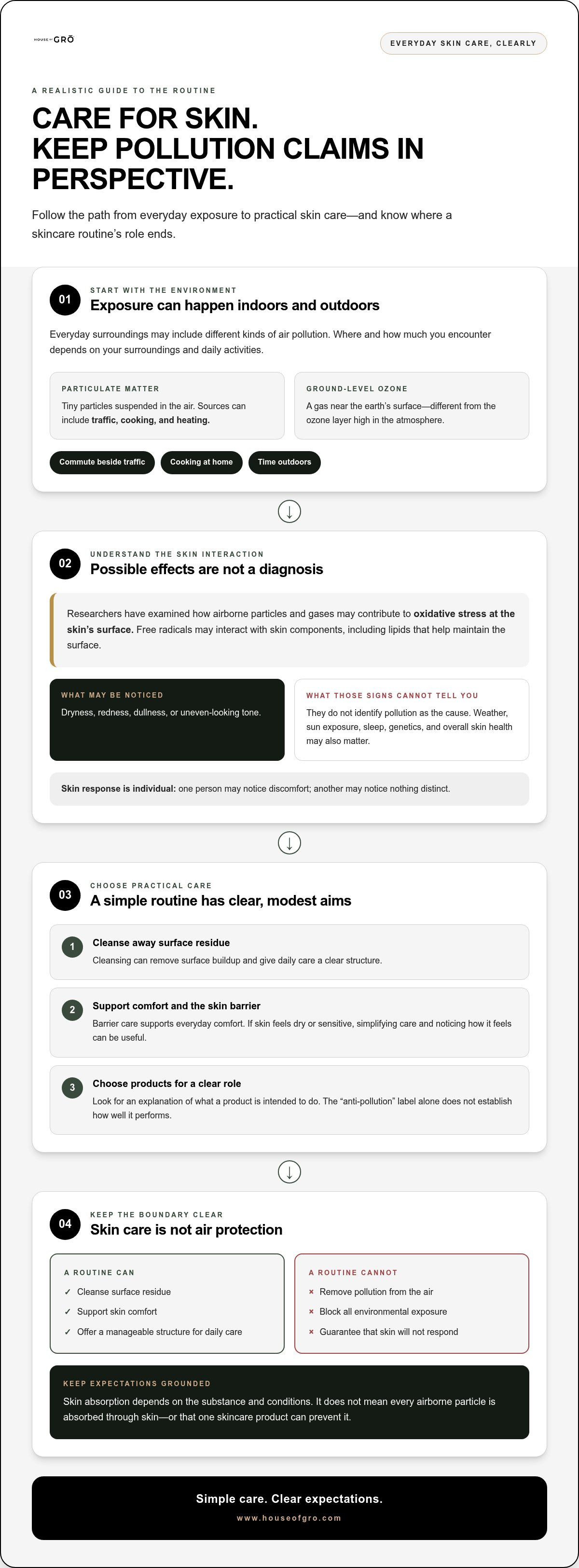
Pollution can be difficult to avoid, whether you’re commuting beside traffic, cooking at home, or spending time somewhere with poorer air quality. Skincare claims can be harder to sort through. Some suggest a product can form a complete shield; others use broad language without explaining what the routine is meant to do. Start by separating everyday skin care from promises about controlling environmental exposure.
An anti-pollution skincare routine is everyday care that cleanses the skin and supports its comfort, not a shield that blocks all exposure. It can help remove surface buildup and give your routine a clear structure. It can’t remove pollution from the air or guarantee that your skin won’t respond to environmental conditions.
Pollution is only one possible influence on how skin looks and feels. Weather, sun exposure, personal care habits, and individual skin sensitivity may matter too. Dryness, redness, or uneven tone doesn’t identify a cause on its own. Avoid treating every concern as evidence of pollution or as a reason to add more products.
Which everyday exposures are commonly discussed?
Particulate matter refers to tiny particles suspended in the air. Depending on their size and composition, they can come from sources such as traffic, cooking, and heating. Ground-level ozone is a gas near the earth’s surface, different from the ozone layer high in the atmosphere. Exposure isn’t limited to city streets. Indoor and outdoor conditions vary, and your exposure depends on your surroundings and daily activities.
Skin is a barrier, but that fact shouldn’t become a sweeping claim about pollutants entering the body. The general concept of skin absorption describes how certain substances may pass through skin. Whether and how much depends on the substance and conditions. It doesn’t mean every airborne particle is absorbed through skin, or that one skincare product can prevent this.
What does “anti-pollution” mean in a skincare routine?
In practical terms, the phrase can describe a routine with simple aims: cleanse away surface residue, keep skin comfortable, and choose care that suits your needs. The label itself doesn’t establish how well a product performs. Look for a clear explanation of a product’s intended role rather than assuming “anti-pollution” means proven protection from every environmental exposure.
Keep expectations grounded. Cleansing is not air filtration, and skincare cannot make surrounding pollution disappear. A product shouldn’t be treated as a way to detoxify skin, prevent all pollution-related effects, or guarantee visible results. A useful anti-pollution skincare routine is modest by design: it supports daily care, while environmental protection comes from measures that address the environment itself.
How Pollution May Interact with the Skin Barrier
Environmental exposure is one part of a much larger picture. Researchers have examined how airborne particles and gases may contribute to oxidative stress at the skin’s surface. That process can involve free radicals, unstable molecules that react with nearby structures. The relationship is complex. Exposure doesn’t mean everyone will see a change, and a visible concern can’t identify its cause on its own.
Free radicals and environmental exposure, explained simply
Free radicals are reactive molecules produced through normal body processes and in response to some environmental stressors. In excess, they may interact with components of skin, including lipids that help maintain its surface. Antioxidants can help neutralize free radicals in biological systems, but this general mechanism doesn’t prove that a particular skincare product prevents pollution-related effects. Individual exposure, skin condition, and other influences all matter.
Dryness, redness, dullness, or uneven-looking tone are not a pollution checklist. Similar changes can have many explanations, including weather, sun exposure, sleep, genetics, and a person’s overall skin health. Skin response is individual, even when air quality varies between a commute, a kitchen, and time spent outdoors. One person may notice discomfort; another may notice nothing distinct.
Why skin-barrier support belongs in the conversation
The skin barrier is the outer layer that helps limit water loss and supports the skin’s surface. Maintaining the skin barrier is a practical focus because it supports everyday comfort, whatever the source of a concern. Dryness or sensitivity may be a reason to simplify care and pay attention to how your skin feels, but neither symptom proves pollution damage.
Think of barrier care as steady, not corrective. A comfortable routine without unnecessary complexity can be easier to maintain than one built around reacting to every environmental headline. It also leaves room to consider the skin’s wider ecosystem. For more on that perspective, explore this guide to microbiome skincare.
Notice patterns without rushing to conclusions. Does your skin feel different after a change in weather, a new product, or a disrupted sleep schedule? These observations can guide small, thoughtful adjustments, but they aren’t a diagnosis. If a concern is persistent or troubling, a qualified healthcare professional can help assess it rather than relying on a skincare label to explain it.
An anti-pollution skincare routine can include barrier support without treating pollution as the sole cause of skin changes. The aim is balance: respond to your skin’s actual needs, keep expectations measured, and choose products with clear, relevant information. If you’re exploring a more intentional approach to daily skincare, HOUSE OF GRŌ’s skincare rituals offer a place to continue that consideration.
Which Anti-Pollution Skincare Steps Matter Most?
A useful routine doesn’t need a separate product for every environmental concern. Start by deciding what each step is for. Cleansing and comfortable hydration are practical foundations. Other steps may suit your preferences, but they aren’t requirements for everyone. Sun protection has a distinct role: it addresses ultraviolet (UV) exposure, not airborne particles.
| Step | Purpose | Role |
|---|---|---|
| Gentle cleansing | Remove everyday surface buildup | Foundational |
| Hydration and barrier care | Support comfort and the skin’s surface | Foundational, as needed |
| Antioxidants | An optional addition often discussed for morning care | Optional |
| Sun protection | Address UV exposure | Daytime fundamental |
| Exfoliation | Loosen or remove surface buildup | Optional |
Core habits versus optional routine additions
Keep the core simple. Choose cleansing that leaves your skin comfortable, then use hydration or barrier-supporting care that fits how your skin feels. There’s no need to cleanse more often simply because pollution is part of daily life. Aim for a routine you can maintain without leaving skin feeling stripped or overloaded.
Antioxidants are often discussed as an optional morning step because some can help neutralize free radicals in biological systems. That general idea isn’t proof that a specific formula prevents pollution-related effects. If you’re considering an antioxidant product, look at its stated purpose and evidence rather than relying on an “anti-pollution” label alone. Exfoliation is optional too. It isn’t a required pollution-removal step, and this guide doesn’t call for a particular frequency or product protocol.
Keep sun protection in its own category. Use daily sun protection appropriate to your needs and follow its directions. It helps address UV exposure; it doesn’t filter particles from the air or replace cleansing.
How to keep the routine proportionate
Before adding anything, review what you already use. Does cleansing feel comfortable? Is your skin adequately hydrated? Are you using daytime sun protection? If those basics are in place, another product may not add meaningful value to your routine. Comfort and consistency matter more than collecting products marketed around pollution.
If your skin is easily unsettled, a gentler, less-is-more approach may feel more suitable. This related guide to skincare for sensitive skin offers another perspective on keeping care considered.
An anti-pollution skincare routine can be a framework, not a checklist. Let your existing needs guide what stays. If you’re considering a more intentional daytime ritual, HOUSE OF GRŌ skincare offers a way to explore your product choices.
How to Build a Simple Morning and Evening Routine
A routine works best when it fits the rhythm of your day and the products your skin already tolerates. You don’t need a separate set of steps for every possible exposure. Think of morning care as preparation for the day and evening care as a gentle reset. Adjust the framework below to your preferences rather than treating it as a fixed prescription.
A calm morning sequence
Keep the morning focused on comfort and daily sun protection. Cleanse only if it feels useful for your skin; some mornings, a gentler start may suit you better. Follow with hydration using a familiar product that leaves skin comfortable. Finish with sun protection appropriate to your needs. This step addresses UV exposure, not airborne particles.
An evening reset after the day
In the evening, cleansing is a practical way to remove surface buildup from the day. Follow with skincare you already know feels comfortable. There’s no need to add multiple new steps simply because you’ve been outdoors or commuting. For a broader perspective on creating a restorative evening ritual, this guide to a restorative night skin care regimen offers related inspiration.
A steady routine of cleansing, comfortable hydration, and daily sun protection supports everyday care, but it can’t make skin pollution-proof.
- Morning: cleanse as needed. Consider how your skin feels when you wake. Use your usual cleanser if it helps you feel fresh, and avoid adding extra cleansing just to pursue a sense of protection.
- Morning: hydrate. Apply the hydration step that already suits your routine. Keep it simple. A comfortable, familiar choice is more useful than layering products you don’t need.
- Morning: apply sun protection. Make this part of daytime care, following the product’s directions. It serves a different purpose from cleansing and doesn’t screen out pollution particles.
- Evening: cleanse away the day. Use your established cleansing step to lift surface buildup. The aim is a clean-feeling finish, not an aggressive attempt to scrub skin.
- Evening: return to familiar care. Continue with products that fit your preferences and leave your skin comfortable. Optional categories, such as antioxidants, don’t need to become universal steps.
Let comfort guide any adjustments. If a change leaves skin feeling less settled, simplify and return to what has worked for you. A manageable anti-pollution skincare routine comes from repeatable habits, not a growing shelf of products. For a considered daytime skincare option, explore HOUSE OF GRŌ skincare as you shape a ritual that feels personal and intentional.
Make Your Anti-Pollution Skincare Routine an Intentional Daytime Ritual
Skincare can support everyday cleansing and comfort. It can’t remove pollution from the air, block every exposure, or guarantee that skin won’t change in response to its surroundings. With those limits in view, choosing a daytime product becomes less about seeking a shield and more about finding care that feels considered and suited to your preferences.
A daytime oil within a considered routine
At Dawn - Rejuvenating Daytime Oil is HOUSE OF GRŌ’s daytime oil. It may suit a personal morning ritual alongside the other steps that work for you. At Dawn is listed at $160.00 and has a rating of 4.9/5 from 84 reviews. It isn’t a pollution barrier, and no pollution-protection outcome should be expected from it. A product can have a place in a routine without being asked to do more than its stated role.
Reviews can be one part of a product decision, but a rating isn’t a promise of a particular result. Consider your preferences and existing routine, and whether the product feels like a suitable addition. A thoughtful choice doesn’t need to be a complicated one.
A family wellness heritage, carried into modern skincare
HOUSE OF GRŌ® is rooted in three generations of family wellness practices. Founded by siblings Irina Gottesman and Sam Kandhorov, the brand carries that heritage into a modern approach to skincare. Chaga mushrooms, hand-harvested from Maine birch trees, appear in several formulas. This is part of the brand’s ingredient story, not a reason to assume a specific pollution-related effect.
If you’re curious about the background of Chaga, the guide to Chaga benefits offers a related read. Keep ingredient exploration grounded: an ingredient’s broader story doesn’t establish what a particular product will do for your skin.
Let the ritual stay simple. Begin with the care that already feels right, then consider whether a daytime oil belongs in that rhythm. There’s no need to build a routine around fear of exposure or promises of perfect skin. A small, intentional moment in the morning can be worthwhile on its own, without being framed as protection from the environment.
Explore HOUSE OF GRŌ® to discover a considered approach to daily skincare and choose with calm attention to what fits your routine.
Choose a Ritual You Can Return To
Let your next step be small. Rather than redesigning your shelf, notice which part of your current routine feels most useful and give it room to become a steady habit. A calm anti-pollution skincare routine isn’t a test of how many products you can layer. It’s a personal practice shaped by comfort, consistency, and thoughtful choices.
If you’re considering a daytime oil, look for one that fits the ritual you want to create. HOUSE OF GRŌ® brings a family wellness heritage into modern skincare, with Chaga hand-harvested from Maine birch trees appearing in several formulas. Let that story inform your curiosity while choosing based on what feels right for your own routine.
Explore the brand’s approach and consider At Dawn - Rejuvenating Daytime Oil, listed at $160.00, as an option for daytime care. Explore HOUSE OF GRŌ® and find a ritual you can return to.
Frequently Asked Questions
Does pollution affect skin indoors as well as outdoors?
Indoor air can contain particles from sources such as cooking and heating, while outdoor air may include traffic-related particles and other pollutants. What’s present varies with the building, ventilation, activities, and surrounding environment. That doesn’t mean indoor exposure affects everyone’s skin in the same way. For daily care, consider your routines and surroundings rather than assuming that staying inside eliminates exposure.
Is blue light from screens considered pollution for skin?
Blue light from a screen is a type of visible light, not airborne pollution such as particulate matter or ozone. Research into visible light and skin is a separate topic, and screen exposure shouldn’t be treated as equivalent to breathing polluted air or spending time outdoors. For most everyday routines, focus first on established basics such as sun protection when appropriate, and avoid adding products solely because a screen is nearby.
Can makeup protect skin from pollution?
Makeup can sit on the skin’s surface, but ordinary makeup shouldn’t be assumed to provide proven pollution protection. Its main purpose is cosmetic, and coverage alone doesn’t establish a protective effect against particles or gases. If you wear makeup, treat it as part of your personal routine, not a substitute for cleansing. Assess any sun-protection claim separately and follow the product’s directions.
Does pollution cause acne or clogged pores?
Pollution may be one factor discussed in relation to skin concerns, but acne and clogged pores can have several influences, including hormones, skincare products, and individual skin characteristics. A breakout after a commute doesn’t prove pollution caused it. Keep your routine steady and notice whether a pattern repeats, especially after changing products or habits. If acne is persistent, painful, or distressing, a healthcare professional can help assess it.
How soon can an anti-pollution skincare routine change how skin looks?
There’s no reliable timeline for visible changes, and a routine can’t promise a particular result. Cleansing may remove surface residue during that wash, but changes in dryness, redness, or breakouts can have different causes and may not respond to skincare alone. Introduce changes thoughtfully so you can tell what suits you. If a concern continues or worsens, seek professional advice rather than adding products in quick succession.
Do I need a separate anti-pollution skincare product?
No, a separate product isn’t essential for everyone. Start by looking at whether your existing routine includes comfortable cleansing and care that suits your skin. A product marketed as “anti-pollution” should have a clear, realistic purpose; the label alone doesn’t show what it can do. If you choose to add something, make one change at a time and assess whether it earns a place in your daily routine.
Does sun protection replace the other steps in an anti-pollution routine?
No. Sun protection addresses ultraviolet exposure, while cleansing serves a different role by removing surface buildup. One doesn’t replace the other, and sunscreen doesn’t filter pollution particles from the air. Keep the steps distinct: use sun protection as part of daytime care and cleanse as appropriate for your routine. Hydration or other skincare can be guided by comfort and personal preference, rather than added automatically.
2024 House of GRŌ® All Rights Reserved.