


In the tremella mushroom vs chaga for skin comparison, the useful question is not which mushroom is better for everyone, but which ingredient story best matches your skincare goal. Tremella is commonly associated with hydration, while chaga is often discussed for antioxidant properties. Those associations can help you decide what to look for, but they do not predict how a finished product will perform.
Ingredient claims can blur together, especially when research on a mushroom is presented as proof of what a topical product will do. The evidence has limits: findings from laboratory or early-stage studies do not automatically show how an ingredient performs in a complete skincare formula.
This guide compares how tremella and chaga are commonly discussed in topical skincare, explains what different kinds of evidence can tell you, and offers practical criteria for assessing a formula. House of GRŌ® brings a family wellness heritage to mushroom-powered skincare, with Chaga hand-harvested from Maine birch trees in several formulas. Start with your skin goal, then assess the complete formula and its claims.
Key Takeaways
- Start with your skincare goal when weighing tremella mushroom vs chaga for skin. Neither ingredient is a universal winner.
- Separate laboratory findings from human research, and look for evidence that matches the ingredient’s topical use and the claim being made.
- Consider the complete formula, including the ingredient form and the product’s stated purpose, rather than choosing by the mushroom named on the label.
- Choose a product whose format and purpose make sense for your existing routine.
- House of GRŌ®’s mushroom-powered skincare includes several formulas featuring Chaga hand-harvested from Maine birch trees.
Tremella Mushroom vs. Chaga for Skin: What Is the Difference?
In topical skincare, tremella and chaga are commonly associated with different interests. Tremella is often discussed in connection with hydration, while chaga is discussed for its antioxidant properties. That distinction gives you a useful starting point when comparing products, but it cannot tell you how a particular formula will perform on your skin.
This comparison is about ingredients applied in skincare, not mushrooms eaten as food or taken as supplements. Research about a mushroom’s traditional use or activity in a laboratory does not automatically show what a topical product will do. Tremella fuciformis (snow fungus) is a different mushroom from chaga, also known as Inonotus obliquus. Each has its own ingredient story, but the formula around it matters too.
What is tremella in skincare?
Tremella is commonly discussed in skincare for hydration-related properties. Treat that reputation as a reason to look more closely, not proof that every tremella product hydrates skin to a particular degree. Ingredient-level findings may describe a mushroom or extract under specific research conditions. They do not establish how a finished cream, serum, or oil performs with its own ingredient blend and product format.
If a product highlights tremella, read its stated purpose and full ingredient list. The ingredient’s hydration association does not tell you the formula’s full composition or how it fits your routine. Keep the distinction clear: research on tremella as an ingredient is not the same as a clinical result for a specific product.
What is chaga in skincare?
Chaga is a distinct mushroom commonly featured in skincare discussions for antioxidant-related properties. Research indexed by PubMed on Inonotus obliquus explores antioxidant activity, but that alone does not prove a visible benefit from applying a particular product.
A careful shorthand: chaga is positioned in skincare as an antioxidant-focused ingredient, not as a guarantee of a visible skin outcome. Antioxidant positioning describes an ingredient story. It does not establish how a finished topical formula performs or promise that it will prevent or reverse a skin concern. Laboratory activity, an ingredient’s presence in a formula, and results in people are different kinds of evidence. Consider them separately rather than treating them as interchangeable proof.
This is the useful starting point for the tremella mushroom vs chaga for skin comparison: each mushroom has a commonly described skincare association, but the name alone cannot determine which product suits you. The ingredient form, the rest of the formula, and the product’s stated purpose all affect what its claims mean. Look for evidence that matches the topical use and the specific claim. Then compare those details with your own skincare goal, rather than choosing by ingredient reputation alone.
How Tremella and Chaga Are Discussed in Topical Skincare
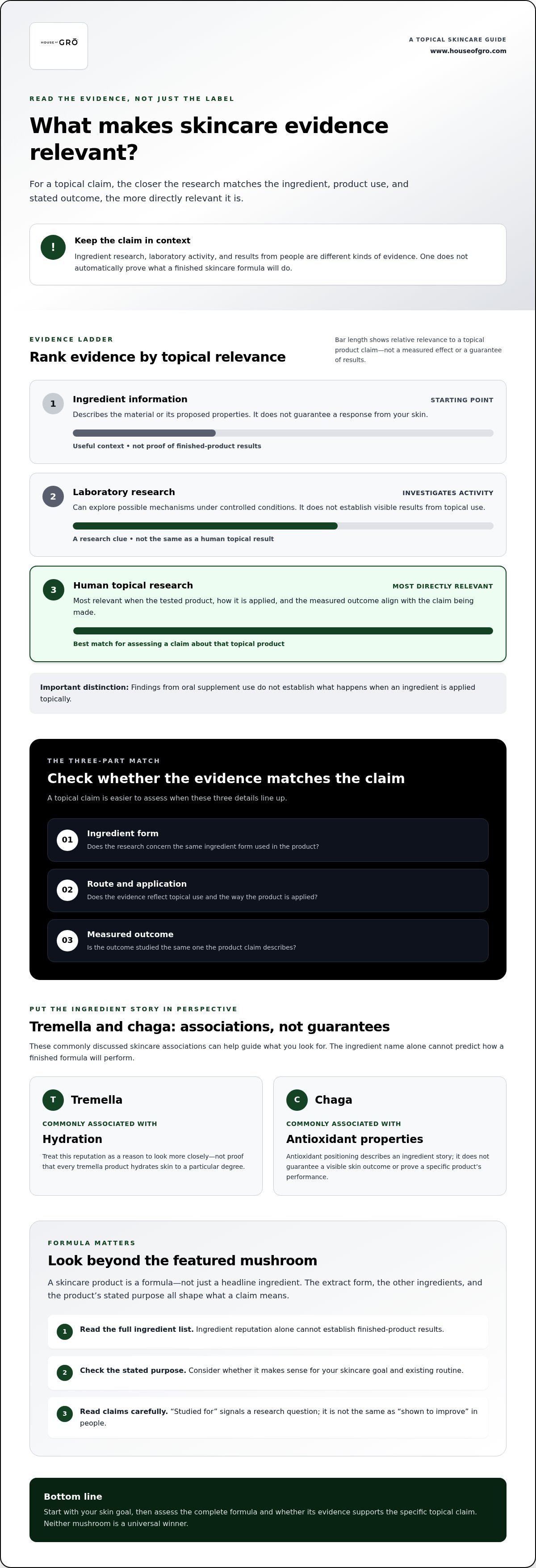
Ingredient conversations can make a proposed benefit sound like a proven product result. A more useful comparison separates three questions: what is known or proposed about an ingredient, what researchers observe in a laboratory model, and what happens when people use a topical product. Each answers something different. The tremella mushroom vs chaga for skin discussion is clearer when you keep those distinctions in view.
What evidence can support a topical skincare claim?
First identify what kind of evidence a claim relies on. A laboratory experiment may explore an ingredient’s activity under controlled conditions. A human study may test an ingredient or finished product on people. These are not equivalent: research on the actual topical formula is more directly relevant to a claim about that product than a cell study or an oral-use study.
- Ingredient information describes the material or its proposed properties, not a guaranteed response from your skin.
- Laboratory research can investigate possible mechanisms, but does not establish visible results from topical use.
- Human topical research is most relevant when the tested product, application, and measured outcome align with the claim being made.
Read the wording closely. “Studied for” signals a research question; it is not the same as “shown to improve” in people. The U.S. Food and Drug Administration explains that a cosmetic’s intended use and claims matter in determining how it is regulated. Its guidance on cosmetic claims offers useful context, but it does not validate a specific mushroom ingredient or product.
Why does the complete formula matter?
A skincare product is a formula, not just a headline ingredient. The form of the extract, the other ingredients, and the product’s intended use all shape what a claim means. Research on one mushroom extract may not apply to a product made with a different extract or formulation. Ingredient reputation alone cannot establish finished-product results.
Read the full ingredient list and the product’s stated purpose. Then consider whether the evidence matches the form being applied, the way it is used, and the outcome described. Claims about hydration, firmness, or protection should not be treated as promises without relevant supporting evidence. These checks also help you compare products without assuming that every formula featuring tremella or chaga works in the same way.
House of GRŌ® takes a mushroom-powered skincare approach, with Chaga hand-harvested from Maine birch trees appearing in several formulas. Explore the brand’s mushroom-powered skincare approach by considering each formula and its purpose, not only the ingredient name.
Tremella vs. Chaga for Skin: Compare Them by Your Skincare Goal
Think of tremella and chaga as different ingredient directions, not competing solutions with one universal winner. Tremella is commonly positioned around hydration. Chaga is commonly associated with antioxidant support. These descriptions can help narrow your search, but they do not show that either mushroom will deliver a specific result in every product. Start with your goal, then assess the formula and evidence behind its claims.
| Comparison point | Tremella | Chaga |
|---|---|---|
| Common skincare positioning | Hydration-focused ingredient | Antioxidant-focused ingredient |
| Evidence question | Does the support relate to topical use and the hydration claim? | Does the support relate to topical use, rather than only antioxidant activity in a laboratory? |
| Formula consideration | Look at the complete ingredient list and the product’s stated purpose. | Assess the full formula and do not read antioxidant positioning as proof of clinical protection. |
When might tremella fit a hydration-focused routine?
If hydration is your main interest, tremella may be relevant because that is its commonly discussed skincare angle. Treat it as a clue for what to investigate, not a promise that a product will hydrate or plump your skin. Read the product’s stated purpose and full ingredient list, and look for evidence that relates to topical use. The ingredient’s reputation alone does not tell you whether a specific formula meets your needs.
When might chaga fit an antioxidant-focused routine?
If you are interested in antioxidant-focused skincare, chaga may catch your attention as an ingredient commonly discussed in that context. This positioning does not establish clinical protection or guarantee a visible change. House of GRŌ® uses Chaga hand-harvested from Maine birch trees in several formulas. Chaga is part of the brand’s mushroom-powered approach, but its presence alone does not establish the outcome of a finished product.
For either mushroom, match the claim to your goal. A hydration claim and an antioxidant claim answer different questions, so they are not direct substitutes. Consider whether the evidence relates to topical application, what the product is designed to do, and how the full formula fits your routine. Those details offer a more grounded basis for choosing than a headline ingredient alone.
Takeaway: Tremella is commonly positioned for hydration, while chaga is commonly positioned for antioxidant support. The better fit depends on your goal, the complete formula, and relevant evidence.
How to Choose a Tremella or Chaga Skincare Formula
A considered choice starts with your needs, not the most confident-sounding mushroom claim. Use this checklist to move from your skin goal to a formula that makes sense for your routine.
- Define the skin goal. Decide what you want the product to support. If hydration is your priority, tremella’s common skincare positioning may be relevant. If you are interested in antioxidant-focused care, chaga’s positioning may interest you. Neither ingredient guarantees a particular result.
- Review the claim. Notice whether it describes an ingredient, a laboratory finding, or the finished product. Ask whether the evidence relates to topical use and supports the specific claim. Research on an ingredient alone does not establish how a particular formula performs.
- Assess the complete formula. Read the full ingredient list and the product’s stated purpose. A mushroom name does not establish ingredient quality or tell you how the rest of the formula is designed. Look for clear descriptions of the ingredient’s role rather than promises of guaranteed outcomes.
- Consider your routine. Think about where the product would fit alongside the skincare you already use, and whether its format and stated purpose suit your habits. A considered routine should feel coherent, not crowded with ingredients chosen only because they are trending.
Questions to ask when reading mushroom skincare claims
Pause over bold wording. Is the claim about an ingredient, a laboratory result, or the finished formula? Does the cited evidence match topical use and the specific outcome described? Does the brand explain the mushroom’s role without presenting a possible benefit as a certain result? These questions help separate useful ingredient information from claims that go further than the evidence.
Ingredient transparency is useful when it gives you meaningful context, but a mushroom name on a label is not a quality guarantee. Consider whether the product clearly describes its purpose and the ingredient’s role in the formula. Do not assume that two products featuring the same mushroom have equivalent compositions or evidence.
How skin goals and routine shape the choice
For hydration-focused interests, tremella may be worth exploring because hydration is its familiar skincare angle. For antioxidant-focused interest, chaga may be relevant to the ingredient story, but that does not prove clinical protection. In both cases, judge the whole product against your goal rather than choosing by a single ingredient name. For more context on routine fit, read this guide to skincare for sensitive skin and its perspective on microbiome skincare.
This approach brings more clarity to the tremella mushroom vs chaga for skin question: consider your goal, the evidence, and the formula together. To explore a mushroom-powered skincare approach rooted in family wellness practices, discover House of GRŌ® skincare.
House of GRŌ® Chaga Skincare: A Thoughtful Next Step
Once you have considered your skincare goal, the evidence behind an ingredient claim, and the complete formula, you can make a more informed choice than a mushroom name alone allows. House of GRŌ® brings that ingredient-led perspective to a family-rooted skincare approach. The brand uses adaptogenic mushrooms and organic botanicals, with Chaga hand-harvested from Maine birch trees appearing in several formulas.
A family-rooted approach to mushroom-powered skincare
House of GRŌ®’s approach is rooted in three generations of family wellness practices. Co-founder Irina Gottesman drew inspiration from her great-grandmother’s practices, bringing that family connection to wellness into the brand’s skincare perspective. The heritage provides context for the brand’s story, not proof of a particular ingredient’s effects. Keep the same distinction in mind when considering tremella mushroom vs chaga for skin: an ingredient philosophy and evidence for a finished product are separate considerations.
Chaga’s place in several House of GRŌ® formulas reflects the brand’s mushroom-powered approach. The Chaga is hand-harvested from Maine birch trees. Not every formula contains Chaga, and its presence should not be read as a promise of a particular skin outcome. Read each product’s information in light of the goal you have identified.
Explore House of GRŌ® skincare
At Dawn, Rejuvenating Daytime Oil is the brand’s priority product. It is rated 4.9/5 with 84 reviews. That rating offers customer feedback, but it is not clinical evidence of a specific skincare result. Consider it alongside the product’s stated purpose and ingredient information, using the same thoughtful criteria you have applied to tremella and chaga.
If the brand’s family wellness heritage and mushroom-powered approach feel aligned with the way you want to think about skincare, explore House of GRŌ®. Let your priorities lead: look for a formula that fits your routine and claims presented with care. A considered choice does not need a universal winner. It needs to be relevant to you.
Let Your Skincare Choice Feel Considered
The tremella mushroom vs chaga for skin decision does not need to become a search for the most impressive promise. Identify what you want from your routine, read claims carefully, and choose a formula whose stated purpose feels relevant to you. A useful next step is one that brings clarity to your choice.
House of GRŌ® offers a way to explore mushroom-powered skincare shaped by a family wellness heritage. Take time to review the formula details and decide what aligns with your approach to skincare. You do not need to choose based on a trend or a single ingredient name.
Explore House of GRŌ® mushroom-powered skincare and find a thoughtful next step for your routine.
2024 House of GRŌ® All Rights Reserved.
Frequently Asked Questions
Is tremella or chaga better for skin?
Neither is automatically better; the right fit depends on your skincare priority and the complete product. If you are comparing tremella mushroom vs chaga for skin, begin by deciding whether hydration-focused or antioxidant-focused ingredient positioning is more relevant to you. Then check whether the product’s stated purpose and supporting evidence align with that interest. A familiar mushroom name alone cannot predict how a formula will suit your routine.
Can tremella mushroom hydrate skin?
Tremella is commonly discussed in skincare in connection with hydration, but that association does not guarantee a specific result. If hydration is your goal, look at the product’s full ingredient list and consider whether its stated purpose is relevant to your needs. Distinguish ingredient research from evidence about the finished formula. A product’s texture or format may affect whether you enjoy using it, but it does not establish a hydration outcome.
Can chaga be used in topical skincare?
Yes. Chaga is used as an ingredient in topical skincare formulas, including several House of GRŌ® formulas. Its presence does not mean every product from the brand contains it, or that applying Chaga guarantees a particular visible change. When assessing a product, read its ingredient information and claims together. This helps you understand what the formula contains without assuming that the mushroom’s reputation predicts its effect on your skin.
What is the difference between tremella and chaga in skincare?
They are different mushrooms with distinct ingredient stories. Tremella is commonly associated with hydration-focused skincare, while chaga is often positioned around antioxidant support. Those descriptions help explain why brands may highlight them for different interests, but they do not show that one ingredient is more effective in every formula. For a practical comparison, consider whether the product’s purpose matches your goal, then look beyond the featured mushroom.
Is there scientific evidence for tremella or chaga in skincare?
Research exists at different levels, but evidence about an ingredient is not automatically proof about a topical product. A laboratory study, research involving oral use, and a human study of a finished topical formula answer different questions. Before relying on a benefit claim, check what was studied and whether the application and outcome match the product claim. Do not treat a proposed mechanism as a demonstrated visible result.
Can tremella and chaga be used together in a skincare routine?
Products containing tremella and chaga can both be considered as part of a skincare routine, but combining them does not guarantee added benefits. The product formulas matter more than the ingredient names alone. Review each product’s stated purpose and consider how it fits with the skincare you already use. There is no basis to assume that using both will create a particular result simply because their commonly described ingredient associations differ.