


What should you expect from the best serum for smile lines? A well-chosen serum may help skin look more hydrated and soften the appearance of fine lines, but it can’t reliably remove deeper folds or change the expressions that shape them. Looking past promises to erase lines makes it easier to choose a product for what it actually says it does.
Smile lines form around the mouth and nose. Their visibility can vary with facial movement, skin hydration, and changes in the skin over time. Knowing what can affect their appearance helps you compare products with realistic expectations rather than chase a guarantee a topical product can’t offer.
This guide explains how to assess common claims, compare product information, and build a manageable routine. For a nighttime skincare ritual, HOUSE OF GRŌ® offers After Dark - Restorative Night Serum. It is a night serum to consider as part of your routine, not a proven smile-line solution.
Key Takeaways
- Facial movement and a relaxed expression can change how smile lines appear.
- Choose a serum for smile lines with realistic expectations. A temporary change in skin appearance is different from a lasting change to a fold.
- Compare formulas by their stated purpose, disclosed ingredients, and the evidence behind their claims.
- Build a manageable skincare ritual by clarifying your goal, reviewing product information, and following the product’s own directions.
- HOUSE OF GRŌ® draws on three generations of family wellness practices. Its product range includes After Dark - Restorative Night Serum.
What Are Smile Lines, and Why Can Their Appearance Change?
Smile lines are creases that run from the sides of the nose toward the corners of the mouth, often becoming more visible when a person smiles. The term usually refers to the folds also called nasolabial folds. It describes a visible feature, not a diagnosis or a precise measure of skin health.
Although the name connects these lines with smiling, they may remain visible when the face is relaxed. Their depth and prominence differ from person to person. Facial structure, repeated movement, and changes in the skin over time can all influence how the area looks.
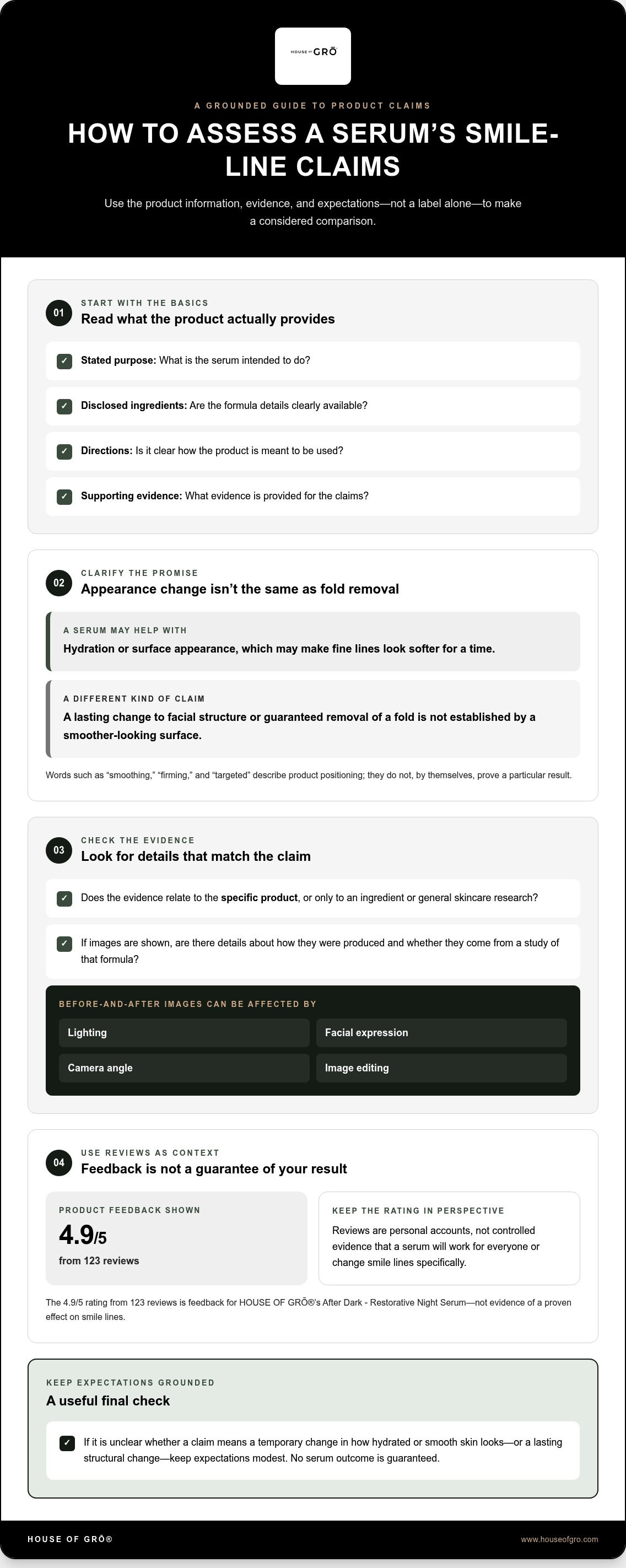
Product labels may use phrases such as “smile line serum” or “targeted wrinkle care” to describe a product’s intended focus. Those phrases don’t establish that a formula can remove a fold. To assess a claim, look at the product’s stated purpose, ingredient information, directions, and any evidence provided.
How smile lines differ from other visible facial lines
In everyday skincare language, smile lines generally refer to the creases extending from the nose toward the mouth. The Wikipedia overview identifies these as nasolabial folds. Lines at the corners of the mouth or around the lips may sit nearby, but they aren’t automatically the same feature. Since wording can vary between cosmetic content and product marketing, focus on the area being described rather than relying on a name alone.
This distinction is useful when comparing a serum for smile lines. A product described as targeting “facial lines” may be intended for a broader area, while a label naming smile lines doesn’t prove a specific result there. This guide focuses on topical skincare and how to interpret its claims. It doesn’t assess injectable treatments, devices, or other procedures. No topical product should be treated as a guaranteed way to remove facial folds.
Why lines can look more noticeable at some times
Facial expression is one reason. Smiling shifts the skin around the mouth and can make the folds more apparent. When the face relaxes, their appearance may soften, though some creases can remain visible. Lighting and viewing angle also affect what stands out in a mirror or photograph. The same expression won’t create identical folds on every face.
Expression can temporarily deepen the look of a fold, while facial structure and individual skin changes influence how visible it remains at rest. A single glance, photo, or product claim may not tell the whole story. Notice the area both at rest and while smiling, and treat what you see as an observation, not a diagnosis or proof that a serum can correct the lines.
What Can a Serum for Smile Lines Realistically Do?
A serum can have a place in a skincare routine, but it isn’t a promise to erase a facial fold. Depending on its formula, a topical product may hydrate the skin or improve its surface appearance, which can make fine lines look softer for a time. That visual difference is not the same as changing facial structure or permanently removing a crease.
Keep the distinction in mind when judging results. Skin that looks smoother after applying a hydrating product doesn’t establish that a deeper fold has changed. Experiences also vary with the person, the formula, and how the product is used. For a broader health-information perspective on skin care, Harvard Health Publishing offers general educational resources. No serum outcome is guaranteed.
How to read claims about smoothing or firming
Words such as “smoothing,” “firming,” or “targeted” describe how a product is positioned, not proof of a particular result. Before choosing a serum for smile lines, look for clear information about its intended purpose, ingredients, and the evidence supporting its claims. A label naming smile lines doesn’t establish that the product has been tested on those folds or will change their appearance.
Before-and-after images can provide context, but they don’t tell the whole story. Lighting, facial expression, camera angle, and image editing can affect how skin looks. Look for details about how images were produced and whether the results come from a study of that specific formula. Research about an ingredient in general shouldn’t automatically be treated as proof about every product containing it.
When assessing a promise, ask what kind of result it describes. Is it a temporary change in how hydrated or smooth the skin looks, or a claim of lasting structural change? Does the evidence relate to the product itself, or only to an ingredient or general skincare research? If the answer isn’t clear, keep expectations modest.
What reviews can and cannot tell you
Reviews can help you understand how other customers describe a product and how it fits into their routines. They are personal accounts, not controlled evidence that a serum will work for everyone or change smile lines specifically. Skin and expectations differ, so one person’s result can’t guarantee another’s.
HOUSE OF GRŌ®’s After Dark - Restorative Night Serum is listed at 4.9/5 from 123 reviews. That rating reflects product feedback, not evidence of a proven effect on smile lines. Consider reviews alongside the product’s stated information rather than treating a rating as a prediction of your own results.
Compare what a product says it does with the evidence it provides, then decide whether it suits the ritual you want to build. If you’re considering a restorative night serum as part of that routine, learn more about HOUSE OF GRŌ® skincare without assuming a specific effect on facial lines.
How to Compare Serums for Smile Lines Without Chasing Hype
A useful comparison starts with the information a product clearly provides, not the promise in its name. When choosing a serum for smile lines, consider its stated purpose, disclosed ingredients, format, and the quality of evidence provided. These details won’t predict your personal results, but they can help you decide whether the information is clear enough to make an informed choice.
| What to compare | What to look for | What it can tell you |
|---|---|---|
| Stated purpose | A clear description of the product’s intended role. | Whether its focus fits what you want from your routine. A line-focused label alone doesn’t prove a particular result. |
| Disclosed ingredients | An accessible ingredient list and clear explanations of featured ingredients. | What the formula contains. General ingredient information isn’t proof that a specific product will produce a specific outcome. |
| Format and texture | Whether it’s described as a serum, oil, cream, or another format, and any texture details the brand provides. | How the product may fit your preferences and existing routine. Don’t infer texture or application details that aren’t stated. |
| Evidence quality | Product-specific research or clear support for the claims being made. | How directly the evidence relates to the formula and promised result. Ingredient research alone is a different level of evidence. |
Which product details are worth comparing
Start with the product page. Does it explain the product’s purpose and disclose its ingredients? Is its format clear? These basics help you compare like with like. Avoid filling in gaps yourself: if a concentration, ingredient combination, or test result isn’t stated, don’t assume it. More detail can aid understanding, but it doesn’t automatically establish effectiveness.
Ingredient names offer context, not a verdict. For example, hyaluronic acid is commonly used as a hydrating ingredient, while retinoids are used in skincare for their effects on skin renewal. These are general descriptions, not claims about every formula containing them. A product’s full formulation and supporting evidence matter, and no ingredient alone proves a smile-line result.
How to weigh targeted products against broader skincare
A targeted product description draws attention to a particular concern. A broader skincare description may emphasize a product’s role within a routine. Neither label proves performance. Choose based on how specific the available information is, what you want from the product, and whether another step would make your routine more useful or unnecessarily complicated.
For broader context on skincare as a ritual, explore this guide to microbiome skincare. It can help you think beyond a single line-focused claim. The goal is to choose a formula and routine you understand, not to rank products by unsupported promises.
How to Build a Considered Routine Around a Serum
A routine is easier to maintain when it has a clear purpose and fits into daily life. Rather than building every step around the hope of eliminating a line, decide what you want your skincare to support. Then choose products based on their descriptions and directions. This keeps your ritual grounded in what you can understand and observe.
A simple process for choosing a routine
Use this four-part framework to bring a serum into your routine with intention. It helps you make a practical choice without assuming every product belongs in every morning or evening routine.
- Clarify your priority. Decide whether you’re seeking a more hydrated feel, a simple evening ritual, or another skincare goal. A specific intention is more useful than expecting a serum to erase lines.
- Review the product information. Read the description, ingredient information, and directions for the exact product. For a HOUSE OF GRŌ® product, follow its own directions rather than relying on generic advice about where or when serums should be applied.
- Keep the routine manageable. Consider how the product fits with the steps you already use. A routine you can follow comfortably is easier to maintain than one with many new additions. For related guidance, the guide to skincare for sensitive skin offers a broader perspective.
- Observe your experience. Notice how your skin feels and looks as you use the product according to its directions. Let your own experience inform whether the step feels right, without treating it as proof of a guaranteed result.
How to assess your experience over time
Keep your observations simple. Note whether the product feels comfortable in your routine and whether your skin’s appearance seems different under similar lighting and with a similar expression. If you change several products at once, it can be harder to work out which change relates to what you notice. A steady, uncomplicated approach makes personal observations easier to interpret, but they aren’t clinical evidence.
Experiences vary, and there’s no single timeline that guarantees a visible change. Avoid judging a serum for smile lines by one mirror check or assuming that a particular number of days will produce a specific effect. Focus on how the product fits your routine and how your skin responds, rather than turning a personal ritual into a test with a promised outcome.
For a wider view of skin-focused habits, explore this guide to how to get radiant skin. If a considered nighttime step feels right for your routine, explore HOUSE OF GRŌ® skincare, including After Dark - Restorative Night Serum, and follow the product’s own directions.
A Thoughtful Nighttime Skincare Ritual with HOUSE OF GRŌ®
An evening routine doesn’t need to promise a change to every line. It can offer a moment to care for your skin and choose products with clear roles. HOUSE OF GRŌ® draws on three generations of family wellness practices. Its approach is described as “Mushroom-Powered Skincare for Naturally Radiant, Hydrated Skin.” That heritage and purpose speak to a considered ritual, not a guarantee of a particular cosmetic result.
How After Dark fits the brand’s nighttime approach
After Dark - Restorative Night Serum is a restorative night serum to consider as part of an evening skincare ritual. It is listed at $175.00 and has a rating of 4.9/5 from 123 reviews. Use the product information and directions to understand its role in your routine.
If you’re comparing a serum for smile lines, keep the distinction clear: After Dark is not presented as a proven treatment for smile lines or a way to erase or reduce them. A product’s nighttime role can make it part of your routine without implying a specific effect on facial folds. Choose it for the place it holds in your skincare practice, with expectations grounded in its stated information.
Explore a broader evening skincare ritual
Sometimes a product makes more sense in the context of a full routine. HOUSE OF GRŌ®’s guide to a restorative night skin care regimen offers related reading for shaping an evening practice. Keep your approach personal and unhurried. A ritual can be meaningful even when it isn’t built around changing one visible feature.
Reviews can add perspective, but they aren’t clinical evidence that a serum changes smile lines or a prediction of what any individual will experience. Read them alongside the product’s own information, which explains its intended role.
Let your routine be simple enough to return to. Read the directions, choose steps that suit your priorities, and allow the ritual to be its own form of care, without expecting a guaranteed outcome. For a closer look at the brand and its skincare, Explore HOUSE OF GRŌ®.
Choose a Skincare Step That Feels Right for You
Your next step doesn’t need to be dramatic. Choose one clear priority, make space for a routine you can sustain, and let product information guide your decisions. A serum for smile lines can be part of that practice, but it doesn’t need to carry the expectation of changing every crease. Thoughtful care can begin with a simple choice and realistic expectations.
If an evening serum feels like a natural fit, take time to explore the options and decide what belongs in your ritual. Explore House of GRŌ® and find a considered next step for your skincare routine.
Let consistency, comfort, and care matter more than a promise to erase lines. Your routine can be a small, steady way to return attention to yourself.
2024 House of GRŌ® All Rights Reserved.
Frequently Asked Questions
Is a serum for smile lines different from a regular face serum?
Not necessarily. “For smile lines” may describe a product’s marketing focus, but it doesn’t show by itself that the formula is different or proven to affect those lines. Compare the product’s stated purpose and ingredient information with your routine needs. If you want a serum mainly for hydration, look for clear information about that purpose rather than relying on a line-specific label to predict results.
Can hydration change how smile lines look?
Hydration may affect how skin appears, though the visible difference varies from person to person. If your skin looks dry or feels tight, notice whether its overall surface looks different after using a product as directed. That observation isn’t proof that a crease has changed structurally. Compare your skin under similar lighting and with similar facial expressions, and be cautious of claims that turn a temporary-looking change into a promise to erase lines.
How long does it take to see results from a skincare serum?
There isn’t one reliable timeline for every serum or every person. The answer depends on what the product claims to do and what kind of change you’re observing. Read the product’s directions and evidence, and don’t treat a fixed-date promise as a guarantee. A simple note about how your skin feels and looks can help you assess your experience without assuming a particular result should appear by a certain day.
Are smile lines the same as nasolabial folds?
In everyday skincare discussions, “smile lines” commonly refers to the folds known anatomically as nasolabial folds, though wording can vary between sources and product categories. A label may use familiar language without offering precise anatomical detail. If you need a specific medical explanation, rely on a reputable dermatology or medical reference rather than assuming every product using “smile lines” means exactly the same thing.
Can facial massage remove smile lines?
Facial massage shouldn’t be relied on to remove smile lines. Some people include it in a routine because they find the practice calming, but a personal experience doesn’t establish lasting change to facial lines. Keep its purpose clear: treat massage as a ritual choice, not a proven line-removal method. Be wary of claims promising a lasting result without reliable evidence for that specific outcome.
What should I look for when comparing serum claims?
Look for a clear product purpose, accessible ingredient information, and evidence that relates to the product and the result being claimed. A description of an ingredient’s general skincare role doesn’t establish how a finished formula performs. Reviews can offer individual perspectives, but they can’t predict your result. Treat a targeted name as a starting point for reading, not proof that a serum will deliver a particular change.