


What makes the best face oil for hot climates is not a promise on the label, but how the product’s stated features fit your preferences and daily routine. Heat and humidity can make facial oil seem like an easy way to feel greasy, especially when your skin already feels shiny or unsettled.
Start with your usual conditions, the finish you prefer, and the products you already use. Skin can feel oily and still lack moisture, so consider an oil as one part of your skincare routine, not a replacement for moisturizer or sunscreen. Product-specific details matter more than broad seasonal claims.
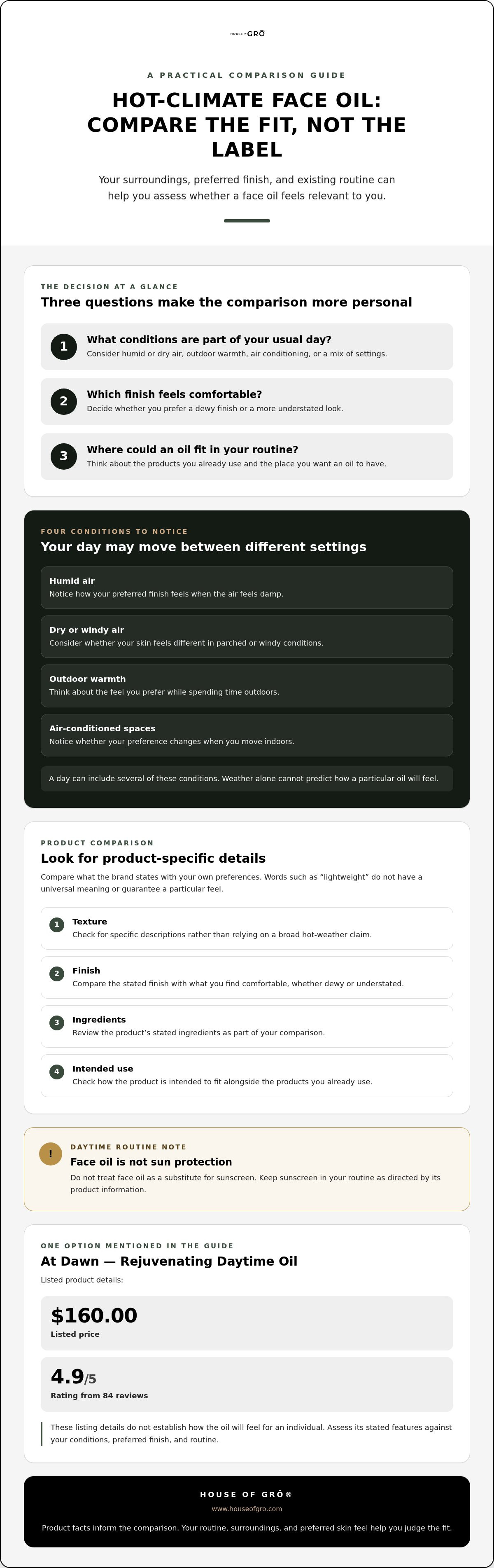
This guide explains how to compare face oils and decide whether a daytime oil suits your preferences. At Dawn - Rejuvenating Daytime Oil is one option to consider, listed at $160.00 with a 4.9/5 rating from 84 reviews. Use your own routine, surroundings, and preferred skin feel to decide whether it belongs on your shortlist.
2024 House of GRO® All Rights Reserved.
Key Takeaways
- The best face oil for hot climates is a personal fit, shaped by your surroundings, preferred skin feel, and routine.
- Consider how heat, humidity, dry air, and air conditioning affect the way you want your skincare to feel.
- Compare stated texture, finish, ingredients, and intended routine placement instead of relying on broad marketing claims.
- Use a simple checklist to clarify your conditions, preferred feel, product facts, and routine fit before choosing.
- Explore At Dawn - Rejuvenating Daytime Oil as one option, listed at $160.00 with a 4.9/5 rating from 84 reviews.
Best Face Oil for Hot Climates: Why the Right Choice Can Feel Counterintuitive
Adding face oil can seem like the wrong move when warm weather already brings a slick or shiny feel. You may wonder whether another layer will feel heavy, make shine more noticeable, or complicate the rest of your routine. Those are reasonable concerns, but the word “oil” alone doesn’t answer them. Products differ, and a broad promise about hot-weather performance can’t tell you how a particular formula will feel to you.
A good hot-climate face-oil choice is one whose stated qualities and place in your routine match your local conditions and the finish you find comfortable. There is no single formula that suits everyone in warm weather. A dry-feeling afternoon, a humid morning, and a day moving between outdoor heat and indoor air conditioning may each shape what you want from skincare.
Start with what you can observe and compare. Do you like a dewy finish, or prefer a more understated look? Do you already use several products in the morning? These preferences can help you narrow your options, though they can’t predict an individual skin response. They make the decision more personal and less dependent on sweeping claims.
Why face oil can seem like the wrong choice in heat
Greasy feel, visible shine, and product layering are practical concerns. A description may use words such as “lightweight” or “nourishing,” but those labels aren’t a shared measure of how a product will feel to you. Look for specific details the brand provides, such as texture, finish, ingredients, and intended use. Compare those details with your own preferences. The skin's natural barrier function is one part of skin’s role; that general fact doesn’t establish how a particular face oil will feel on an individual.
What a hot-climate face-oil guide should help you decide
A useful guide helps you narrow the decision rather than offering a one-size-fits-all answer. Consider three questions: What conditions do you experience most often? What finish feels comfortable? Where might an oil fit among the products you already use? Product-specific information supports the comparison, while your routine and preferences help you judge relevance. No buying guide can guarantee how your skin will respond.
- Which conditions describe your usual day?
- What finish feels pleasant rather than distracting?
- What does the product state about texture and intended use?
Those questions provide a practical starting point. The next sections look at climate settings and product details to weigh, so you can compare options without assuming that “for hot weather” proves a perfect fit.
How Heat, Humidity, and Indoor Air Shape Face-Oil Preferences
A hot climate isn’t one unchanging setting. You might spend the morning in humid air, cross a dry, windy street at midday, then work for hours in an air-conditioned room. Each environment can feel different on your skin. Instead of expecting one product to suit every moment, notice which conditions are part of your regular day and what finish feels comfortable in them.
Climate describes the conditions around you; product features describe what the formula states. Keep those ideas separate. A product description can inform your comparison, but the weather alone can’t verify how that product will feel or how your skin will respond.
Humid heat versus dry heat
In humid weather, the air may feel damp, while dry heat can feel parched or windy. You may move between both across a day or season. Note when and where a product feels comfortable in your routine instead of assuming a label such as “summer” predicts its feel. The same oil may be experienced differently depending on the person, surroundings, and other products used alongside it.
Make the comparison concrete. Think through a typical day: time outdoors, time in humid or dry air, and the products you already apply. Then look for clear, product-specific descriptions of texture, finish, ingredients, and intended use. Terms such as “lightweight” don’t have a universal meaning, so treat them as prompts to look for detail, not proof of a particular result. This can help you decide what to explore as you look for the best face oil for hot climates.
Outdoor warmth and air-conditioned spaces
Moving from outdoor warmth into air conditioning adds another variable. You may prefer a different feel in a cool indoor setting than during a warm commute. Don’t assume that one oil will feel a particular way in both settings. Instead, consider whether your routine is comfortable across the environments you encounter most often.
Sun exposure is a separate part of daytime skincare. Face oil should not be treated as sun protection or as a substitute for sunscreen. Keep sunscreen in your routine as directed by its product information, and assess a face oil for its stated qualities and the role you want it to play, not for UV protection.
Skin’s outer barrier helps limit water loss. Transepidermal water loss, often shortened to TEWL, describes water moving through the skin and evaporating from its surface. Dry indoor air or changing conditions may influence how your skin feels, but this general explanation can’t diagnose your skin or predict an individual response to an oil. Ground your choice in your own observations and product facts, not promises about changing skin behavior.
- Notice whether your day is mostly humid, dry, air-conditioned, or variable.
- Record which finishes feel comfortable in those settings.
- Separate stated product details from assumptions based on climate.
With your environment in view, you can explore House of GRŌ® skincare as part of a considered routine.
How to Compare Face Oils for Hot Weather Without Guesswork
A useful comparison begins with details you can actually assess. Separate a product’s stated features from impressions such as “feels light” and from promises that don’t explain how a particular formula may suit you. A clear finish description, ingredient information, and intended routine placement offer more to compare than a broad claim that an oil is ideal for summer.
Use this framework to compare options side by side. Treat product descriptions as information, not a guarantee of your personal experience.
| Criteria | What to look for | Question to consider |
|---|---|---|
| Finish | A stated finish, such as matte or dewy | Does that match the look and feel I prefer? |
| Texture | Specific wording about texture, rather than a general seasonal claim | Is the description clear enough to guide my choice? |
| Ingredients | An ingredient list and transparent product information | Can I understand what the product contains? |
| Routine placement | Stated directions or intended use | Does it fit the routine context I’m considering? |
An ingredient list helps you see what a formula states it contains, but it can’t establish how that formula will feel on everyone. Words such as “nourishing” or “lightweight” may be useful clues, yet they aren’t a personal-use result. Keep verified details separate from your expectations. That distinction makes it easier to compare products without treating marketing language as a promise.
Compare finish, feel, and product information
Prioritize descriptions that explicitly name a finish or texture. For example, House of GRŌ® describes Eye Detox - Brightening Oil as having a matte finish. That is a product-specific example, not a claim about At Dawn - Rejuvenating Daytime Oil. Don’t infer At Dawn’s finish, absorption speed, or texture from its name. If a detail matters to your choice, rely on information stated for that specific product.
Match the choice to your routine and preferences
Consider whether you’re looking for an oil within a daytime routine or another routine context. Read the product’s own directions and intended use, then compare them with the steps you already follow. Don’t assume that different products have the same application instructions. Your preferred finish, observed comfort, and local conditions can narrow the options, but they can’t guarantee how an individual product will feel for you.
When assessing the best face oil for hot climates, look for a match between your preferences and product-specific facts rather than a universal “hot weather” label. A thoughtful comparison leaves room for personal experience while keeping claims in perspective.
A Practical Checklist for Choosing a Face Oil in a Hot Climate
A simple sequence can bring clarity to a crowded skincare shelf. Start with the conditions you experience, name the finish you enjoy, compare stated product information, then consider how an oil fits your routine. This keeps the decision grounded in your own observations rather than skin-type labels or broad promises.
Choose by moving from climate, to preferred feel, to verifiable product details, and finally to routine fit. Treat the checklist as a way to narrow options, not a way to predict or diagnose your skin’s response.
Start with your climate and preferred skin feel
Think about an ordinary day, not just the hottest one. Is the air humid, dry, or changeable? How much time do you spend in air-conditioned spaces? Then describe the finish you prefer, whether matte, dewy, or another finish stated by a product. Labels such as oily or dry can offer context, but they can’t replace your preferences or product-specific information.
- Identify your conditions. Note humidity, dry air, and time spent in conditioned indoor spaces. If your day varies, include the transitions that matter most.
- Define your preferred feel. Decide whether you lean toward a matte, dewy, or otherwise described finish. Think about what feels comfortable in your existing routine.
- Compare stated facts. Review each product’s ingredient list, finish, claims, and directions. Separate explicit details from assumptions about how a formula might perform.
- Review routine fit. Consider whether you want an oil in a daytime routine or another context. Use the product’s own directions to assess whether it aligns with the steps you already follow.
Check product facts before choosing
Keep the comparison precise. An ingredient list tells you what a product states it contains; it doesn’t establish how it will feel for everyone. A finish description is a product detail, while an expectation about how it will wear is personal. Note what is explicitly stated and leave unsupported performance promises out of your decision. Your observations can help narrow choices, but they can’t guarantee a particular result.
Keep sun protection separate from your oil choice. Face oil isn’t a substitute for sunscreen. If you want more routine context, the brand’s skincare for sensitive skin article may help you consider how your broader routine is organized; its microbiome skincare article offers another perspective on skincare. Use these as background, not as a diagnosis or a promise about how any product will work.
When you’re ready to explore skincare through this considered lens, discover House of GRŌ® skincare and review product-specific information alongside your preferences.
Considering At Dawn by HOUSE OF GRŌ® as a Daytime Oil
Once you have a clearer sense of your climate, preferred finish, and routine, you can consider a specific daytime-oil option without assuming it will suit everyone. At Dawn - Rejuvenating Daytime Oil is House of GRŌ®’s daytime oil. The details below help you understand what’s stated about it and what to weigh against your own preferences.
What the At Dawn product facts can tell a shopper
At Dawn - Rejuvenating Daytime Oil is listed at $160.00. It has a rating of 4.9/5 with 84 reviews. These are useful product facts to consider, but they don’t establish how the oil will feel on your skin or whether it fits your routine in hot weather.
Keep the distinction clear. The product’s name identifies it as a daytime oil, while the listed price and customer rating offer points for comparison. Those details don’t describe a matte or lightweight finish, absorption speed, or suitability for every skin type. Base those judgments on product-specific information and your own preferences, rather than assumptions drawn from the name or rating.
The brand also offers a 30‑Day Money-Back Guarantee, shipping not included. Consider this stated policy alongside the product facts, while keeping your expectations realistic. A guarantee does not predict an individual skin response or determine whether an oil is the right match for your climate.
How to make a considered next step
Before deciding, return to the criteria that matter in your daily life: the conditions you experience, the finish you prefer, the product information available, and how a daytime oil might fit into your routine. Keep sunscreen separate in your daytime care, and don’t treat face oil as sun protection. A calm comparison is more useful than trying to identify one universally suitable choice.
- Compare the stated product details with what you want from a daytime oil.
- Use the rating as one reference point, not a promise of personal results.
- Let your climate observations and routine guide whether the option feels relevant to explore.
If those details align with what you’re looking for, Explore At Dawn and House of GRŌ®. Review the product facts and weigh them against your own preferences. That’s a grounded way to consider the best face oil for hot climates: not as a universal answer, but as a thoughtful choice shaped by your routine and the information available.
2024 House of GRŌ® All Rights Reserved.
Choose a Daytime Ritual That Feels Like Yours
Your next step doesn’t need to be a quick verdict. Let your preferences guide what you explore, and give more weight to clear product information than to promises that sound universal. The best face oil for hot climates is a considered personal choice, shaped by the conditions you encounter and the role you want a daytime oil to play.
House of GRŌ® describes its heritage as rooted in three generations of family wellness practices. That history offers context for the brand, while your own priorities remain central to choosing skincare. Explore the product details and decide whether they align with the feel and routine you’re seeking.
Explore House of GRŌ through the product details above and decide whether At Dawn fits your routine.
Frequently Asked Questions
Can you use face oil in hot, humid weather?
Yes, face oil can be part of a hot-weather routine if its stated details and your own comfort suit you. You might consider how it feels during a day spent mostly indoors before deciding whether it fits your routine in other settings. Comfort can differ by product and person, so no oil is universally suitable. Check the product’s directions and consider how it fits alongside your existing routine.
Is face oil suitable for oily skin in a hot climate?
It may be an option, but an “oily skin” label alone can’t tell you whether a particular oil will feel comfortable. Consider your own preferences: for example, whether you enjoy a dewy finish or prefer less visible sheen. Then compare the product’s stated finish, ingredients, and directions. This is a personal skincare choice, not a promise that oil will change how your skin behaves.
Does face oil replace sunscreen in hot weather?
No. Face oil should not be presented as a replacement for sunscreen, even in a daytime routine. Treat sun protection as a separate step and follow the directions on your sunscreen product. Assess oils for their stated skincare qualities and routine placement, not for UV protection. A face oil’s name or other product claims don’t establish sun-protective ability.
Can you wear face oil under makeup in warm weather?
That depends on the specific product directions and your preferred makeup routine. Don’t assume an oil will layer smoothly, dry down quickly, or behave the same way under every foundation. Review the product’s stated directions, then consider whether its intended use aligns with your routine. If you choose to try the combination, pay attention to your own comfort and appearance rather than relying on a general warm-weather claim.
How do you choose between a matte and dewy face oil finish?
Start with the look and feel you prefer, then compare product descriptions that explicitly state a finish. “Matte” and “dewy” are useful distinctions when they’re stated for the product you’re considering. If a description doesn’t name its finish, don’t infer one from the product name or ingredients. A stated finish helps you compare options, but it can’t guarantee that you’ll experience it in the same way.
What should you look for in a face oil for a hot climate?
Look for clear, product-specific details about finish, texture, ingredients, and directions. Consider the conditions you experience, such as humid outdoor days or long stretches in air conditioning, and decide what feel you prefer in those settings. The best face oil for hot climates is a personal choice, not a universal formula. Check that the product’s stated use makes sense for your routine, and keep sun protection separate.
Is At Dawn - Rejuvenating Daytime Oil described as matte?
At Dawn - Rejuvenating Daytime Oil isn’t described here as matte, so don’t infer that finish from its name or daytime use. HOUSE OF GRŌ® describes Eye Detox - Brightening Oil as having a matte finish, but that is a separate product and its feature shouldn’t be transferred to At Dawn. For a considered comparison, rely on details stated specifically for the product you’re evaluating.