


What if a good skincare routine asked less of you, not more? A quick skincare routine for moms can feel complete without taking over the morning. Start with familiar basics, such as cleansing, moisturizing, and daytime sun protection, then decide which steps fit your needs and the time you have.
If a long routine feels unrealistic, you’re not alone in wanting a gentler approach. Consistency is easier to aim for when the routine is manageable, not crowded with steps you don’t need. This guide helps you separate everyday basics from optional additions, then shape a short routine that can flex with busy mornings and changing schedules.
We’ll cover a practical order for making those choices, ways to make the habit easier to keep, and small opportunities to make skincare feel like a moment of care. If you’re considering a daytime product, At Dawn - Rejuvenating Daytime Oil is one option from House of GRŌ®, a brand rooted in three generations of family wellness practices. Keep the routine simple, and give each step a clear purpose.
Key Takeaways
- A quick skincare routine for moms can be a small, repeatable practice that flexes with the time and energy you have.
- Build a morning routine by choosing from familiar skincare categories, rather than treating every step as essential.
- Compare minimal and expanded routines by how much time they take and how easy they are to maintain.
- Make it easier to return to your routine after interruptions without turning a missed step into another source of pressure.
- Consider how At Dawn - Rejuvenating Daytime Oil might fit into your daytime routine, alongside practical ways to keep skincare personal and manageable.
Quick Skincare Routine for Moms: What Really Needs Your Time?
A quick skincare routine for moms should fit around real life, not ask real life to make room for a long checklist. Early starts, caregiving, work, school runs, and interrupted moments can make even a few quiet minutes hard to find. Some mornings leave room for an extra step; others don’t. A useful routine can change from one day to the next.
Think of “quick” as a small set of personal-care steps you can return to when the day allows. To make it practical, identify what you already do and what you actually want from a routine. The point isn’t to complete every possible skincare step. It’s to make manageable choices that feel clear rather than demanding.
Why a short routine can fit a demanding day
Your schedule is specific to you. A parent balancing an early commute may have a different morning from someone caring for a baby at home or working shifts. Instead of copying another person’s routine, notice where a skincare habit could fit: after washing up, while the kettle warms, or before getting dressed. A habit is easier to remember when it connects to something already in your day.
Skincare includes a range of products and common practices, so it can help to understand the basics before deciding what belongs in your routine. This Skin care principles overview offers general background. Use it as context, not as a reason to add every step. If you have a skin concern or need advice tailored to you, general routine-building tips aren’t a substitute for professional guidance.
What makes a routine feel manageable?
Start with a few familiar steps you already understand. Keep the products together and arrange them in the order you tend to use them, so you don’t have to decide what comes next each morning. It can also help to choose a short version for mornings when a child needs you or the clock is moving faster than expected. Flexibility is part of the plan, not a sign that you’ve failed it.
A realistic routine asks for less time, fewer decisions, and less preparation on busy days. That doesn’t mean it will create a particular skin result. Skin can respond differently from person to person, and a simple routine isn’t a promise of instant change. The practical goal is a pattern that feels comfortable enough to revisit.
- Keep: steps that feel useful and fit your morning.
- Pause: anything you’re adding only because a routine seems incomplete without it.
- Adapt: shorten the sequence when the day is interrupted, then return to your usual version when you can.
Some days, a small pause at the sink may feel like a moment of care. Other days, getting on with the morning is enough. Your routine should support your day, not become another measure of how much you managed to do.
How to Build a Quick Skincare Routine for Moms
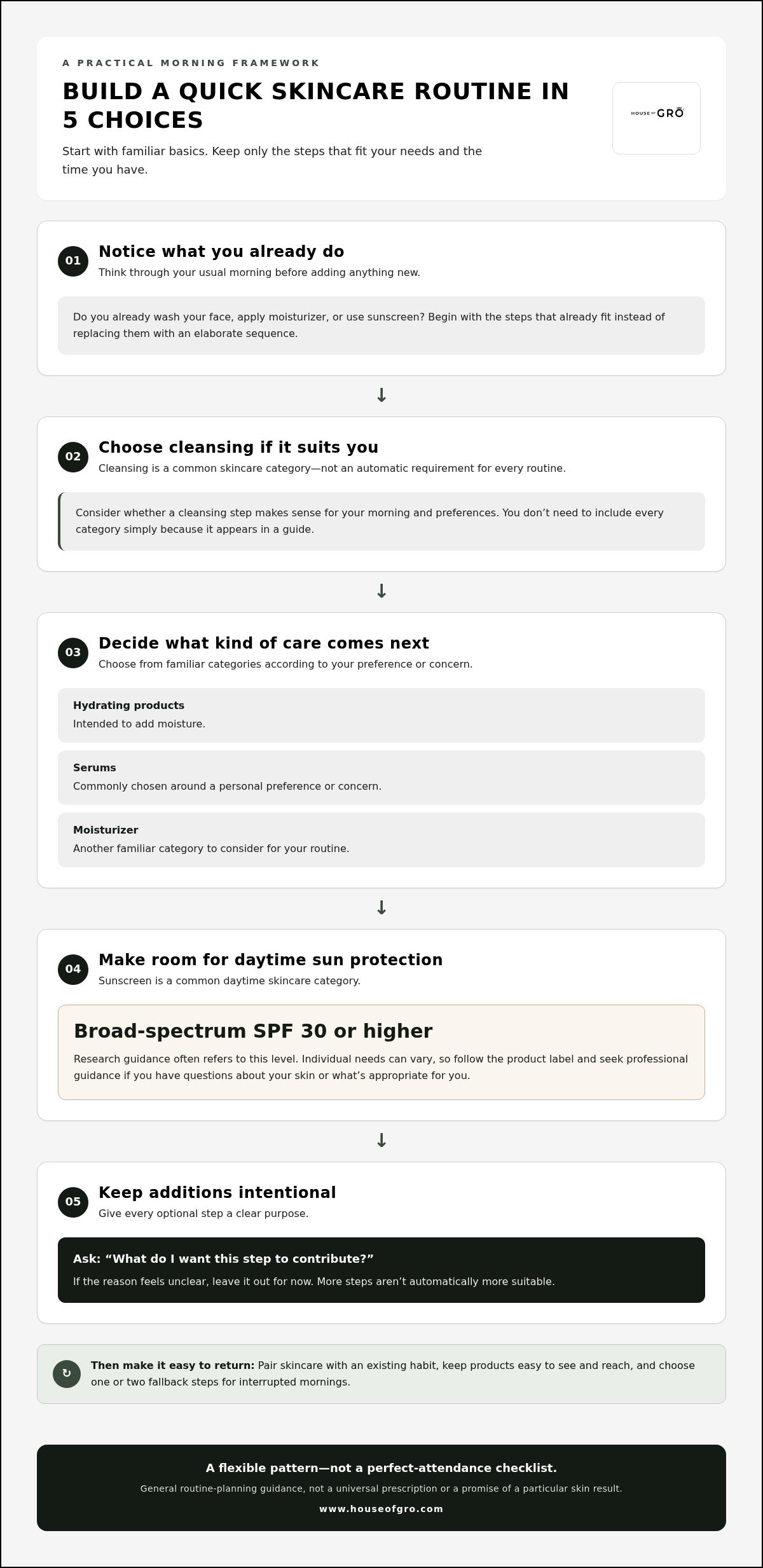
A simple framework can help you decide what belongs in your morning without turning skincare into a second to-do list. Begin with what you already understand, then keep only the additions that feel useful to you. This is general routine-planning guidance, not a universal prescription or a promise of a particular skin result.
A routine is easier to return to when each step has a clear place and purpose.
- Notice what you already do. Think through your usual morning. Do you wash your face, apply moisturizer, or use sunscreen? Start with the steps that already fit instead of replacing your habits with an elaborate new sequence.
- Choose a cleansing step if it suits your routine. Cleansing is one common skincare category. Whether you prefer splashing with water or using a gentle face wash from Dreams Beneath, consider whether it makes sense for your morning and preferences. You don’t need to include every category simply because it appears in a guide.
- Decide what kind of care you want next. Hydrating products are intended to add moisture, while serums are commonly chosen around a personal preference or concern. A moisturizer is another familiar category. You can explore minimalist skincare essentials for another perspective, then decide what feels relevant to your routine.
- Make room for sun protection. Sunscreen is a common daytime skincare category. Research guidance often refers to broad-spectrum SPF 30 or higher, but individual needs can vary. Follow the product label, and seek professional guidance if you have questions about your skin or what’s appropriate for you.
- Keep additions intentional. Before adding an optional step, ask what you want it to contribute. If the reason feels unclear, leave it out for now. More steps aren’t automatically more suitable.
Make the routine easy to remember
Pair skincare with something that already happens, such as getting dressed or brushing your teeth. Put the products you use near your usual getting-ready spot, where they’re easy to see and reach. Keep the space simple. A crowded counter can make a short routine feel more complicated than it is.
Then choose a fallback: one or two steps you can manage when the morning is interrupted. Let that shorter version count, and return to your fuller routine another day. The aim is a flexible pattern, not perfect attendance.
Keep general routine choices separate from directions for a particular product. A daytime oil, for example, is a product category; follow that product’s own directions rather than making assumptions based on a general framework. House of GRŌ®’s daytime skincare is one place to learn about the brand’s product.
Minimal or Expanded Skincare Routine: Which Fits Mom Life?
A routine can be short and still feel considered. You may also enjoy a few more steps when the morning allows. Neither approach is automatically better. For a quick skincare routine for moms, compare how much time each version asks of you and whether it feels comfortable to repeat on ordinary days.
Use the table as a planning tool, not a rulebook. The step counts are examples, not a recommended minimum or a measure of what your skin needs.
| Approach | Time and steps | Day-to-day feel |
|---|---|---|
| Minimal | A few familiar steps; often only a brief part of the morning | Simple to remember and easier to adapt when the schedule shifts |
| Expanded | Several chosen steps; usually takes longer | Offers more room for personal preferences, but may take more planning |
When a minimal routine may suit your schedule
A minimal approach can feel practical during early starts, school mornings, busy workdays, or seasons when your personal time is often interrupted. A compact sequence may mean fewer decisions at the sink and less setup before you begin. It doesn’t make the routine more effective by default; it simply makes the process smaller.
Ask yourself: how much time do I usually have, and how much effort do I want skincare to take on a typical morning? Consider an ordinary weekday, not an unusually calm one. If a short sequence fits that version of your life, it may be a comfortable starting point.
When you may want to add an optional step
An expanded routine may appeal if you enjoy the ritual, have time for it, or want to include a product category that reflects a clear personal preference. Add one step at a time, then notice whether it feels comfortable to keep. If it makes mornings feel crowded, simplify again. An optional addition doesn’t need to become a daily requirement.
If you’re curious about the skin microbiome as part of your skincare reading, the microbiome skincare guide can be a topic to explore. Let interest guide you, rather than the feeling that every new idea belongs in your routine.
Your schedule can change from one day to the next, and your routine can change with it. Some mornings may suit the shorter version; others may leave space for an extra step. Choose based on the time and effort you want to give, not on a promise of different skin results. A routine is personal, and it should feel like it belongs to your life.
How to Keep Your Quick Skincare Routine Going on Busy Days
A routine has to live in the middle of real mornings: someone needs breakfast, plans change, and a quiet moment can disappear. The goal isn’t to protect a perfect streak. It’s to make skincare easy to return to, without letting a shortened morning become another reason to feel behind.
Build flexibility into your morning
Choose a time and place that already feel convenient. That might be at the bathroom sink while you get ready, or later in the morning when the house is quieter. The best option is the one that fits your own rhythm, not a schedule that looks ideal on paper.
Decide in advance what your fallback looks like. It could be one familiar step, or simply setting aside the rest of the routine until you have more time. Keep the choice uncomplicated. You don’t need to make up for a shorter morning or restart with a more elaborate plan the next day.
A few small adjustments can make the habit easier to pick up again:
- Keep the products you use together in the place where you usually get ready.
- Choose a cue you’re likely to encounter, such as finishing your usual morning wash-up.
- Let your full routine and fallback routine both count as options.
- If the morning gets away from you, return to your chosen routine at the next convenient opportunity.
These are prompts, not rules. If a particular location or cue adds friction, try a different one. The routine should fit around your day rather than compete with caregiving, work, or rest.
Make the routine feel like a personal ritual
A brief pause can be enough to make a familiar habit feel more personal. Notice the coolness of water, the softness of a towel, or the calm of a few unhurried breaths. You don’t need a special setting or extra products. Let the moment be simple, and let it belong to you.
If your skin feels easily unsettled or you’re looking for general information, a skincare for sensitive skin guide may be a helpful topic to explore. Keep general reading separate from personal medical advice, especially if you have ongoing concerns or questions about what’s suitable for you.
Some days, your routine may take its usual shape. Other days, it may be shorter or not happen at all. That’s part of living with a changing schedule. A quick skincare routine for moms should offer a gentle point of return, not a new standard to meet. House of GRŌ® draws on three generations of family wellness practices, a heritage that reflects the value of making everyday care personal and intentional.
House of GRŌ® shares its approach to skincare online.
Bring House of GRŌ® Into a Quick Daytime Skincare Routine
Before choosing a product, decide what role you want it to play in your morning. A quick routine doesn’t need every skincare category, and a daytime oil is a consideration, not a required step. Think about whether it fits the kind of routine you want to keep, the time you have, and your personal preferences.
Keep the framework simple. First, settle on the basic steps that already make sense for you. Then consider whether an additional product has a clear place in that routine. If you’re unsure, there’s no need to add it just to make the sequence feel more complete. General routine guidance can help you plan, but it isn’t product-specific application advice or a promise of a particular result.
A daytime product to consider
At Dawn - Rejuvenating Daytime Oil is one daytime product to consider as you shape your routine. It’s a daytime oil, not a required part of every morning. You may prefer a shorter routine, or you may enjoy making room for a product category that feels right for you. Follow the product’s own information rather than relying on assumptions about how or when to use it.
House of GRŌ® describes its approach as mushroom-powered skincare. Chaga in several formulas is hand-harvested from Maine birch trees. If ingredient sourcing and a considered approach to personal care matter to you, those details can help you learn about the brand without turning a product into a promise about what your skin will do.
For a concrete point of reference, At Dawn - Rejuvenating Daytime Oil is rated 4.9/5 from 84 reviews. Reviews can give a sense of other customers’ experiences, but they can’t determine whether a product belongs in your routine. Your preferences and the product information remain important parts of the decision.
A brand story rooted in family wellness
House of GRŌ® draws on three generations of family wellness practices. That heritage connects naturally with a routine built around intention: make a considered choice, then give it a place in your day without adding pressure. A small personal ritual can feel meaningful without becoming elaborate.
The idea behind a quick skincare routine for moms is not to create a perfect sequence. It’s to choose steps that feel manageable in your life. If you’re considering At Dawn, explore the product details and decide whether a daytime oil belongs in your own approach. Keep the routine personal and flexible.
2024 House of GRO® All Rights Reserved.
Let Your Routine Grow at Your Own Pace
Choose one small starting point for tomorrow. Keep it simple enough to fit the morning you’re likely to have, not an idealized version of the day. After a few mornings, notice what feels natural and what feels like extra effort. Adjust without judgment. A routine can change as your schedule changes.
The most useful quick skincare routine for moms is one that leaves room for real life. It doesn’t need to be perfected before it can feel personal. Let each step earn its place, and allow the practice to stay light.
Explore House of GRŌ®’s skincare and consider whether At Dawn - Rejuvenating Daytime Oil fits your routine.
Frequently Asked Questions
How many steps should a quick skincare routine for moms have?
There’s no fixed step count. Choose a few actions you can complete without rushing, based on what you already prefer and the time your morning allows. For example, decide whether cleansing, moisturizing, or daytime sun protection belongs in your routine instead of adding steps just to reach a certain number. If your schedule shifts, reconsider what feels manageable without treating the routine as a checklist.
Can I keep my skincare routine simple as a busy mom?
Yes. A simple routine can suit a full day, especially if your mornings often change at short notice. You might choose familiar products you already know how to use rather than trying several new things at once. Keep optional additions separate from your everyday basics. If you have a particular skin concern, an appropriately qualified health professional can offer advice that’s specific to you.
What should a morning skincare routine include?
There isn’t one set of steps that works for everyone. Common categories include cleansing, moisturizing, and sun protection, but your preferences and circumstances matter. Read each product’s directions and use them as written rather than assuming products share the same instructions. When deciding what to keep, consider which steps you already use comfortably and which genuinely serve a purpose in your morning.
How can I make time for skincare with a baby or young children?
Look for a small opening within a task you already do, such as getting dressed, instead of waiting for a long stretch alone. If your morning is often interrupted, decide beforehand which parts can wait so you’re not making new choices under pressure. You could also set out only the products you plan to use. Keep skincare products safely out of children’s reach.
Is a more expensive skincare product necessary for a quick routine?
No. Price alone doesn’t tell you whether a product suits your preferences or routine. Consider its intended role, its directions, and whether you’re comfortable making space for it. House of GRŌ® lists At Dawn - Rejuvenating Daytime Oil at $160.00. That price is a product detail, not a promise of a particular skin result or a reason every routine needs a daytime oil.
Can I use At Dawn - Rejuvenating Daytime Oil in my routine?
At Dawn - Rejuvenating Daytime Oil is a daytime oil from House of GRŌ® and may be a personal option, not a required step. Follow the directions provided with the product rather than relying on general routine advice to determine how to use it. If you’re deciding whether to include it, consider whether a daytime oil fits your preferences and the routine you want to maintain. The product comes with a 30‑Day Money-Back Guarantee, shipping not included.
What if I miss my skincare routine one morning?
A missed morning is a normal interruption, not a failure. Simply return to your usual routine the next time it fits your day; there’s no need to add extra steps to compensate. If the reason you missed it was that the routine felt difficult to manage, use that as a cue to reconsider what you’ve included. For a specific skin concern, seek advice from an appropriately qualified health professional.