


What if a “clean” label tells you less about how a skincare product will work for your skin than you think? In the U.S., clean beauty has no single legal definition, so brands can use the term in different ways. It’s understandable to want thoughtful ingredients and visible results without relying on marketing language alone. Results-driven clean beauty starts with your skin goals, then looks beyond the label.
A considered choice comes from details you can assess: what a formula is described as doing, which ingredients the brand highlights, and how the product fits your routine. No single claim establishes that a product is right for everyone. Comparing those details helps you choose with more confidence, without turning skincare into a research project.
In this guide, you’ll learn how to interpret clean beauty claims, compare products against your goals, and build a purposeful shortlist. You’ll also see how to weigh ingredient and performance information, so you can make a practical choice based on what matters to you.
Key Takeaways
- Start with one clear skin goal, then assess whether a product’s stated purpose fits it.
- Compare ingredient lists, product descriptions, claim support, and value without assuming benefits a brand hasn’t stated.
- Results-driven clean beauty means weighing product-specific details, not treating a clean label as proof of performance.
- Build a focused shortlist and consider one routine change at a time.
- Explore HOUSE OF GRŌ®’s skincare story, shaped by three generations of family wellness practices and Chaga hand-harvested from Maine birch trees.
What Does Results-Driven Clean Beauty Actually Mean?
A clean label may reflect a brand’s ingredient philosophy, but it doesn’t tell you whether a product fits your skin or what it is intended to do. A product can align with your preferences and still not match your personal goal. Keep those questions separate as you compare options.
Results-driven clean beauty means looking at three things: the outcome a product says it supports, the formula details the brand provides, and the evidence available for its performance. This doesn’t assume that a clean claim proves a product works, or that it doesn’t. It gives you a clearer basis for comparison.
There’s no single, universal definition of “clean beauty” in the United States. The FDA does not set a federal definition for the term, so brands may use different standards to describe their ingredient approach. A clean label is a brand’s positioning, not a regulated category with one shared checklist.
A label describes how a product is positioned; evidence helps show whether its stated performance is supported. Keep that distinction in view when reading product pages. A named ingredient or broad claim may offer context, but neither alone establishes a particular result.
Why clean beauty claims can vary between brands
One brand may define “clean” through ingredient exclusions; another may emphasize sourcing, formulation choices, or transparency. Two products can use the same label while following different standards. Treat the term as a starting point, then look for the brand’s explanation of its approach.
Separate that explanation from a formal regulatory definition, and don’t turn ingredient language into a safety verdict. A product description can tell you what a brand chooses to disclose, but a broad label alone doesn’t establish whether an ingredient or formula is safe, unsafe, clean, or toxic.
What shoppers mean when they ask for results
Start with a specific personal goal before comparing products. “I want my skin to feel more hydrated” is more useful than “I want better skin.” A clear goal helps you assess whether a product’s stated purpose is relevant, without assuming it will deliver a particular outcome for you.
Keep your expectation distinct from the brand’s description. If a product page describes a formula as hydrating, for example, don’t infer that it also addresses concerns the page doesn’t mention. Read the full ingredient list and product details, and note what’s stated separately from what you hope to experience.
Reviews can add perspective, but they describe individual customer experiences. Skin, routines, and expectations differ, so a positive review isn’t a promise of the same result for you. Use reviews alongside product-specific claims and any available supporting evidence. That makes comparison more useful and helps keep your routine intentional rather than driven by labels alone.
How to Compare Results-Driven Clean Beauty Products
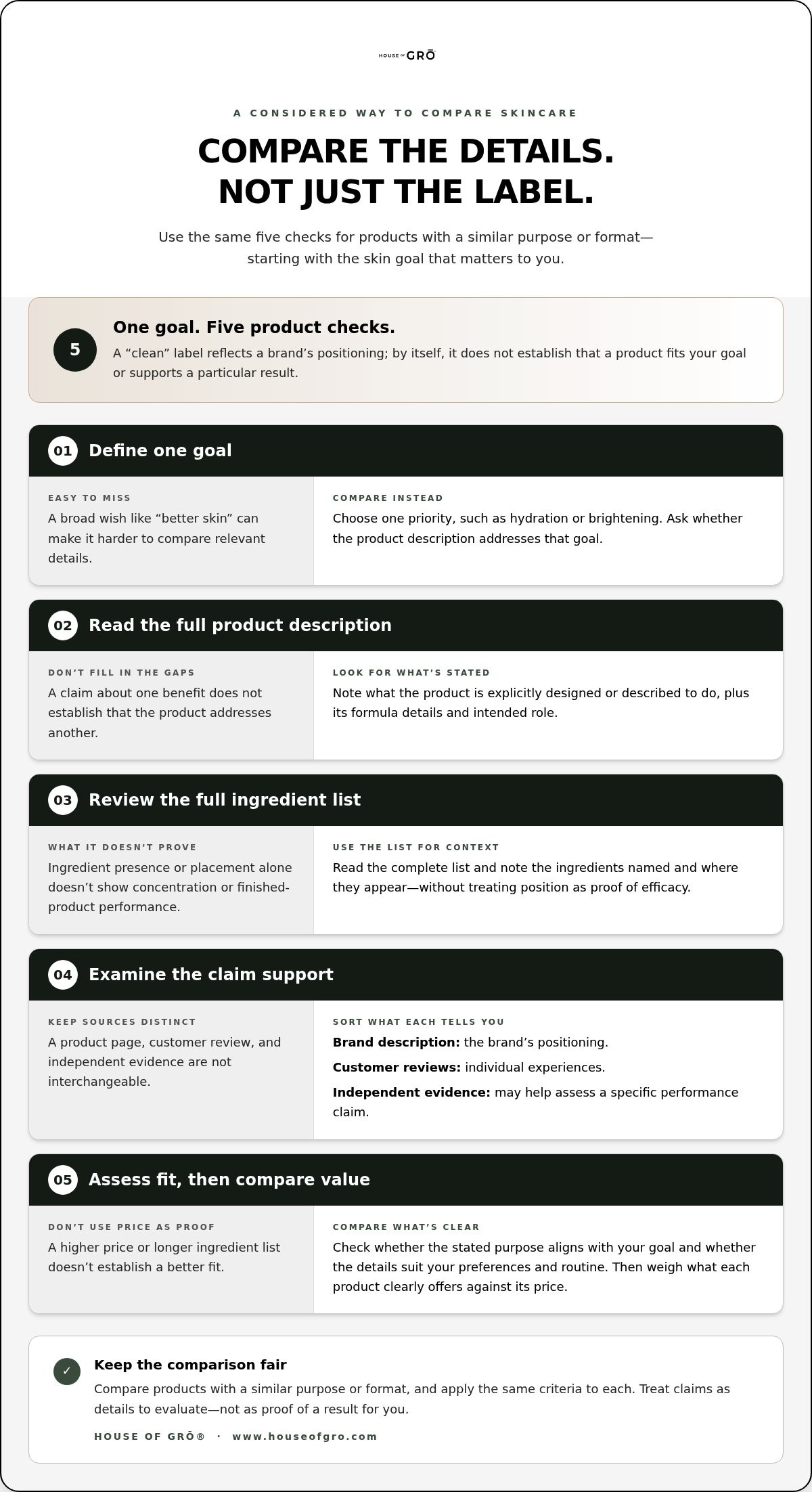
A useful comparison begins with your priorities, not the loudest claim on a product page. Use this checklist to move from a broad skincare goal to details you can assess. For a fair comparison, look at products with a similar purpose or format and use the same criteria for each.
- Define one goal. Choose the main thing you want a product to address, such as hydration or brightening. One priority makes it easier to compare relevant details instead of being pulled toward every trending ingredient or promise.
- Read the full product description. Note what the product is explicitly designed or described to do, along with any details about its formula and intended role. Don’t fill in gaps. If the description doesn’t mention a benefit you’re looking for, don’t assume it’s included.
- Review the full ingredient list. Look at the ingredients named and where they appear in the list, but don’t treat placement as proof of concentration or performance. Ingredient presence tells you something about the formula; by itself, it doesn’t show that the finished product achieves a particular outcome.
- Examine the claim support. Separate the brand’s own description from customer reviews and independent evidence. Product pages explain the brand’s positioning, reviews share individual experiences, and independent evidence may help assess a specific performance claim. Don’t let one type stand in for another.
- Assess fit, then compare value. Consider whether the product’s stated purpose aligns with your goal and whether its details suit your preferences and routine. Once you’ve narrowed the options, compare what each product clearly offers against its price. A higher price or a longer ingredient list doesn’t establish a better fit.
Start with your skincare goal, not the trend
Choose one priority before searching. A popular ingredient or “clean” label can prompt you to learn more, but neither establishes personal suitability or proves a result. Ask: does the product description address the goal I chose? Use the answer as a shopping filter, not a prediction or personalized medical recommendation.
Read ingredients and product claims with care
Read the complete list rather than focusing on one highlighted ingredient. Its position can offer context about the list, but it doesn’t reveal an exact concentration or establish efficacy. Look for specific descriptions of the product itself, and treat broad promises or superlatives as claims to evaluate, not proof. Keep brand statements, customer reviews, and independent evidence in separate mental columns.
This measured approach is the heart of results-driven clean beauty: compare what’s stated, what’s supported, and what matters to you. To apply the same thoughtful lens to a skincare brand’s product descriptions, explore HOUSE OF GRŌ skincare.
Do Clean Beauty Products Deliver Results? Compare Claims, Not Labels
Clean positioning alone proves neither that a skincare product works nor that it doesn’t. To assess a results claim, separate what the brand calls the product, what it says is in the formula, what outcome it claims, and what supporting information is available. This is more useful than relying on a broad category or a popular ingredient.
| What you’re comparing | What to look for | What it can tell you |
|---|---|---|
| Label language | Terms such as “clean” or “natural,” plus the brand’s explanation of its standards | How the brand positions its ingredient approach, not whether a product achieves a specific result |
| Stated ingredients | The full ingredient list and any ingredients highlighted in the description | What the brand says is in the formula, not proof that the ingredient produces a particular outcome in that product |
| Product-specific claims | A clearly stated outcome or purpose, if one is given | What the brand says the product is intended to do |
| Available evidence | Product-specific testing or other supporting information, if supplied | Whether the stated performance claim has support beyond descriptive language |
These categories answer different questions. An ingredient can appear in a formula without demonstrating that the finished product delivers a named benefit. A product description can state an intended purpose without showing the evidence behind it. For results-driven clean beauty, evaluate each claim on its own terms rather than treating a label, ingredient, or customer rating as proof of performance.
How to assess a skincare results claim
First, identify the exact outcome named in the product description. Is it a clear, specific purpose, or a broad phrase that could mean several things? Then look for support tied to that product and claim, such as product-specific testing when details are supplied. Descriptive language explains the brand’s message; it isn’t the same as evidence. Don’t infer clinical trials, certifications, or other proof unless the brand provides it. For readers applying this critical lens across their broader beauty regimen, resources from TRU BLOOM highlight how to distinguish unverified supplement claims from clinically backed results.
Market figures need the same care. Historical statistics cited in an ESW article may describe earlier market estimates or projections, but they don’t establish current 2026 market facts or show whether an individual skincare product works. Category growth and consumer interest offer context, not product-level evidence.
What reviews can and cannot tell you
Reviews are customer feedback, not controlled evidence or a promise of a universal outcome. Look for recurring themes, but read them as personal accounts shaped by individual skin and routines. Ratings and review counts show the volume and tone of feedback; they can’t predict what you’ll experience. Use them alongside the product’s stated claims and any available supporting evidence.
How to Build a Clean Beauty Shortlist That Fits Your Routine
A shortlist turns broad research into a practical choice. Start with your skincare goal, then keep products whose published descriptions speak to it. You don’t need to replace everything or assemble a new routine at once. Compare a few relevant options using the same criteria, and consider one change at a time.
Choose a first product with intention
Let your goal guide the product category. If you’re looking for a body serum, compare body serums rather than adding a face product simply because it features a trending ingredient. Check whether the description addresses your priority. Keep the decision focused on stated details, not imagined benefits or assumptions about how a product should be used.
Before browsing, write down what matters: format, ingredients you want to review, the product’s stated purpose, and the kind of supporting information you value. That filter keeps your shortlist relevant. It also helps you spot when an appealing label or ingredient spotlight isn’t enough to show a match for your goal.
Balance product fit with premium value
Price belongs in the comparison, but it doesn’t establish performance or suitability. Weigh the listed price alongside the product format, description, ingredient details, and customer feedback. Keep each factor in its lane: reviews offer customer perspectives, while a product description tells you how the brand presents the formula.
For instance, At Dawn - Rejuvenating Daytime Oil is listed at $160.00 and has a 4.9/5 rating from 84 reviews. Those details provide price and customer-feedback context, not a guarantee of an individual result. This is the measured approach behind results-driven clean beauty: decide based on relevant, stated information rather than assuming cost or popularity proves a product is right for you.
Use this checklist as a worksheet. Fill it with published product information only. If a detail isn’t stated, leave it blank rather than guessing.
- Product and format: What is the product, and what format is it?
- My chosen goal: What priority am I using to guide this comparison?
- Stated purpose: What does the product description say it is intended to address?
- Ingredient details: Which ingredients are listed or highlighted? Don’t infer concentration or unlisted benefits.
- Customer feedback: What rating and review count are shown, if provided? Treat them as feedback, not a promise.
- Listed price and fit: What is the published price, and do the product details align with what matters to me?
Compare your notes and choose the option that aligns most closely with your goal and preferences, or pause if none feels like a clear fit. For a focused look at a skincare range as you build your shortlist, explore HOUSE OF GRŌ skincare.
HOUSE OF GRŌ®: A Mushroom-Powered Option for Considered Skincare
With a comparison framework in place, HOUSE OF GRŌ® offers a brand-specific option to consider. Founded by siblings Irina Gottesman and Sam Kandhorov, the luxury skincare brand draws on three generations of family wellness practices. Its story connects that heritage with a modern skincare routine, without making the heritage a promise of a particular result.
What the brand's stated story and product details offer
HOUSE OF GRŌ® describes its approach as mushroom-powered skincare for naturally radiant, hydrated skin. The brand says Chaga is hand-harvested from Maine birch trees and appears in several formulas. This sourcing detail is part of the brand’s product story; it shouldn’t be assumed to apply to every formula or to any one product unless its details say so.
Use these points as you would any product information: distinguish the brand’s stated story from a specific performance claim. Mushroom-powered describes the approach; it doesn’t, by itself, establish what a product will do for an individual. To compare the range with your goal, review each product’s details and weigh them against the criteria you’ve chosen.
Explore At Dawn as a considered daytime skincare choice
At Dawn - Rejuvenating Daytime Oil is one option to consider if its published details align with your shortlist criteria. It is listed at $160.00 and has a customer rating of 4.9/5 from 84 reviews. Those figures provide price and customer-feedback context. They don’t guarantee a particular result or establish that it’s the right fit for every routine.
HOUSE OF GRŌ® also offers After Dark - Restorative Night Serum at $175.00, with a 4.9/5 rating from 123 reviews; Eye Detox - Brightening Oil at $132.00, with a 5/5 rating from 74 reviews; and Touch - Hydrating Body Serum at $118.00, with a 5/5 rating from 36 reviews. Eye Detox finishes matte, and Touch includes a roller applicator. The range also includes Feel - Relief Salve at $135.00, with a 5/5 rating from 5 reviews; it delivers targeted, cooling relief. The Essential Bundle, a bundle of selected products, is listed at $349.00. Use the product names, formats, listed prices, and customer feedback to decide which details fit your comparison, without treating ratings as a prediction of your experience.
The brand offers a 30-Day Money-Back Guarantee, shipping not included. If At Dawn fits the criteria you’ve set, explore HOUSE OF GRŌ® skincare and review its product details as part of your skincare choice.
2024 House of GRŌ® All Rights Reserved.
Make Your Next Skincare Choice With Intention
Your next step doesn’t need to be a complete routine reset. Start with one thoughtful choice. Notice what matters in a product, what aligns with your priorities, and whether its stated details make it a fit for your routine. A measured approach keeps skincare personal instead of turning every new claim into a reason to change course.
That’s the value of results-driven clean beauty: choosing with clarity while leaving room for your own experience. There’s no need to chase every trend or decide in a hurry. Start with a product that speaks to your priorities, then assess its details at your own pace.
Ready to take that next step? Explore HOUSE OF GRŌ® skincare and compare the product details with your goals.
Frequently Asked Questions
What does results-driven clean beauty mean?
Results-driven clean beauty means choosing skincare by weighing its stated purpose and available support alongside the brand’s clean beauty approach. The phrase isn’t a formal product category with a shared performance standard. If your priority is hydration, for example, look for a product description that specifically addresses hydration, then distinguish that stated purpose from evidence about the formula. This makes the phrase a decision framework, not a promise.
Is clean beauty as effective as conventional skincare?
“Clean” and “conventional” don’t establish effectiveness on their own. A product’s performance depends on its formula and the claim being made, not simply the label a brand uses. Compare the specific outcome described and any supporting information available for that product. Don’t assume a clean-positioned product is more or less effective than another formula based on category language alone. Judge the details, not the label.
How can I tell whether a clean beauty brand is transparent?
Look for clear, consistent product information that lets you understand what’s being claimed. A transparent product page makes the full ingredient list easy to find, describes the product’s intended purpose, and distinguishes factual details from broad brand language. If a brand mentions testing or other support, check whether it explains what was assessed. Specific information is more useful than sweeping claims without product-level context.
Can clean beauty products deliver visible results?
Products may deliver results described by the brand, but visible outcomes aren’t guaranteed for every person. Skin and routines vary, and an ingredient’s presence doesn’t establish what the finished formula will do. Before choosing, identify the exact change you hope to see and check whether the product description addresses it. Treat customer stories as individual experiences, not a forecast of how your skin will respond.
What should I look for when comparing clean skincare ingredients?
Start with the complete ingredient list rather than relying only on highlighted ingredients or a “free-from” claim. Note which ingredients are named in the product description and whether the brand explains their role. Don’t infer a precise concentration from list placement or assume an ingredient guarantees a benefit. If you have a known sensitivity, use the list as a reference and seek appropriate professional guidance for personal health concerns.
How do I choose a clean beauty product for my skincare goals?
Choose one priority first, such as finding a product whose stated purpose relates to hydration or brightening. Then compare products in the same format, review their descriptions and ingredient lists, and note any support the brand provides. Keep the shortlist small enough to assess calmly. If no option clearly matches your goal based on published details, pause rather than buying because of a trend or an appealing claim.
Is HOUSE OF GRŌ®'s At Dawn oil reviewed by customers?
Yes. At Dawn - Rejuvenating Daytime Oil has a 4.9/5 rating from 84 reviews. That rating reflects customer feedback and offers a sense of how reviewers describe their experiences, but it can’t guarantee the same outcome for you. Read reviews as personal accounts, and consider them alongside the product’s stated details and your skincare priorities when deciding whether it belongs on your shortlist.