


What if the first step toward a brighter-looking complexion isn’t another product, but a closer look at what your skin may be responding to? If you’ve thought, “my skin looks dull and tired,” you’re not alone, and it doesn’t automatically mean your routine is missing something. Dehydration, a buildup of dead skin cells, sun exposure, weather, and everyday habits can all affect how skin looks.
It’s easy to feel pulled between conflicting advice: exfoliate more, add a new active, change everything. But a tired-looking complexion isn’t a diagnosis, and a longer routine isn’t always a gentler one. Pause to notice what’s already working and where a small adjustment may make sense.
This guide covers common contributors, ways to review your current skincare habits, and manageable next steps. It also explains when a persistent or concerning change is worth discussing with a healthcare professional. A calmer routine starts with understanding what you’ve noticed, then responding with care.
Key Takeaways
- When you think “my skin looks dull and tired,” remember that appearance alone can’t identify the cause.
- Review your current products and recent changes before adding anything new. Adjust one routine element at a time so you can notice patterns.
- Build a manageable plan around gentle cleansing and consistency, then observe how your skin responds.
- Consider routine, environment, and daily habits together rather than assuming one factor explains a change in your complexion.
- At Dawn - Rejuvenating Daytime Oil can be an optional part of an intentional skincare ritual, but no single product can be expected to resolve dullness.
My skin looks dull and tired: what that appearance may mean
The mirror can catch you off guard. Your complexion may seem less bright than usual, or its texture may look uneven in a way you hadn’t noticed before. If you’re thinking, “my skin looks dull and tired,” that observation is worth acknowledging, but it doesn’t reveal the cause. Skin appearance can shift for different reasons, and a single glance can’t tell you which one applies.
Start with description, not diagnosis. Notice what looks different and whether the change passes or persists. You don’t need to assume your skin needs a stronger routine or another product.
What people usually mean by dull-looking skin
“Dull” is a plain-language way to describe skin that seems to have less visible brightness or radiance. You might notice a rougher-looking surface, an uneven-looking tone, or a complexion that appears flatter than usual. These observations describe what you see; they don’t identify a medical condition or explain why the change occurred.
Skin tone and perceived radiance are not quite the same thing. Tone describes the color of skin, while “dull” usually refers to how bright or even its surface appears to you. For background on factors influencing skin tone, remember that color variation alone doesn’t define skin health. A familiar complexion can look different under varied lighting, after a change in routine, or at a different time of year. Where possible, look in consistent, natural light before deciding that something has changed.
There isn’t one fix that suits everyone. Exfoliation or a new product may be unnecessary, and a change in appearance by itself doesn’t show what your skin needs. The useful first step is to notice a pattern before reacting to it.
When the change appeared and what to notice
Think back to when you first noticed the difference. Did it appear suddenly or emerge gradually? What else changed around that time? You don’t have to connect the dots yet. Simply note details that may help you describe the change clearly.
- Any recent change to your skincare routine, including a new product or a different cleansing habit.
- A shift in season, weather, or time spent outdoors.
- Changes in sleep, stress, or other everyday routines.
- Whether the appearance is settling, persisting, or changing alongside discomfort or other visible concerns.
A brief note on your phone or calendar can help you track what you observe without overchecking your skin. Temporary variation may settle, while a change that persists, worsens, feels uncomfortable, or comes with other concerning symptoms deserves more attention. Skin appearance alone can’t tell you whether there’s an underlying issue. If you’re worried or the change isn’t resolving, seek advice from a qualified healthcare professional. Your notes can help you explain what you’ve noticed and when it began.
Why skin can look dull and tired: routine, environment, and daily habits
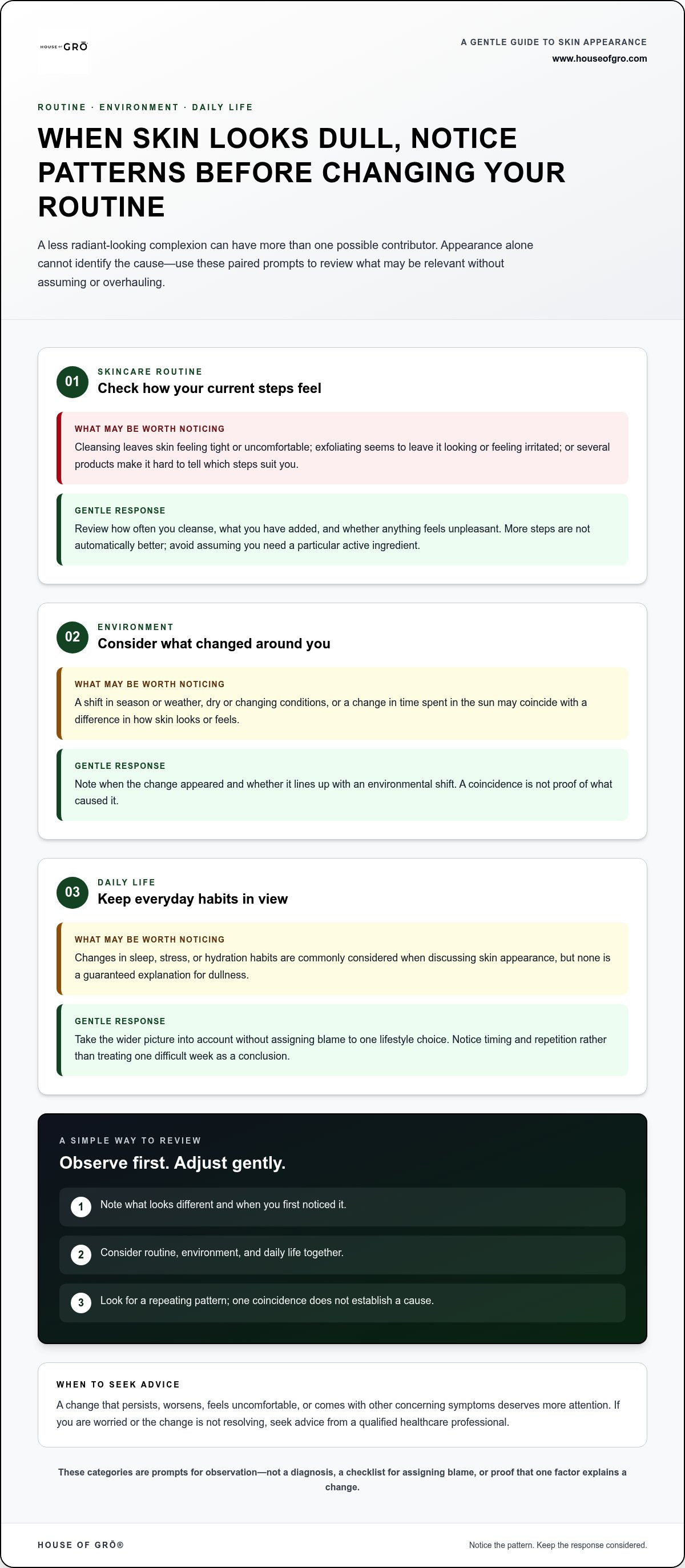
A less radiant-looking complexion can have more than one possible contributor. Your routine, surroundings, and day-to-day habits may all be relevant, but appearance alone can’t identify a cause. If you’re thinking, “my skin looks dull and tired,” treat it as a prompt to notice patterns, not proof that you’ve done something wrong or need a stronger product.
Sorting possibilities into three broad areas can keep the search manageable, rather than turning every suggested cause into another reason to change your routine.
Skincare habits that may affect how skin appears
Your routine may be worth reviewing if cleansing leaves your skin feeling tight or uncomfortable, or if exfoliating seems to leave it looking or feeling irritated. Using several products can also make it harder to tell which steps suit you. These signs don’t diagnose a problem, but they are useful reasons to pause and consider whether your routine feels comfortable and manageable.
More steps aren’t automatically better. A product that doesn’t suit your skin, or frequent changes that make it difficult to see how your skin responds, may complicate your routine. Rather than assuming you need a particular active ingredient, first look at how often you cleanse, what you’ve added, and whether anything feels unpleasant.
Everyday and environmental factors to consider
Sun exposure, seasonal weather, and dry or changing conditions can influence how skin looks and feels. Sleep, stress, and hydration are also commonly considered in discussions of skin appearance, but none should be treated as a guaranteed explanation for dullness. A difficult week or a change in weather may coincide with a complexion change without proving what caused it.
Keep the wider picture in view. Skin can respond to several influences at once, and one person’s pattern may not explain another’s. Consider these categories as prompts for observation, not a checklist that assigns blame:
- Routine: changes in cleansing, exfoliation, or the number of products used.
- Environment: shifts in season, weather, or time spent in the sun.
- Daily life: changes in sleep, stress, or hydration habits.
Look for timing and repetition. For example, note whether a change appeared after a new routine step, during a seasonal shift, or alongside a change in your usual schedule. One coincidence is not a conclusion. A repeating pattern may give you a more useful starting point for reviewing your habits, while persistent or uncomfortable skin changes deserve professional advice.
Keep the review gentle. You don’t have to overhaul your routine or pin the change on one lifestyle choice. If you’re drawn to a more considered approach to daily skincare, explore these thoughtful skincare rituals as one source of inspiration.
How to review your skincare routine without adding more products
If you’re thinking, “my skin looks dull and tired,” it can be tempting to reach for a new serum or add another step. Try a quieter first move: take stock of what you already use. A clear routine record can help you notice changes without treating every suggestion as something your skin needs.
Follow this simple sequence. Keep it practical, not perfect.
- List your current products. Note what you use in the morning and evening, including cleansers, moisturizers, and exfoliating products.
- Mark what’s new or changed. Add when you introduced a product, changed how often you use it, or altered another part of your routine.
- Notice your skin’s response. Record whether a step seems linked with tightness, stinging, redness, or other discomfort. A coincidence isn’t proof, but it’s useful information.
- Simplify where you can. Consider whether every step has a clear purpose. Avoid layering extra products just to address dullness.
- Observe, then reassess. Keep the routine steady enough to notice patterns. Revisit your notes when it feels useful, without expecting a specific timeline for visible change.
Changing one routine element at a time makes it easier to see what may be connected to a change in how your skin looks or feels. If several products or habits change together, the picture gets harder to read. Consistency doesn’t mean following a rigid routine forever. It means making adjustments thoughtfully rather than reacting to every new piece of advice.
A simple routine audit for dull-looking skin
Start with three questions: Which products are new? Which do you use most often? Does any step seem to leave your skin uncomfortable? These questions focus your review on the routine you actually have, instead of an idealized one built from a long list of recommendations. You may find that simplifying is a more useful experiment than adding another layer.
If you’re reading about microbiome skincare, use it as a prompt to stay curious, not as a reason to buy specialized products automatically. The same principle applies to skincare trends generally: first consider whether the advice fits your own routine and observations.
When a sensitive-skin perspective may help
If your routine regularly leaves your skin feeling irritated or uncomfortable, take that response seriously and review your steps gently. Exploring guidance on skincare for sensitive skin may offer useful context, but no single routine suits everyone. If discomfort persists or the skin change concerns you, seek advice from a qualified healthcare professional rather than trying to solve it by adding more products.
How to build a gentle plan when your skin looks dull and tired
A thoughtful plan doesn’t need to be a complete reset. If you’re wondering what to do when my skin looks dull and tired, begin with one manageable change and treat it as an experiment, not a prescription. Keep the rest of your routine familiar where practical. Notice how your skin feels and looks over time, without expecting a guaranteed result or a fixed timeline for change.
Start with small, observable changes
Choose an adjustment that feels simple to maintain, such as returning to gentle cleansing or pausing a step that seems to cause discomfort. Avoid increasing exfoliation or introducing several active ingredients at once. That can make it harder to identify what your skin tolerates. Keep brief notes about comfort and visible changes, and look at them occasionally rather than comparing your complexion every day.
A gentle plan can stay uncomplicated:
- Keep cleansing comfortable. Use a gentle approach and avoid scrubbing or washing in a way that leaves skin feeling tight or irritated.
- Keep the routine steady. Continue familiar steps that feel comfortable instead of adding products simply because your skin looks less radiant.
- Change one thing at a time. Give yourself room to notice whether an adjustment seems helpful, neutral, or uncomfortable before making another change.
Sun protection is also a practical part of caring for skin. The American Academy of Dermatology recommends broad-spectrum sunscreen with SPF 30 or higher, alongside shade and protective clothing. Follow the sunscreen’s directions for use and reapplication. Sun protection is a preventive habit, not a promise to correct dullness, and it doesn’t replace professional advice about a skin change that concerns you.
Know when self-care is not the whole answer
A complexion that looks less bright can have varied explanations, and dullness alone doesn’t mean you’re unwell. Still, arrange professional advice if a change persists, appears suddenly, worsens, or comes with discomfort or other skin changes that concern you. A dermatologist can assess your skin in context; you don’t need to diagnose the cause yourself before seeking guidance.
Make the plan responsive, not rigid. If a routine adjustment seems to increase irritation, stop and consider seeking professional advice rather than pushing through or adding more steps. If you’re unsure what to change, keep your routine simple and bring your observations to a healthcare professional. Notes about when the change began, what you altered, and how your skin feels can help make that conversation clearer.
Once your care feels manageable, you can choose whether to make it a more intentional daily ritual. Explore HOUSE OF GRŌ® skincare as one option, while keeping your routine guided by what feels comfortable for your skin.
A more intentional morning ritual with HOUSE OF GRŌ®
Once you’ve taken time to understand your routine, an optional product can be part of a thoughtful daily ritual. House of GRŌ® is a family-owned skincare brand rooted in three generations of family wellness practices. Its story offers a personal perspective on skincare, but no one product can promise to resolve a change in complexion. If you’re still thinking, “my skin looks dull and tired,” keep your needs and comfort at the center of any choice.
Where At Dawn fits into the brand’s story
At Dawn - Rejuvenating Daytime Oil is the brand’s daytime oil. House of GRŌ® draws on family wellness practices passed through three generations, and its story was inspired by co-founder Irina Gottesman’s great-grandmother and her recognition of mushrooms’ potential for skin. Chaga mushrooms hand-harvested from Maine birch trees feature in several of the brand’s formulas. These details are part of the brand’s story, not evidence that the oil will produce a particular result.
At Dawn - Rejuvenating Daytime Oil costs $160.00 and is rated 4.9/5 from 84 reviews. Ratings can offer a glimpse of other customers’ experiences, but they can’t predict how a product will work for you or determine what may be behind a dull-looking complexion. Consider it only if it feels like a considered fit for the routine you’ve already reviewed. There’s no need to add it, or any other product, simply because you want a faster change.
Continue exploring radiant-skin rituals
If you want to keep learning, explore the broader ideas behind how to get radiant skin and the background of Chaga benefits. Let those topics support thoughtful questions, not pressure to collect more products. A calm ritual might simply mean tending to the routine you already have with greater attention. The best next step is one that feels manageable, informed, and responsive to your own skin.
House of GRŌ® describes its mission as mushroom-powered skincare for naturally radiant, hydrated skin. That is the brand’s stated mission, not a guaranteed outcome. Skin changes for different reasons, and a product can’t replace professional guidance when a concern persists or feels unusual. Keep practical foundations in place, including a routine that feels comfortable and sun protection suited to your needs.
If a daytime oil feels like a meaningful addition to your personal ritual, explore House of GRŌ® and At Dawn - Rejuvenating Daytime Oil.
2024 House of GRŌ® All Rights Reserved.
Let your next step be a gentle one
If you catch yourself thinking, “my skin looks dull and tired,” you don’t have to treat that thought as a demand to change everything. Let it be an invitation to pay attention. A considered routine can make space for what your skin seems to need, while leaving room to pause when something feels uncomfortable or concerning.
Radiance isn’t a daily test to pass. Some days your complexion may look different, and that doesn’t automatically call for a new step. Choose care that feels steady and personal rather than chasing a quick transformation. If a simple ritual helps you bring more intention to the start of your day, discover the approach behind HOUSE OF GRŌ® skincare.
Move at your own pace. Keep what feels thoughtful, let go of pressure, and seek professional guidance when a skin change worries you. Small, attentive choices are a meaningful place to begin.
Frequently Asked Questions
Can dull-looking skin be a sign of a medical condition?
Sometimes, but a dull appearance by itself can’t show whether a medical condition is involved. Skin can look less bright for many reasons, including ordinary shifts in routine or surroundings, and appearance alone isn’t enough to identify one. If the change persists, feels unusual, or appears with symptoms such as pain, itching, swelling, or a new rash, arrange an assessment with a healthcare professional. Your concern is valid, even if the cause proves minor.
Is dull skin the same as dehydrated skin?
No. Dullness describes how the complexion appears; dehydration is one possible contributor discussed in skincare guidance. Thinking “my skin looks dull and tired” doesn’t establish that your skin is dehydrated or that you need to drink more or apply a particular product. A mirror can’t determine hydration status. Consider your wider routine and how you feel overall, and seek professional guidance if the concern persists or you’re unsure what the change means.
Can stress make my skin look dull and tired?
Stress may be one factor worth noticing, but it can’t be assumed to cause a change in your complexion. If your skin seems different during a demanding period, note whether sleep, your usual skincare, or other routines shifted too. That context may help you describe a pattern, but it doesn’t prove a cause. If the change persists or brings discomfort, consult a healthcare professional rather than relying on a skincare product to resolve it.
How much water should I drink for brighter-looking skin?
There isn’t one water target that guarantees brighter-looking skin. Hydration needs vary, and drinking more than your body needs isn’t an established quick fix for complexion. Follow reputable health guidance where you live, and ask a clinician for advice if you have a health condition or questions about fluid intake. When considering hydration, pay attention to overall wellbeing rather than using skin brightness alone as a measure of whether you’re drinking enough.
What happens if my skin still looks dull after I simplify my routine?
If your complexion looks unchanged, it doesn’t mean you should automatically reach for stronger exfoliants or layer new active ingredients. A routine adjustment may not address every contributor, and appearance can’t identify which factor matters. If the change continues, appears suddenly, or comes with discomfort or another symptom, seek a healthcare professional’s assessment. A brief note of when you noticed it and what changed in your routine can help you explain your concern.
Can sleep affect how tired my skin looks?
Sleep is discussed as one possible influence on skin appearance, but a tired look can’t show that sleep is the cause, and rest alone can’t promise radiance. Consider whether your sleep pattern changed around the time you noticed your complexion. Those looking to cultivate a calmer rest environment often explore grounding bed sheets and mats from makers like Sleep Earthed as part of their nightly routine. If poor sleep continues or affects your wellbeing, discuss it with a healthcare professional. For sleep goals, follow current guidance from reputable health sources rather than relying on skincare advice.