


The best overnight anti-aging treatment isn’t necessarily the strongest formula or the one promising a morning transformation. It’s a product that suits your skin, fits your routine, and feels comfortable to use consistently. Overnight skincare can support hydration and a cared-for appearance, but it won’t erase fine lines by morning. A realistic routine matters more than a dramatic promise.
Choosing what belongs in your evening routine can still feel complicated. Creams, serums, and other treatments come in different textures and serve different purposes. A practical place to start is with what you want to address, what you already use, and what your skin tolerates.
This guide will help you set realistic expectations, compare treatment types, and make sense of ingredients without turning your evening routine into a guessing game. You’ll also find a simple way to build a ritual around cleansing and moisturizing, with an overnight option such as House of GRŌ®’s AFTER DARK Restorative Night Serum. A considered routine can be simple, comfortable, and easy to return to.
Key Takeaways
- Choose the best overnight anti-aging treatment by matching its purpose to your skin’s needs and your comfort with its ingredients.
- Compare creams, serums, and other formats by intended purpose, texture, and how they fit your routine.
- Focus on one or two skin goals instead of layering treatments for every concern.
- Keep your evening ritual simple: cleanse, apply your treatment as directed, and moisturize if appropriate.
- Explore how AFTER DARK Restorative Night Serum fits House of GRŌ®’s botanical and adaptogenic approach to nighttime skincare.
What Is the Best Overnight Anti-Aging Treatment for Your Skin?
An overnight treatment is a skincare product used in the evening to support a particular skin goal. It might be a serum, cream, or another format. “Treatment” describes the product’s purpose, not its texture or type.
That distinction makes choosing easier. A night cream is one option, but it isn’t the whole category. The best overnight anti-aging treatment for you depends on your priorities, how your skin responds, and how well the product fits with the rest of your routine. A richer texture isn’t automatically more effective than a lighter one, and a serum isn’t automatically a better choice than a cream.
How do creams, serums, and overnight treatments differ?
An overnight treatment is a skincare product used in the evening to support a specific skin goal. Creams and serums describe formats; treatment describes purpose. Creams often feel richer, while serums are typically lighter, but textures vary between formulas. Texture affects how a product feels and layers with other steps, so consider whether you’ll enjoy using it. Follow the product’s directions rather than assuming every serum or cream should be layered in the same way.
Evaluate claims with the same care. Skin aging involves multiple biological processes and influencing factors, as outlined in this overview of understanding skin aging. A topical product may support a particular skincare goal, but a promise of dramatic change by morning is not a useful basis for choosing one. Look for a clear purpose and realistic language, not just an appealing claim on the label.
Which skin concerns can guide your first choice?
Start with one priority. If your skin feels dry or tight, consider whether hydration is your main need. If you’re focused on visible texture or specific skin concerns, resources from skincare brands like VENSIA can help you identify products whose stated purpose aligns with that goal. If your skin feels unsettled, simplifying your routine may be a better starting point than adding another active formula.
Before introducing a new treatment, take stock of what you already use, especially products with active ingredients. Adding several new formulas at once makes it harder to identify what your skin tolerates. Introduce changes thoughtfully and pay attention to how your skin feels. If sensitivity is a concern, consider seeking advice from a qualified healthcare professional.
Your evening routine doesn’t need to be elaborate to feel considered. For more context on shaping the steps around your needs, explore this night skin care regimen. A clear goal, a suitable format, and a routine you can maintain are a steadier starting point than chasing a product that promises everything.
How Overnight Skincare Supports a Restorative Evening Routine
An evening product can support skin comfort while you sleep. That’s different from claiming it reverses aging or repairs skin overnight. A moisturizer, for example, may help reduce the feeling of dryness. A formula designed around a particular concern can also have a place in a broader routine. Neither promises a sudden transformation by morning.
Overnight products can support a consistent skincare routine, but they can’t guarantee an overnight transformation. How your skin looks and feels depends on the formula, your skin, your other routine steps, and regular use. A softer-feeling surface or a more hydrated appearance may be a reasonable cosmetic aim. Results and experiences vary.
What can a nighttime product realistically do?
Hydration can help skin feel supple and make its surface look temporarily smoother. A comfortable skin barrier also helps skin retain moisture, so avoiding unnecessary irritation may support a calmer, more comfortable feel. These are modest goals, not proof that a product has reversed the processes associated with skin aging.
Nighttime is simply one opportunity to follow a routine. Sleep alone doesn’t determine how a product performs, and there’s no universal timeline for visible changes. Notice how your skin responds over time instead of judging a formula by how it looks one morning.
How do common anti-aging ingredients fit into the picture?
Ingredient categories can help you understand a formula’s intended role, but they don’t guarantee a particular result. Retinoids are commonly used in skincare aimed at visible signs of aging, though they may not suit every skin or routine. Peptides appear in products formulated around concerns such as the look of firmness. Ceramides are associated with supporting the skin barrier, while hyaluronic acid is used to attract and hold moisture.
Suitability and tolerance vary. Consider what you already use before adding an active formula, and follow the product directions. If your skin is sensitive, a gentler, simpler routine may be a better starting point than combining several actives. For more on skin balance and the microbiome, read the microbiome skincare guide.
The best overnight anti-aging treatment isn’t defined by a long ingredient list. Choose with a clear purpose, then give your routine room to be consistent. If you’re drawn to an intentional, botanical approach to skincare, explore House of GRŌ’s skincare philosophy.
How to Compare Overnight Anti-Aging Treatments Without Chasing Hype
A useful comparison starts with your routine, not a ranking. The best overnight anti-aging treatment is the one that suits your skin needs and your routine. Before choosing, name one or two priorities, such as hydration or the look of texture. Trying to address every concern with several products at once can make your routine harder to follow and harder to assess.
Which comparison criteria matter most?
Look beyond the product name. Compare its stated purpose with your main concern, then consider the texture you’ll enjoy using and how it fits with your current steps. A clear ingredient list can help you understand what’s in a formula, but a longer list or more active ingredients doesn’t automatically mean better results. Fit and tolerance matter.
Use this table as a starting point. Formats and formulas vary, so check each product’s directions and claims.
| Product format | Intended role | Texture | Routine considerations |
|---|---|---|---|
| Cream | Often chosen for moisturizing and comfort | Can range from light to rich | Consider how it feels alongside other moisturizing steps |
| Serum | May be formulated around a specific skin goal | Often fluid or lightweight, though formulas differ | Check its directions and how it fits with your other products |
| Facial oil | Can be selected to complement a moisturizing routine | Typically has a smooth, oil-based feel | Consider your texture preference and the order stated on the label |
| Overnight mask | Designed as an evening care step; intended use varies | May feel more substantial than a leave-on serum | Follow the directions for frequency and layering |
Editorial picks and bestseller lists can introduce options, but popularity isn’t a personalized recommendation. Return to your goal, the product’s stated role, and whether you’re likely to use it consistently.
How can you reduce irritation and routine overload?
Introduce one new product at a time. That makes it easier to notice how your skin responds and to identify which change may be behind discomfort. Follow the label rather than assuming products can be layered in any order. Avoid combining multiple potent active formulas unless reliable, product-specific directions support that routine.
If irritation develops, pause the new product. A thoughtful routine leaves room to adjust. More steps aren’t always more care.
How to Use an Overnight Treatment in a Simple Night Routine
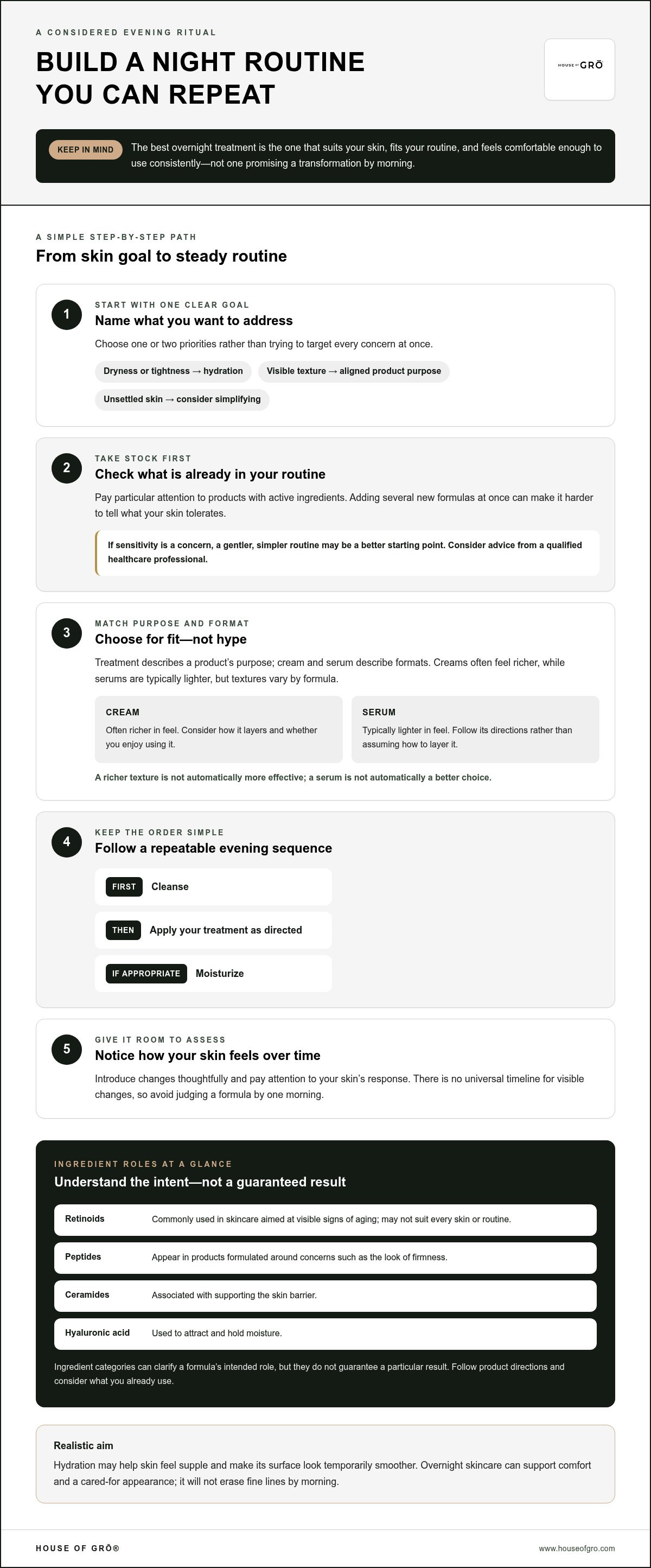
A good evening routine should feel easy to return to. Start with gentle cleansing, use your chosen treatment according to its directions, then apply moisturizer if it suits the formula and your skin. The best overnight anti-aging treatment is only useful in practice if you can use it comfortably and consistently.
What is a practical order for nighttime skincare?
Keep the sequence simple and let product instructions guide the details. A flexible starting point:
- Cleanse gently. Remove the day’s buildup without leaving skin feeling stripped.
- Apply your treatment as directed. Check whether the instructions call for clean, dry skin or another preparation.
- Moisturize if appropriate. Follow the product’s guidance on layering rather than assuming every treatment pairs with every cream.
Your existing routine may include other steps, so treat this as a framework, not a rule that overrides product labels. Some formulas have specific directions about order or frequency. Applying more than directed, or adding extra layers to speed results, can make a routine less comfortable without guaranteeing better outcomes.
How should you introduce a new overnight product?
Make one change at a time. Use the product as directed and observe how your skin feels over time instead of switching formulas frequently or judging the result after a single use. A simple note about comfort, dryness, or visible changes can help you assess whether the step feels right for you.
If the label recommends patch testing, follow its instructions. If irritation develops, pause use and consider seeking professional guidance, especially if discomfort persists. For a gentler perspective on building a routine, explore this sensitive skin skincare guide.
Let the ritual be uncomplicated: cleanse, apply thoughtfully, and give your skin time to respond. Explore House of GRŌ®’s intentional skincare approach for an overnight option designed to be part of an evening routine.
Make AFTER DARK Restorative Night Serum Part of an Intentional Ritual
House of GRŌ®’s overnight skincare option is AFTER DARK Restorative Night Serum. It’s part of a range shaped by adaptogenic mushrooms, organic botanicals, and modern skincare thinking. This approach offers a point of comparison if you’re looking for a nighttime step that aligns with a more intentional routine. It doesn’t promise a particular clinical result.
What defines House of GRŌ®’s approach to nighttime skincare?
Founded by siblings Irina Gottesman and Sam Kandhorov, House of GRŌ® brings a family-founded perspective to modern wellness. The brand describes its formulas as microbiome-friendly and highlights wild-harvested Chaga from Northern Maine as part of its broader ingredient story. These are brand-level details, not a list of ingredients in AFTER DARK. The serum’s product information provides its specific composition.
This distinction matters. A brand philosophy can help you decide whether an approach resonates with you, while the individual product label and directions give you details for choosing and using a formula. Ingredient transparency and personal tolerance both matter.
How can a restorative serum fit a considered routine?
Let the serum be one deliberate step, not a reason to add several more. Keep the rest of your routine familiar, and follow AFTER DARK Restorative Night Serum’s product directions for application and layering. If you’re introducing it, make that the only new change for now. Notice how the routine feels and give yourself time to decide whether it’s comfortable to maintain.
The best overnight anti-aging treatment isn’t defined by an ambitious promise. It’s a considered choice that fits your skin needs and becomes part of a routine you can return to. A few quiet minutes in the evening can be a personal ritual of care, without turning skincare into a measure of overnight transformation.
Explore House of GRŌ® and its approach to intentional skincare at Explore House of GRŌ®.
Choose a Nighttime Ritual You Can Return To
The best overnight anti-aging treatment is less about a dramatic promise and more about a considered fit. Start with one or two skin priorities, compare a product’s purpose and texture, and follow its directions. A simple routine you use comfortably is more useful than a crowded shelf of formulas you’re unsure how to layer.
Overnight skincare can support hydration and a softer-feeling surface, but it can’t guarantee transformation by morning. Let your skin’s comfort guide your choices. Introduce new products thoughtfully, then give yourself time to notice how they fit.
House of GRŌ® brings adaptogenic mushrooms and organic botanicals into its skincare approach. The brand describes its formulas as microbiome-friendly, all-natural, and cruelty-free. AFTER DARK Restorative Night Serum is part of the range’s nighttime offering, without needing to promise more than a consistent ritual can deliver.
Explore House of GRŌ® and discover an evening practice that feels intentional, simple, and your own.
Frequently Asked Questions
What is the best overnight anti-aging treatment?
The best overnight anti-aging treatment is one that matches your skin’s needs, feels comfortable, and fits your routine. Start by choosing a priority, such as hydration or the appearance of texture. Then compare the product’s stated purpose, ingredients, and directions with what you already use. No single cream or serum is right for everyone, and a consistent, comfortable routine is more useful than chasing dramatic overnight promises.
Can an overnight treatment reduce the appearance of fine lines?
An overnight treatment may temporarily soften the appearance of fine lines if it helps hydrate the skin, but it can’t promise to erase them by morning. What you notice depends on the formula, your skin, and how the product fits into your routine. Choose a treatment with a clearly stated purpose, follow its directions, and think in terms of gradual cosmetic support rather than an instant transformation.
How often should I use an overnight anti-aging treatment?
Use an overnight treatment as often as its product directions recommend. Some formulas are intended for regular use, while others may call for a different frequency. If you’re introducing a new product, make it your only routine change and observe how your skin feels. Don’t apply more than directed in an effort to speed results. Pause use if irritation develops, and seek professional guidance if discomfort persists.
What is the difference between a night cream and an overnight serum?
A night cream and an overnight serum are different product formats, while “overnight treatment” describes a product’s role in an evening routine. Creams often feel richer, and serums are often more fluid, though textures vary by formula. Neither format is automatically more effective. Choose based on the product’s purpose, your texture preference, and its directions for application and layering with other skincare.
Should I use retinol in my overnight skincare routine?
Retinol may suit some routines, but it isn’t a universal choice. Consider your skin’s tolerance, the other products you use, and the retinol product’s specific directions before adding it. Start with one new product at a time rather than combining several active formulas without clear guidance. If you have sensitive skin, ongoing irritation, or questions about whether retinol is appropriate for you, consult a qualified healthcare professional.
Does an overnight treatment replace moisturizer?
Not necessarily. An overnight treatment may focus on a particular skin goal, while a moisturizer is generally used to support skin hydration and comfort. Some products may serve more than one role, but don’t assume every serum replaces moisturizer or that every formula should be layered. Check the product’s stated purpose and directions, then add moisturizer if it suits your routine and the instructions allow it.
How long does it take to see results from an overnight treatment?
There’s no set timeline that applies to every overnight treatment. Skin may feel softer or more hydrated after use, but visible changes vary with the formula, your skin, and regular use. A single morning isn’t a reliable measure of longer-term effects. Follow the product directions and give your routine time to show how it feels and fits. Be cautious of claims promising dramatic, guaranteed results by a specific date.