


What if chaga’s most compelling promise is also its most modest? If you’re asking “what is chaga good for,” the clearest answer is its antioxidant potential, not a proven treatment. Traditional use and encouraging laboratory findings have drawn attention, but they don’t establish that chaga prevents or treats illness in people.
It’s easy to blur the claims together. A tea or supplement and a skincare ingredient may share the same source, but they’re used differently and supported by different kinds of evidence. One shouldn’t be treated as proof of the other.
Here, we’ll look at chaga’s traditional context, what current research can and can’t tell us, and considerations around oral use. We’ll also distinguish those claims from topical skincare, where chaga may have a place as an antioxidant ingredient in a thoughtful daily ritual. House of GRŌ® uses wild-harvested chaga from Northern Maine in its microbiome-friendly formulas. The aim is clarity, not hype: understand the potential, respect the limits, and make choices with care.
Key Takeaways
- Learn what is chaga good for by separating antioxidant potential from benefits demonstrated in people.
- Use the type of evidence behind a claim to judge how much confidence it deserves.
- Understand why chaga’s form, amount, health history, and medicines matter when considering oral use.
- Recognize that applying chaga in skincare is different from consuming it and isn’t a medical treatment.
- Explore how wild-harvested Northern Maine chaga can feature as an antioxidant ingredient in a considered skincare ritual.
What Is Chaga Good For? Start With the Potential, and the Limits
Chaga is studied for its bioactive compounds, including compounds with antioxidant activity, but human benefits remain uncertain. That distinction matters: a promising ingredient in early research is not the same as a treatment shown to work in people.
So, what is chaga good for? At present, research points to questions worth exploring, not established health outcomes. Traditional use can offer cultural and historical context, but it doesn’t prove that chaga prevents or treats a condition.
What is chaga, and where does it grow?
Chaga is the common name for the fungus Inonotus obliquus. It grows on birch trees, often forming a dark, rough-looking mass on the trunk. It’s a fungus, not a plant, and it isn’t the kind of culinary mushroom commonly served as food. The Inonotus obliquus overview describes its association with birch and its traditional use.
For House of GRŌ®, the ingredient context is specific: its chaga is wild-harvested in Northern Maine and used in skincare formulas as an antioxidant ingredient. This topical use is distinct from drinking or eating chaga.
What does “good for” mean when evidence is still emerging?
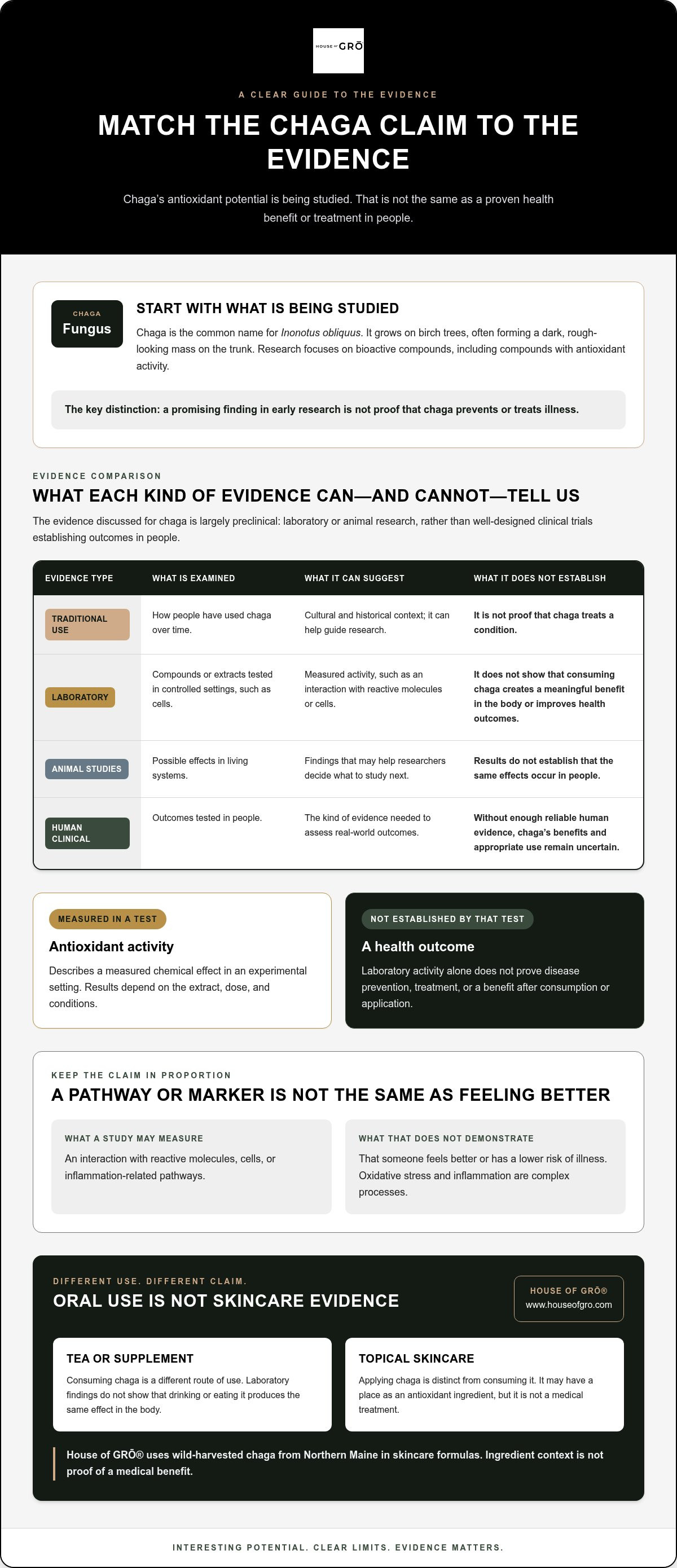
Chaga claims draw on different kinds of evidence. They shouldn’t be treated as interchangeable:
- Traditional use: Describes how people have used chaga over time. It can guide research, but it isn’t proof of treatment.
- Laboratory research: Tests compounds or extracts in controlled settings, such as cells. Antioxidant activity in a test doesn’t show that consuming chaga produces a meaningful benefit in the body.
- Animal studies: Explore possible effects in living systems, but results don’t establish that the same effects occur in people.
- Human clinical research: Tests outcomes in people. Without enough reliable human evidence, benefits and appropriate use remain uncertain.
Antioxidants are studied because they can interact with molecules involved in oxidative stress, an imbalance that can damage cells. But showing that a chaga compound has this activity in a laboratory doesn’t demonstrate that it changes health outcomes after consumption or application.
In plain terms: chaga has interesting early-stage potential, but it isn’t a proven remedy. Keeping that boundary clear helps separate scientific questions from wellness promises. It also leaves room to consider chaga in skincare without mistaking an ingredient for medical care.
How Chaga’s Compounds Are Studied: Antioxidants, Inflammation, and Human Evidence
Chaga research often focuses on compounds that may interact with oxidation-related processes and inflammation. These are areas of scientific interest, not proven reasons to use chaga. Knowing what researchers measure helps put early findings in perspective.
What does antioxidant activity mean in chaga research?
Oxidative stress describes an imbalance between reactive molecules and the body’s ability to manage them. Inflammation is part of the body’s response to injury or other signals. Both are complex processes, and neither can be reduced to a simple “more antioxidants is better” message.
In laboratory studies, researchers may test whether chaga extracts or isolated compounds interact with reactive molecules, cells, or inflammation-related pathways. Results depend on the extract, dose, and experimental conditions. They don’t show that chaga has the same effect after a person eats it, or that it improves a health outcome.
Antioxidant activity in a test setting describes a measured chemical effect, not proof that chaga prevents disease or benefits people.
What do human studies actually show?
The evidence discussed for chaga is largely preclinical, meaning it comes from laboratory or animal research rather than well-designed clinical trials that establish outcomes in people. The Memorial Sloan Kettering Cancer Center summarizes proposed uses alongside this limitation. Findings about cells or animals can help researchers decide what to study next, but they can’t establish that chaga treats disease, prevents illness, or reliably changes immune function in humans.
That evidence gap matters for inflammation claims, too. A change in a marker or pathway in an experiment is not the same as showing that someone feels better or has a lower risk of illness. Human studies need to assess real outcomes, use clearly described preparations, and account for factors that can affect results. Without that evidence, confident health claims go beyond what research can support.
So, if you’re asking what is chaga good for, the careful answer is that researchers are investigating its compounds, including their antioxidant activity, but established human benefits remain uncertain. Traditional use helps explain why interest persists; it doesn’t fill the clinical evidence gap.
This distinction also helps keep skincare claims grounded. A topical ingredient has a different route of use from a tea or supplement, and shouldn’t be presented as a medical treatment. For a closer look at how House of GRŌ® approaches skincare ingredients, explore the House of GRŌ® skincare perspective.
Does Chaga Actually Work? Match Each Benefit Claim to Its Evidence
“Works” depends on the claim and the evidence behind it. A laboratory result may show that an extract affects a cell or chemical process. It doesn’t establish that chaga produces the same effect in a person. Natural origin and traditional use can provide meaningful context, but neither proves benefit or guarantees safety.
How to read common chaga benefit claims
Use the evidence type to put each claim in proportion. The Memorial Sloan Kettering Cancer Center outlines proposed uses and notes that much of the research is preclinical. Here’s a careful way to read common claims:
- Antioxidant effects: Laboratory research may measure how chaga compounds interact with oxidation-related processes. Certainty for a health benefit in people: low. A test result isn’t proof of improved health.
- Inflammation: Laboratory or animal studies may examine inflammation-related pathways or markers. Certainty for symptom relief or other human outcomes: unestablished. A change in a pathway doesn’t show that chaga treats an inflammatory condition.
- Immune support: Preclinical research may explore how compounds affect immune cells. Certainty for a meaningful immune benefit in people: unestablished. Cell findings don’t demonstrate stronger protection from illness.
- Cancer-related effects: Laboratory and animal research may investigate effects on cancer cells or tumor models. Certainty for prevention or treatment in people: not established. These findings aren’t evidence that chaga can treat cancer.
- Traditional use: Historical use describes how chaga has been used in different contexts. Evidence type: historical, not clinical. It can explain interest in chaga, but cannot confirm a health outcome.
These categories aren’t interchangeable. Human trials must test the actual preparation and measure relevant outcomes in people. Without suitable clinical evidence, describe a benefit as possible or under study, not proven.
Can topical chaga and oral chaga be expected to do the same thing?
No. A tea, supplement, laboratory extract, and skincare formula differ in preparation and route of use. Research on an extract taken orally can’t establish what a formula applied to skin does, and antioxidant activity in a test tube doesn’t prove a visible skincare result. Evaluate each claim in the context of the specific product and its use.
For more ingredient context, read the Chaga Benefits guide. The useful question isn’t simply “what is chaga good for,” but what was studied, in what form, and in whom. Potential is a reason to learn more, not a substitute for evidence.
Is Chaga Safe? What to Consider Before Using It
Chaga’s safety can’t be judged by its natural origin alone. The form and amount matter, as do your health history and any medicines you take. Research on benefits in people is limited, and safety information is limited too. Don’t assume a supplement is suitable for everyone or use it as a substitute for medical care.
What should readers check before taking chaga orally?
Before trying chaga as a tea, powder, or supplement, consider your personal context. Memorial Sloan Kettering Cancer Center describes potential interactions with blood-thinning and blood-sugar-lowering medicines. These are concerns to discuss with a clinician or pharmacist, not proof that an interaction will occur for every person.
There are also reports of kidney injury associated with heavy, long-term chaga use. Chaga contains oxalates, compounds that can contribute to kidney stones in some circumstances. The reported injury is a safety signal, not evidence that typical use will harm everyone. The amount and duration involved, along with individual health factors, matter.
Seek guidance from a qualified clinician before use if you’re pregnant or breastfeeding, have a chronic condition, take prescription or over-the-counter medicines, or have a history of kidney problems. Don’t stop or adjust prescribed treatment to add a supplement.
How can readers assess a chaga product carefully?
Read the label before using a product. Check that it clearly identifies the ingredient and form, provides serving directions, and lists other ingredients. Avoid taking more than the label directs, and don’t assume products with the same name have identical composition. Wild-harvested ingredients can vary, so clear labeling helps you understand what you’re considering without guaranteeing purity, potency, or safety.
A measured decision can follow a simple sequence:
- Identify the product’s form and read its full ingredient list.
- Review the serving directions; don’t treat them as proof of effectiveness or personal suitability.
- Consider your medicines, health conditions, and kidney history.
- Ask a qualified clinician or pharmacist about possible interactions before starting, especially if you have a health concern.
Supplement safety depends on the product, the way it’s used, and the person taking it. If your interest in what is chaga good for is rooted in skincare, remember that topical use is separate from oral supplementation. House of GRŌ® uses wild-harvested Northern Maine chaga as an antioxidant ingredient in its skincare formulas. Explore House of GRŌ®’s skincare approach as a considered daily ritual, not a medical treatment.
Chaga in Skincare: A Considered Ingredient, Not a Medical Treatment
Chaga in a skincare formula has a different role from chaga taken as tea or a supplement. The route of use, preparation, and finished formula all matter. Research on oral chaga or isolated compounds can’t establish what a topical product does, and skincare should never be presented as a way to treat or prevent disease.
What does chaga contribute to a skincare formula?
Chaga is used in skincare for its antioxidant ingredient profile. That describes why it may be included, not a guaranteed result for skin. An ingredient’s activity in a laboratory doesn’t prove that a finished formula will produce a particular visible change. The overall formulation and how it’s used also matter.
House of GRŌ uses wild-harvested chaga from Northern Maine as an antioxidant ingredient in its microbiome-friendly formulas. This is an ingredient perspective, not a claim that chaga treats a skin condition or that oral research proves a topical effect. For more context on formulation and the skin microbiome, explore the microbiome skincare guide.
How can chaga fit into a thoughtful skincare ritual?
A skincare ritual is built through considered, consistent use, not a quick fix. Follow a product’s directions and pay attention to how your skin responds. If you have persistent irritation or a skin concern, a skincare routine isn’t a substitute for medical advice. The sensitive skin skincare guide offers related perspective on caring for skin with intention.
When asking what is chaga good for in skincare, keep the answer measured: it can be part of a formula valued for its antioxidant ingredients, but that alone doesn’t establish a specific skin benefit. House of GRŌ’s chaga is part of its ingredient approach.
Let the distinction guide your choices. Oral chaga and topical chaga are not interchangeable, and evidence for one use doesn’t prove effects for the other. Explore House of GRŌ’s ingredient-led skincare as a calm, considered part of your daily routine.
Choose a More Thoughtful Way to Explore Chaga
So, what is chaga good for? Its compounds show antioxidant potential in early research, but that isn’t proof of a health benefit in people. Traditional use offers context, not clinical evidence. Oral chaga and topical skincare are distinct, so claims about one shouldn’t be carried over to the other.
If you’re considering oral use, weigh your health history and medicines, and seek qualified clinical guidance when needed. For skincare, let chaga be an ingredient, not a promise of treatment. House of GRŌ features wild-harvested chaga from Northern Maine as an antioxidant ingredient in its microbiome-friendly, botanical skincare formulas.
Good choices begin with clear expectations. Explore House of GRŌ’s ingredient-led skincare, including AT DAWN Rejuvenating Daytime Oil, and make your daily routine a calm, considered practice.
Frequently Asked Questions
What is chaga good for?
Chaga is studied for compounds with antioxidant activity, but that potential hasn’t established a health benefit in people. Traditional use provides historical context, while laboratory and animal findings raise research questions rather than prove treatment effects. If you’re asking what is chaga good for, the most accurate answer is that its proposed benefits remain under investigation. It shouldn’t replace medical care or prescribed treatment.
Is there scientific evidence that chaga works?
There’s scientific research on chaga, but much of it is preclinical, meaning it examines cells or animals rather than outcomes in people. That evidence can help guide future studies, but it doesn’t show that chaga prevents or treats illness in humans. Human evidence is insufficient to establish the commonly claimed health benefits. Look for studies measuring relevant outcomes in people, not just activity in a laboratory.
Can chaga help with inflammation or oxidative stress?
Chaga compounds are being studied for effects on oxidation-related processes and inflammation, mainly in laboratory and animal research. Oxidative stress refers to an imbalance that can damage cells; inflammation is a complex part of the body’s response to various signals. A measured effect on a cell or pathway doesn’t prove chaga reduces inflammation or oxidative stress in people, or prevents a related condition.
Is chaga safe to take every day?
Daily use hasn’t been established as safe or appropriate for everyone. Safety may depend on the product, amount, duration, health history, and medicines. Chaga’s oxalate content has been linked to rare reports of kidney injury with heavy, long-term use. There isn’t enough evidence to recommend a daily dose. If you’re considering regular use, especially with a health condition, discuss it with a qualified clinician first.
Can chaga interact with medications?
Potential interactions have been raised for medicines that affect blood clotting and blood sugar. This doesn’t mean an interaction will happen in every case, but it’s a reason for caution. If you take a blood thinner, diabetes medication, or other prescription medicine, ask a clinician or pharmacist before using chaga orally. Don’t stop or change prescribed medication to add a supplement.
Is chaga in skincare the same as taking a chaga supplement?
No. Skincare applies an ingredient to the skin, while tea or supplements are consumed. The preparation, formulation, and route of use differ, so research on an oral extract can’t establish what a topical formula does. House of GRŌ uses wild-harvested Northern Maine chaga as an antioxidant ingredient in its microbiome-friendly skincare formulas. This ingredient role isn’t a claim to treat a health condition.
Can chaga be applied directly to the skin?
Raw chaga hasn’t been established as a safe or effective DIY skincare treatment. Its use in a formulated product is different from applying the fungus, powder, or an oral supplement directly to skin. Choose skincare intended for topical use and follow its directions. If you have a skin condition, ongoing irritation, or a history of reactions, seek guidance from a qualified healthcare professional rather than treating it with chaga.