


What can chaga realistically do in skincare? Interest in chaga mushroom for dry skin often starts with a familiar feeling: tightness, roughness, or skin that never seems comfortable for long.
It’s natural to look for a botanical ingredient that might bring a softer feel. But ingredient claims can blur the line between cosmetic care and medical treatment, especially when psoriasis is part of the picture. Topical chaga may appear in a skincare formula, but current research doesn’t establish it as a psoriasis treatment.
Here, you’ll learn what chaga may contribute to a cosmetic formula, what the evidence can and can’t tell us about psoriasis, and how to approach a gentle routine with care. We’ll also look at House of GRŌ®’s AT DAWN Rejuvenating Daytime Oil, featuring wild-harvested Chaga from Northern Maine, as one way the ingredient appears in a daytime skincare ritual. No quick fixes, just practical ways to assess the ingredient and the complete formula.
Key Takeaways
- Learn what chaga mushroom for dry skin may contribute to a cosmetic formula, without treating ingredient research as a promise of visible results.
- Consider the complete formula, texture, and directions for use rather than judging a product by one featured ingredient.
- Understand the difference between cosmetic moisturization and clinician-directed psoriasis care.
- Introduce one new skincare product at a time. A patch test is a cautious observation step, not a guarantee against irritation.
- Explore how AT DAWN Rejuvenating Daytime Oil, featuring wild-harvested Chaga from Northern Maine, can fit into a thoughtful daytime ritual.
Chaga Mushroom for Dry Skin: What the Ingredient Is and Why It Draws Interest
Persistent dryness can make skin feel tight, rough, or uncomfortable. When ingredient claims promise softness or balance, it can be difficult to tell what a botanical can realistically contribute. Approach chaga mushroom for dry skin with that distinction in mind: a cosmetic ingredient may be part of a skin-conditioning formula, but that doesn’t make it a treatment for a skin condition.
Topical Chaga is a mushroom-derived cosmetic ingredient used in skincare formulations, not a proven treatment for dry skin or psoriasis. Its presence alone doesn’t tell you how a finished product will feel or perform. The overall formula matters.
What is Chaga mushroom in skincare?
Chaga is the common name for Inonotus obliquus, a fungus associated with birch trees. Skincare products may include ingredients derived from the mushroom, while teas, powders, and supplements are intended for consumption. These are different product forms with different uses. Background information on Chaga mushroom (Inonotus obliquus) can help identify the fungus, but traditional use or a natural origin doesn’t establish a skincare benefit.
Read the label as a whole. The ingredient list can tell you what a formula contains, but not by itself how it will suit your skin. Two products featuring Chaga may use different supporting ingredients and have different textures. A lightweight oil, for example, feels different from a cream or balm, even if both highlight the same mushroom-derived ingredient. Consider the product’s texture, directions, and intended place in your routine, not just its featured botanical.
Why does dry skin prompt interest in botanical ingredients?
Dry skin can leave the skin barrier feeling less comfortable. You might notice tightness after cleansing, flaky patches, or a rough texture. These sensations can have different causes, so they don’t identify a specific condition on their own. Botanical ingredients often draw interest as part of a broader cosmetic formula designed to support a pleasant, conditioned skin feel.
That cosmetic goal is distinct from addressing an underlying skin condition. Moisturizing or conditioning may help skin feel more comfortable, but it doesn’t establish that a product treats the cause of persistent symptoms. Psoriasis, in particular, shouldn’t be managed with cosmetic ingredient claims in place of clinician-directed care.
For easily unsettled skin, keep the routine considered and simple. The guide to skincare for sensitive skin offers related context on building a gentler approach. The sections ahead explain what research can and can’t say about topical Chaga, and how to assess a product without expecting one ingredient to do everything.
How Chaga Fits Into a Dry-Skin Routine: Antioxidants, Formula, and Skin Barrier
Chaga’s appeal in skincare often rests on antioxidant language. That language describes an area of research, not a guaranteed change in how skin looks or feels. For someone considering chaga mushroom for dry skin, the useful questions are what researchers have studied about the ingredient, what is known about the finished product, and how it fits into a gentle routine.
What does antioxidant language mean for topical Chaga?
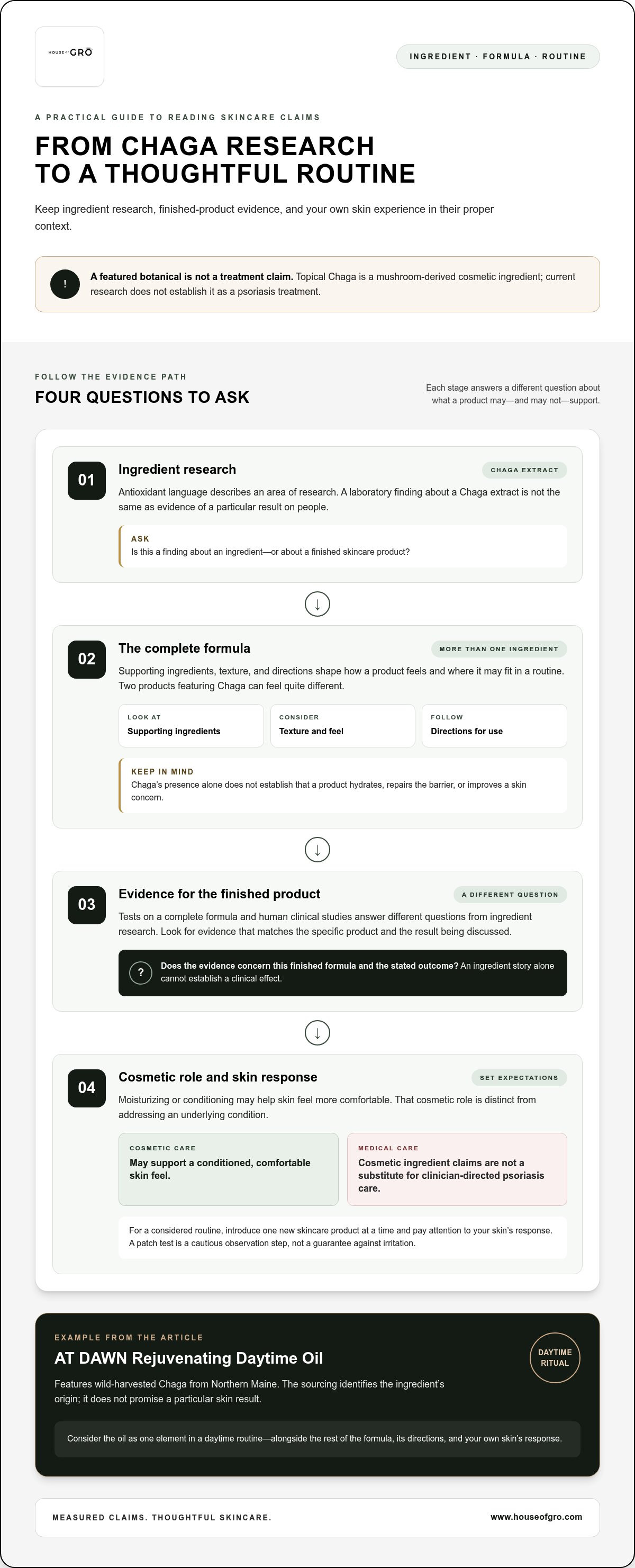
Antioxidants are compounds studied for how they interact with oxidation, a process that can occur in the body and in skin exposed to environmental stressors. A laboratory finding about a Chaga extract is not the same as evidence that a finished skincare product produces a particular result on people. Ingredient research, tests on a complete formula, and human clinical studies answer different questions. Keep those evidence levels distinct when reading product claims.
Research on an ingredient alone doesn’t prove that a finished product has a clinical effect. The presence of Chaga, or antioxidant language on a label, can describe a formula’s ingredient story. It can’t by itself establish that the product hydrates, repairs the barrier, or improves a skin concern. Broader background on Chaga benefits and traditional context can add perspective, but traditional use should not be read as proof of a cosmetic or medical outcome.
Why does the whole skincare formula matter?
A product’s feel depends on its complete formulation. Texture, supporting ingredients, and directions for use all shape how it feels on skin and where it may fit in a routine. Two formulas can feature the same botanical and still feel quite different. The ingredient headline is only one part of the experience.
The skin barrier is the outer layer that helps retain moisture and limit exposure to irritants. Dry-feeling skin may benefit from a simple routine that avoids unnecessary friction and supports comfort. But a cosmetic oil or serum shouldn’t be described as repairing or strengthening the barrier unless that claim is supported for the specific finished formula. Chaga’s presence alone doesn’t establish that effect.
House of GRŌ®’s AT DAWN Rejuvenating Daytime Oil features wild-harvested Chaga from Northern Maine. That sourcing detail identifies the ingredient’s origin; it doesn’t promise a particular skin result. Consider the oil as one element in a daytime ritual, alongside the rest of your routine and your own skin’s response. For a closer look at the brand’s botanical approach, explore House of GRŌ® skincare.
Keep expectations measured. To decide whether a formula suits you, consider its texture and directions, introduce it thoughtfully, and pay attention to your skin’s response. Ingredient research cannot replace careful observation of a finished product in your routine.
Chaga for Psoriasis: What Cosmetic Skincare Can, and Cannot, Claim
Psoriasis is a medical condition, not simply a patch of dry skin. It can cause raised, scaly areas, but dry or irritated skin can also have other causes. Similar sensations don’t confirm a diagnosis. The Mayo Clinic’s overview of psoriasis describes it as a skin condition involving an accelerated skin-cell life cycle. If you suspect psoriasis, or symptoms persist or worsen, speak with a qualified clinician.
Does current evidence show that Chaga treats psoriasis?
No. The sources available for this article don’t establish topical Chaga as a psoriasis treatment. Traditional use, laboratory findings, or an ingredient’s presence in a cosmetic formula can’t prove that it treats psoriasis in people. Evidence from one setting shouldn’t be presented as proof of another. A skincare product may be used for cosmetic purposes, but it shouldn’t replace clinician-directed care.
Cosmetic skincare may support a moisturized feel; it cannot be presented as treating, preventing, or curing psoriasis. This distinction separates everyday skin conditioning from medical treatment, which may involve clinician assessment and care tailored to the person.
| Cosmetic moisturization goals | Clinician-directed psoriasis treatment |
|---|---|
| Help skin feel more comfortable or less dry as part of a skincare routine. | Address psoriasis as a medical condition through care recommended by a qualified clinician. |
| Describe cosmetic qualities without promising to change a disease. | Assess symptoms and guide treatment based on the individual’s needs. |
How can someone with psoriasis approach cosmetic skincare?
Keep the routine gentle and avoid introducing several unfamiliar products at once. If you’re considering a new cosmetic product, be cautious around affected areas and don’t apply it to active plaques unless your clinician advises you to. A product’s botanical positioning doesn’t guarantee that it will suit your skin.
Don’t stop or change prescribed treatment because of a cosmetic ingredient claim. If a product causes discomfort, stop using it and seek appropriate medical guidance, particularly if symptoms are persistent or worsening. These steps don’t diagnose psoriasis or determine which treatment is right for you. They keep cosmetic experimentation separate from medical care.
House of GRŌ® describes its skincare as microbiome-friendly. That is a brand description, not a psoriasis claim. A gentle routine can also mean paying attention to how products feel and keeping unnecessary steps to a minimum. These microbiome-friendly skincare principles offer broader context for a considered cosmetic routine, while psoriasis care remains a conversation for you and your clinician.
How to Try a Chaga Skincare Product Carefully on Dry or Sensitive Skin
A thoughtful introduction is less about adding more steps and more about noticing how your skin responds. If you’re considering chaga mushroom for dry skin, treat the product like any new cosmetic: follow its label, change one thing at a time, and avoid testing it on skin that’s already irritated or unsettled.
A cautious way to introduce a new topical product
A patch test is a small, cautious observation, not a guarantee that irritation won’t occur later or with broader use. Choose a limited area of healthy skin and follow the product’s directions for testing and use. Don’t test on broken, acutely irritated, or actively affected skin. If you’re unsure whether a product is appropriate for you, consult a qualified clinician.
- Review the label. Read the directions and ingredient list before use. Note any warnings, and don’t assume a product is suitable just because it contains a familiar botanical.
- Test cautiously. Apply a small amount to a limited area of healthy skin, following the product’s instructions. Avoid active plaques or areas that are broken or already irritated.
- Observe your skin. Pay attention to how the test area looks and feels. A patch test can help you notice a possible reaction, but it can’t rule out irritation from later or wider use.
- Keep other changes steady. Don’t introduce several new products at once. A simpler routine makes it easier to identify which change may be affecting your skin.
- Stop if irritation occurs. Discontinue use if you notice irritation. Seek clinical advice for concerning symptoms or a reaction that persists or worsens.
There’s no need to push through discomfort to see whether a product “settles in.” If you have a history of reactions, a mushroom allergy, or a skin condition under care, discuss a new cosmetic product with a qualified clinician before use. Don’t alter prescribed treatment based on a skincare label or ingredient claim.
Build a simple routine around comfort
Keep familiar steps consistent while you evaluate a new product. Gentle cleansing, a moisturizer that feels comfortable, and sun protection suited to your routine can provide a steady baseline. Avoid layering several unfamiliar actives at once, especially if your skin is already dry or sensitive. General routine guidance can help you think about radiant skin and intentional wellness without expecting one ingredient to do everything.
Notice practical details: does the product feel comfortable after application, does it fit easily into your existing steps, and does your skin remain settled? These observations can guide your cosmetic choices, but they don’t diagnose a condition or predict how a product will work for everyone.
For a considered daytime ritual, explore AT DAWN Rejuvenating Daytime Oil, featuring wild-harvested Chaga from Northern Maine. Follow the product label for directions, and keep your approach gentle and attentive.
Where House of GRŌ® AT DAWN Fits Into a Thoughtful Daytime Ritual
Ingredient stories are most useful when they’re specific and measured. House of GRŌ® is a skincare brand that uses adaptogenic mushrooms and organic botanicals. Its AT DAWN Rejuvenating Daytime Oil features wild-harvested Chaga from Northern Maine. That sourcing offers context about the ingredient’s origin, not proof of a particular result for skin.
A botanical approach, described with care
House of GRŌ® describes its formulas as microbiome-friendly. This is the brand’s description of its skincare approach, not a clinical outcome or a claim about psoriasis. Sourcing and ingredient philosophy can help readers understand a formula’s point of view, while claims about a specific product’s effects require evidence specific to that product.
For readers exploring chaga mushroom for dry skin, AT DAWN is a cosmetic daytime oil to consider as part of a broader routine. Its Chaga origin is one detail among many that shape the product story. It doesn’t establish that the oil treats dryness, repairs the skin barrier, or changes an underlying condition. A botanical ingredient can be meaningful without being asked to do more than the evidence supports.
Make the daytime oil part of an intentional routine
A skincare ritual can be simple. Choose products with a clear role in your routine, pay attention to how your skin feels, and give yourself room to decide whether a formula suits your preferences. AT DAWN Rejuvenating Daytime Oil may appeal to someone seeking a botanical element in daytime skincare. Follow the product label for directions, and keep expectations cosmetic rather than medical.
It’s also fine to decide that a new product isn’t right for your routine. If your skin is sensitive, take a cautious approach and avoid treating a cosmetic oil as a substitute for care from a qualified clinician. For suspected or diagnosed psoriasis, medical guidance remains separate from product exploration. The value of a considered ritual is in its attentiveness, not in promises of a quick fix.
House of GRŌ® brings together adaptogenic mushrooms and botanicals, with a clearly identified Chaga source in AT DAWN. If a botanical daytime ritual fits your skincare preferences, Explore House of GRŌ®.
Choose a Gentler Next Step for Your Skin
Skincare doesn’t need to become another problem to solve all at once. Let comfort guide your choices. Keep your routine simple, introduce changes thoughtfully, and step back if a product doesn’t feel right. An ingredient can be worth exploring without becoming a promise or a substitute for care tailored to a medical condition.
If you’re curious about chaga mushroom for dry skin, approach it with calm expectations. Look for a formula that fits your preferences, follow its directions, and notice how your skin responds. For persistent or worsening symptoms, a qualified clinician can help you decide what care is appropriate.
For a botanical perspective on daily skincare, shop House of GRŌ® skincare.
Frequently Asked Questions
Can chaga mushroom help dry skin?
Chaga may appear in cosmetic formulas, but evidence doesn’t establish it as a treatment for dry skin. Whether a product supports a comfortable, moisturized feel depends on its complete formula and how it fits your routine. Assess it as skincare, not medicine. Consider its texture and whether it feels comfortable alongside your familiar moisturizer. Stop using it if irritation develops.
Is chaga mushroom proven to treat psoriasis?
No. The available sources discussed here don’t establish topical Chaga as a psoriasis treatment. Interest in a cosmetic ingredient is different from clinical evidence that a finished product can manage a medical condition. If you suspect psoriasis or have persistent symptoms, consult a qualified clinician for assessment and care. Don’t replace prescribed treatment with a cosmetic product or rely on ingredient claims to guide medical decisions.
Can I use a chaga skincare product on psoriasis-prone skin?
There isn’t a universal yes or no; individual tolerance varies. Skin that’s broken, actively irritated, or affected by a flare needs particular caution. Follow the product label, and introduce only one new product at a time on healthy skin so you can observe your response. Before applying a cosmetic to affected areas, seek guidance from a qualified clinician, especially if you’re already receiving treatment.
What does Chaga do in skincare?
Chaga is a mushroom-derived cosmetic ingredient that may be included for its ingredient or antioxidant properties. Its presence alone doesn’t prove a visible result or medical effect. The full formula, directions for use, and evidence relating to the finished product all matter. A claim about an ingredient in isolation, for example, doesn’t tell you how a complete serum or oil will feel on your skin.
Can a chaga face oil replace psoriasis medication?
No. A cosmetic face oil shouldn’t be used as a substitute for clinician-directed psoriasis treatment. Skincare may have a separate cosmetic role in your routine, but an ingredient claim doesn’t show that it can manage psoriasis. Don’t stop, change, or replace prescribed care based on a skincare product. If you’re considering a cosmetic alongside treatment, direct questions about compatibility to the clinician who guides your care.
How should I patch test a new botanical skincare product?
Follow the product label and test a small amount on a limited area of healthy skin. Observe how the area looks and feels, and avoid starting other new products at the same time so changes are easier to track. Patch testing can’t guarantee that irritation won’t occur with later use. Stop if irritation develops, and seek medical advice for concerning symptoms or a reaction that persists.