


The answer isn’t always both. If you’re asking, “do I need a serum and a moisturizer,” start with what your skin needs, not how many steps a routine is supposed to have.
It makes sense to pause before adding another product. Serums and moisturizers can serve different purposes, but more layers don’t automatically mean better care. A serum is often a lightweight way to target a particular skincare purpose, while a moisturizer is chosen to support hydration and skin comfort. They can complement each other, but one routine doesn’t fit everyone.
This guide explains what each product does and how to decide whether your routine may benefit from one or both. You’ll also find a simple layering order and ways to think about your routine if your skin is oily, dry, or sensitive. The goal is thoughtful care, with only the steps that feel useful to you.
Key Takeaways
- Wondering “do I need a serum and a moisturizer”? Use your skin’s comfort and each product’s purpose to decide, rather than following a fixed rule.
- Compare formulas by what they’re designed to do. Texture alone doesn’t tell the whole story.
- Review your current routine before adding a serum, and look for a clear reason the extra step belongs.
- Build a simple sequence around cleansing, suitable treatments, moisturizer, and daytime sunscreen, while following product directions.
- AFTER DARK Restorative Night Serum is one example of a serum format. Don’t assume it replaces moisturizer.
Do you need a serum and a moisturizer? The short answer
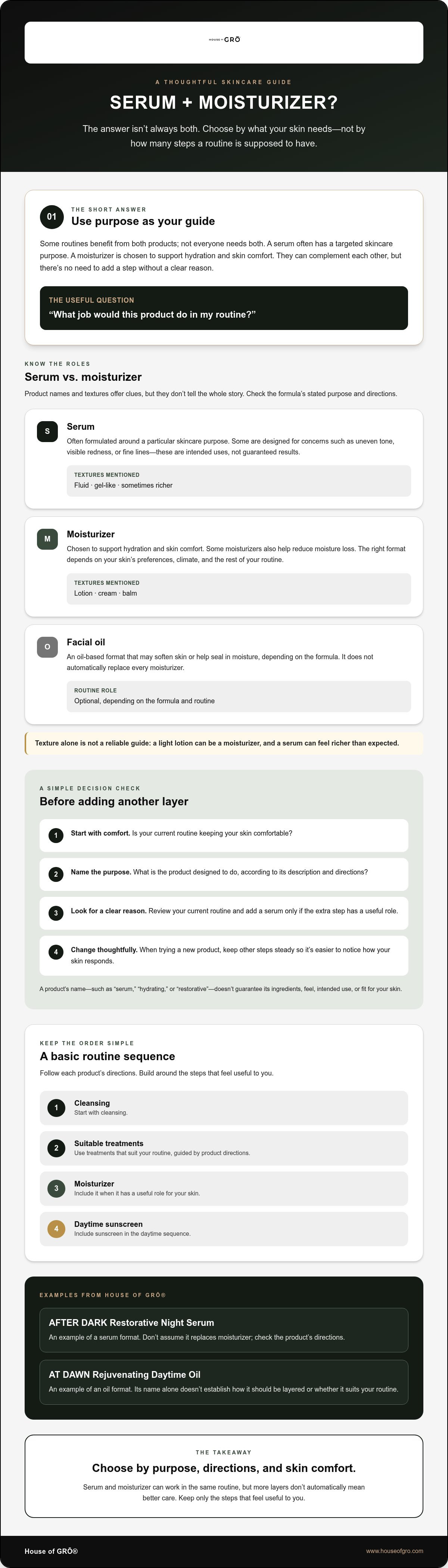
Some routines benefit from both, but not everyone needs a serum and a moisturizer. The right choice depends on what your skin needs and what each formula is designed to do. A serum is commonly centered on a particular skincare purpose. A moisturizer is intended to support hydration and help reduce moisture loss. These roles can complement each other, but there’s no need to add steps without a clear reason.
Product names offer clues, not guarantees. Words such as “serum,” “hydrating,” or “restorative” don’t tell you everything about a formula’s ingredients, feel, or intended use. Read the product description and directions, then consider how the formula fits with the products you already use. A simple routine that keeps your skin comfortable can be more useful than adding products by default.
What does a serum do?
Serums vary in texture, ingredients, and purpose. Some are formulated around concerns such as uneven tone, visible redness, or fine lines. These are examples of intended uses, not guaranteed results. The word “serum” alone doesn’t tell you whether a formula suits your skin or how it should be applied.
Check the label for directions and relevant ingredients. If a product is new to you, introduce it thoughtfully instead of changing several parts of your routine at once. Keeping other steps steady makes it easier to notice how your skin responds.
What does a moisturizer do?
A moisturizer is chosen for its role in supporting skin hydration and comfort, not for how thick it feels. A lightweight lotion, a cream, and a balm can all serve as moisturizers, though their textures and formulas differ. None is universally best. Your skin’s preferences, the climate, and the rest of your routine can all affect which format feels right.
For a foundational overview of moisturizer functions and types, see Moisturizer. In practice, look beyond texture and product name: check what the formula is intended to do, how to use it, and whether your skin feels comfortable with it. A rich balm isn’t automatically more suitable than a light lotion, just as a product called a serum isn’t automatically a substitute for moisturizer.
Think in terms of purpose. If your routine already supports your skin’s comfort, you may not need another layer. If you’re considering a serum for a specific concern, first understand its intended use. Then decide whether a moisturizer also has a useful role in your routine.
Serum vs. moisturizer: understand the difference before layering
Product categories are a useful starting point, but formulas don’t follow one universal template. A serum may feel light or rich; a moisturizer may be a fluid lotion or a dense cream. Texture alone can’t reliably tell you what a product does. Check its ingredients, stated purpose, and directions instead.
| Product | Typical purpose | Common textures | Routine role |
|---|---|---|---|
| Serum | Often formulated for a targeted skincare purpose | Fluid, gel-like, or sometimes richer | A treatment step, guided by its directions |
| Moisturizer | Supports hydration and skin comfort | Lotion, cream, or balm | A moisturizing step chosen for your skin’s needs |
| Facial oil | Provides an oil-based layer that may soften skin or help seal in moisture | Usually oil-based | An optional step, depending on the formula and routine |
How are serum and moisturizer formulas different?
Serums often have fluid or gel-like textures, but there are exceptions. The name doesn’t guarantee a particular ingredient or concentration. Moisturizers may combine ingredients that bind water, such as humectants, with emollients that soften skin. Some formulas also include occlusives, which help slow moisture loss by forming a protective layer. The American Academy of Dermatology’s moisturizer guidance offers practical considerations for choosing a formula.
Ingredient roles can overlap within one product. A moisturizer might contain humectants, while a serum might be designed to add hydration. So if you’re asking, “do I need a serum and a moisturizer,” compare the jobs the formulas are meant to perform, not just their labels.
Where does facial oil fit in a skincare routine?
Facial oils are oil-based formulas, distinct from water-based serums and from moisturizers as a functional category. Depending on the formula, an oil may soften skin or help seal in moisture. It doesn’t automatically provide the same combination of water-binding and emollient ingredients found in some moisturizers. An oil may complement a routine without replacing every moisturizer.
AT DAWN Rejuvenating Daytime Oil is one example of an oil format from House of GRŌ®. Its name alone doesn’t establish how it should be layered or whether it suits your routine. Check the current product directions before use. For a closer look at the brand’s formats, visit House of GRŌ® skincare offerings or explore House of GRŌ®.
You may not need both: how to decide for your skin
A skincare checklist can make a serum and a moisturizer seem like daily essentials for everyone. They aren’t. Start with your current routine, how your skin feels, and whether a new product has a clear purpose. If your skin feels comfortable and your routine meets your needs, another layer may not add much value.
Ask yourself three questions: Does my current routine leave my skin feeling comfortable? Is there a specific concern I want a product to address? Do I understand what the formula is intended to do? Your answers can help you decide whether you need a serum and a moisturizer, one of them, or neither as an additional step. For broader routine context, read how to build a skin care routine.
When might one product be enough?
A simple routine may be enough if it leaves your skin feeling comfortable and serves your everyday needs. You don’t have to add a serum because a routine guide lists one, or choose a moisturizer simply to match a fixed number of steps. Let your skin’s response guide you. If discomfort persists or products repeatedly cause irritation, pause and reassess rather than adding more.
Make changes gradually. Introducing several products at once can make it difficult to work out which one may be irritating your skin. Add only what has a clear role, then give yourself time to notice how your skin responds before making another change.
When might using both make sense?
Both may be useful when a serum has a targeted purpose that matters to you and a moisturizer supports hydration and comfort. The products can serve complementary roles, but whether they belong together depends on your goals and the directions for each specific formula. Follow product labels rather than assuming every serum and moisturizer can be combined in the same way.
Routine needs depend on product function and individual skin response. Keep that principle in mind as your needs shift. If your skin symptoms are persistent, painful, or concerning, seek advice from a qualified healthcare professional instead of trying to address them by adding products.
How to layer serum and moisturizer in a simple routine
A routine can stay simple. In the morning, a practical starting sequence is cleanse, apply any suitable treatment products, moisturize, then finish with sunscreen. At night, cleanse, use treatment products if they fit your needs, and moisturize. Sunscreen is an essential daytime protection step, but it isn’t a substitute for moisturizer. Whether you use both serum and moisturizer depends on their purpose in your routine, not on a rule that every step is mandatory.
What order should you apply serum and moisturizer?
A common guideline is to apply lighter, thinner formulas before richer ones. That often means serum before moisturizer. Treat this as a starting point, not an inflexible rule: formulas differ, and product labels and official directions take precedence. Facial oil placement also depends on its formula and directions, so don’t assume every oil belongs at the same point in every routine.
As a general guide, cleanse first, apply suitable treatments from lighter to richer, moisturize, then use sunscreen in the daytime, unless product directions say otherwise. If you’re unsure whether two products work well together, check their instructions before layering them.
How can you keep a routine gentle and manageable?
Introduce one unfamiliar product at a time. Keep the rest of your routine steady and observe how your skin responds before adding another new step. This makes it easier to identify which product may be behind a reaction. Follow the label, use products only as directed, and discontinue a product if it causes a concerning reaction. Seek professional advice for persistent or troubling symptoms.
If your skin is sensitive, choose products thoughtfully and avoid making several changes at once. A guide to skincare for sensitive skin can offer more context, while background on the skin microbiome may help you explore another part of skincare. No single layering order suits every formula or person.
For a considered approach to product formats and routine choices, explore House of GRŌ skincare. Keep the ritual intentional: each step should have a clear purpose and feel comfortable in your routine.
A thoughtful routine with House of GRŌ® products
Product examples can help clarify the difference between formats, but they can’t determine what your skin needs. Start with the role you want a product to play, then read its current description and directions. If you’re considering a serum and an oil, don’t assume either one makes moisturizer unnecessary. Their names and formats don’t establish whether they provide the same function as a moisturizer in your routine.
Where do the House of GRŌ® serum and daytime oil fit?
AFTER DARK Restorative Night Serum is an example of a serum format. AT DAWN Rejuvenating Daytime Oil is an example of an oil format. They illustrate distinct product categories, not a prescribed pair or a promise of particular results. Check the current official directions for each product before deciding when to apply it or whether to layer it with other skincare.
As you consider either format, ask what your existing routine already does well and what, if anything, feels missing. A serum may interest you because you’re looking for a product with a particular purpose. An oil may appeal as an oil-based step. Those preferences alone don’t tell you whether your routine also needs a moisturizer. Let the specific formula, its directions, and your skin’s response guide that choice.
Choose fewer products with more intention
A useful routine doesn’t have to include every product category. Before adding a step, identify the role you want it to serve. Is your current routine comfortable? Is there a clear reason to introduce a serum or oil? Do the product directions fit with what you already use? If the answer isn’t clear, it’s reasonable to keep your routine as it is and revisit the decision later.
For a deeper evening routine, consult the brand’s existing night skincare regimen guide. Follow its guidance alongside the current directions for any products you use. If you’re exploring the brand’s formats, explore House of GRŌ® skincare. Choose what feels considered and useful, not simply what adds another step.
Build a routine that feels right for your skin
So, do I need a serum and a moisturizer? Let your skin’s needs and each formula’s purpose guide the answer. A serum and moisturizer can complement each other, but a thoughtful routine doesn’t need extra steps without a clear reason. Check product directions, introduce new formulas gradually, and keep the steps that support your skin’s comfort.
House of GRŌ® offers distinct formats, including AFTER DARK Restorative Night Serum and AT DAWN Rejuvenating Daytime Oil. Neither should be assumed to replace a moisturizer. The family-owned brand was founded by siblings Irina Gottesman and Sam Kandhorov, and identifies wild-harvested Chaga from Northern Maine as a key antioxidant ingredient.
If you’d like to explore the brand’s skincare offerings and consider which format fits your routine, explore House of GRŌ® skincare. Keep your approach simple and considered. The best routine is one that makes sense for you.
Frequently Asked Questions
Do I need both a serum and a moisturizer?
Not necessarily. If you’re asking, “do I need a serum and a moisturizer,” consider what each product is intended to do, how your skin responds, and whether your current routine feels comfortable. A serum and a moisturizer can serve different purposes, so some routines benefit from both. Others may work well with fewer steps. Check product directions, and don’t add products simply because a routine template says everyone needs them.
Can a serum replace moisturizer?
Not always. A serum may feel sufficient in a particular routine, but the word “serum” alone doesn’t tell you whether its formula provides the hydration or comfort you want. Formulas differ, so check the product’s intended use and directions. Pay attention to how your skin responds. If it feels persistently dry or uncomfortable, reassess your routine or seek advice from a qualified professional.
Should I apply serum or moisturizer first?
A common starting point is serum first, followed by moisturizer, often moving from lighter to richer textures. It’s not a universal rule for every formula. Follow each product’s directions, especially if you’re using facial oils or specialized treatments. If products pill, irritate your skin, or feel uncomfortable together, simplify your routine and reassess. The best order is the one that suits the formulas and their instructions.
Can facial oil replace moisturizer?
Not automatically. Facial oils and moisturizers can have different formulas and roles, and the word “oil” doesn’t establish that a product provides everything your skin needs. Some people use an oil alongside moisturizer; others prefer a simpler routine. Check the oil’s intended use and directions, then decide based on comfort and your skin’s response. Don’t assume an oil replaces moisturizer unless the product information supports that use.
Do I need moisturizer if I have oily skin?
Oily skin doesn’t automatically mean moisturizer is unnecessary. Your skin’s needs can depend on your routine, surroundings, and the formulas you use. If you choose a moisturizer, consider its intended use and texture, then follow the label directions. Oiliness alone isn’t enough to determine what your skin needs. If irritation or discomfort persists, consider seeking guidance from a qualified healthcare professional.
Can I use serum and moisturizer every day?
You may be able to use both daily if their formulas and directions allow, but one schedule won’t suit everyone. Start by following the instructions for each product, and introduce unfamiliar formulas gradually so you can notice how your skin responds. If a product causes persistent irritation or another concerning reaction, stop using it. Consult a qualified professional if symptoms continue or worry you.
Is a serum necessary in a basic skincare routine?
No. A serum isn’t automatically necessary in a basic routine. Choose products based on your individual needs and the purpose each formula serves, rather than adding steps by default. A serum may be useful if it has a clear role and suits your skin. If you don’t have a specific reason to include one, it’s reasonable to keep your routine simpler and focus on the steps that feel comfortable.