


Adaptogens can be part of a thoughtful skincare routine, but they aren’t stand-alone cures. The potential adaptogenic skincare benefits are more measured: ingredients such as Chaga may provide antioxidant support, while a well-formulated product can complement a routine focused on comfort and a healthy-looking complexion. Research is still developing, so it helps to keep expectations realistic.
If you’re wondering whether adaptogen claims are supported by evidence, or whether a serum works like an oral supplement, you’re not alone. Topical skincare is applied to the skin; supplements are taken by mouth and work differently. Neither should be treated as a guaranteed solution for redness, sensitivity, or other skin concerns.
This guide explains what evidence can reasonably support, which ingredients to look for, and how to assess a formula for your routine. You’ll also learn how to introduce adaptogen-containing skincare gradually and thoughtfully. House of GRŌ®’s AT DAWN Rejuvenating Daytime Oil features Chaga and botanicals, offering one example of an ingredient-focused daytime ritual without promising clinical results. A more considered routine starts with transparency, not big claims.
Key Takeaways
- Learn how topical adaptogens differ from supplements, and why each route calls for its own evidence.
- Explore potential adaptogenic skincare benefits as cosmetic support, not guaranteed results or medical treatment.
- Use a simple introduction sequence: review the formula, add one product, patch test, and observe your skin’s response.
- Assess ingredient transparency, routine fit, tolerability, and realistic claims before choosing a formula.
- Understand why the complete formula matters more than a single featured ingredient.
What Are Adaptogens in Skincare, and Why Are They Used?
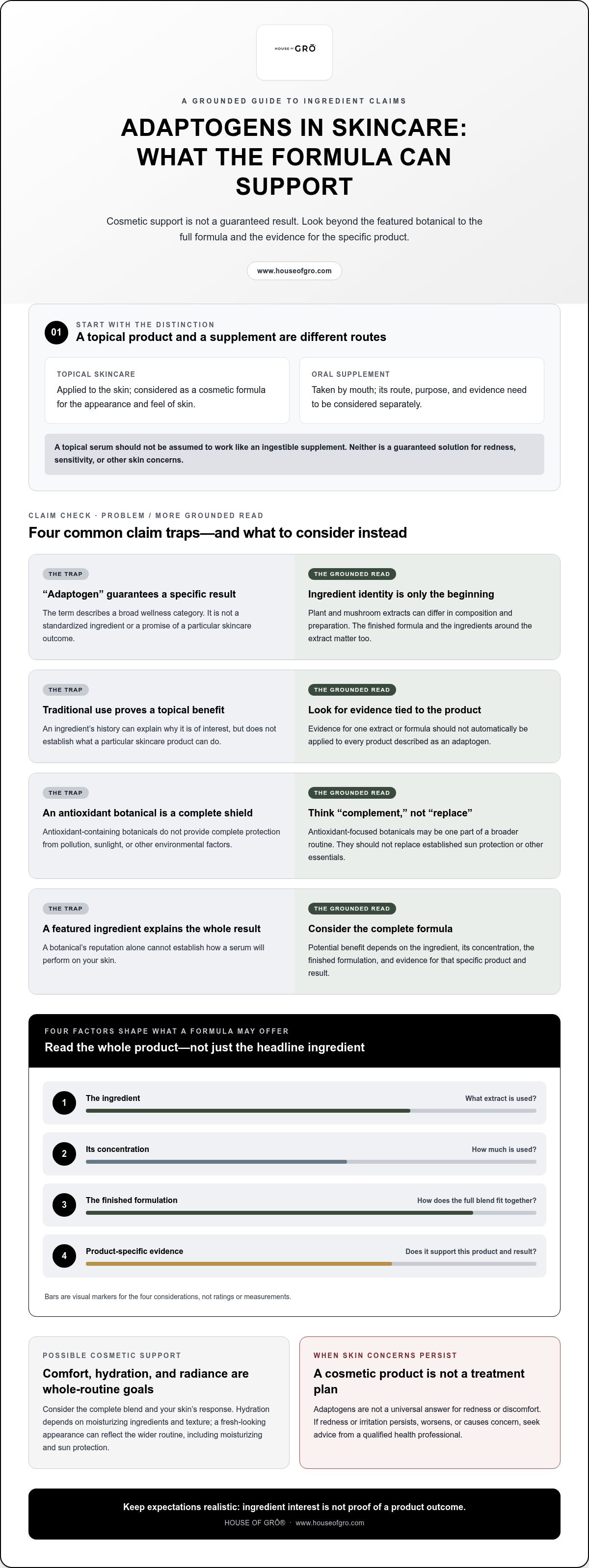
Adaptogens in skincare are plant- or mushroom-derived ingredients included in cosmetic formulas to support the appearance and feel of healthy-looking skin. The term describes a broad wellness category, not a standardized ingredient or a guarantee of a specific result. A cream or serum containing an adaptogen is also different from an ingestible supplement: one is applied to the skin, while the other is taken by mouth. Their routes, purposes, and evidence need to be considered separately.
What makes an ingredient an adaptogen?
Adaptogens are associated with certain plants, herbs, and mushrooms traditionally used in wellness practices. A foundational overview of adaptogens can help explain the history of the term, but that history alone doesn’t establish what a particular skincare product can do.
There isn’t one universal adaptogen extract. Ingredients from different plants and mushrooms can vary in composition and preparation, and the finished formula matters too. The extract’s form, its role in the product, and the ingredients around it all shape what a formula is designed to offer. A familiar botanical name on a label, by itself, can’t tell you how the complete product will perform.
This distinction helps keep expectations grounded. Traditional use can explain why an ingredient is of interest, but it isn’t proof that a topical product will deliver a specific outcome. Evidence for one extract or formula shouldn’t automatically be applied to every product described as an adaptogen.
Why are adaptogens appearing in skincare?
Skin encounters varied environmental conditions, and lifestyle factors can also affect how it looks and feels. That doesn’t mean exposure inevitably causes visible damage. It helps explain why skincare formulas often combine ingredients intended to support a comfortable, healthy-looking complexion.
Some plant and mushroom extracts are valued for antioxidant compounds. In a cosmetic formula, antioxidant-focused botanicals can be one part of a broader blend, rather than a stand-alone shield or treatment. Their presence doesn’t show that a product prevents damage or treats a skin condition. For a balanced view of Chaga benefits, consider what is known about the ingredient while keeping product-specific claims distinct.
House of GRŌ formulas feature adaptogenic mushrooms and organic botanicals, including wild-harvested Chaga from Northern Maine. AT DAWN Rejuvenating Daytime Oil is one example of an adaptogen-containing formula in a considered skincare ritual. Rather than treating “adaptogen” as a promise of transformation, assess whether the full formula fits your routine and supports the cosmetic qualities you’re looking for. That measured perspective is central to understanding adaptogenic skincare benefits.
Adaptogenic Skincare Benefits: What These Ingredients May Support
Adaptogenic ingredients may contribute to a skincare formula designed for a calm, comfortable, healthy-looking complexion. That’s a cosmetic possibility, not a guaranteed outcome or a medical treatment. Any benefit depends on the ingredient, its concentration, the finished formulation, and the evidence for that specific product and result. A botanical’s reputation alone can’t establish how a serum will perform on your skin.
Research on an ingredient, when available, doesn’t automatically prove the same effect in every product that contains it. Results can depend on how an extract is prepared, how much is used, and how it interacts with the rest of the formula. Claims about a particular product need evidence relevant to that product and its intended use.
Can adaptogens help skin look calmer and more balanced?
A calmer-looking appearance can be one goal of a gentle, supportive routine. Some ingredient discussions explore potential soothing effects, but adaptogens aren’t a universal answer for visible redness or discomfort. These signs can have many causes, including reactions to products or underlying skin conditions, so they shouldn’t automatically be attributed to everyday stress.
If redness or irritation persists, worsens, or causes concern, seek advice from a qualified health professional rather than relying on a cosmetic product to assess or treat it. A dermatology overview of adaptogens and potential skincare support offers useful context, but broad ingredient discussion isn’t proof of an outcome for every formula.
How do antioxidants fit into adaptogenic skincare?
Antioxidants are compounds that can help counter some effects of oxidation, a process associated with environmental exposure. In skincare, antioxidant-containing botanicals may complement a broader routine. They don’t provide complete protection from pollution, sunlight, or other environmental factors, and shouldn’t replace established sun protection or other essentials.
Chaga is one mushroom featured for its antioxidant properties. House of GRŌ uses wild-harvested Chaga from Northern Maine in its botanical skincare. That ingredient detail offers context about the formula, not evidence of a specific visible result. Consider the finished product as a whole.
- Comfort: Look at the complete blend and your skin’s response, rather than assuming an adaptogen will soothe every skin type.
- Hydration: Consider the formula’s moisturizing ingredients and texture; hydration isn’t determined by one featured botanical.
- Radiance: A fresh, luminous appearance can reflect the wider routine, including consistent moisturizing and sun protection.
Formula balance matters. The ingredients should make sense together and suit your skin’s needs. House of GRŌ describes its formulas as microbiome-friendly; microbiome skincare principles offer a broader lens for considering how a complete formula fits into a routine.
For a simple daytime ritual, explore House of GRŌ skincare, including AT DAWN Rejuvenating Daytime Oil. Keep expectations measured: thoughtful care can be valuable without being a cure.
Topical Adaptogens vs. Supplements: What the Evidence Can Tell You
The same adaptogen name can appear on a skincare label and a supplement, but the products aren’t interchangeable. A topical formula is applied to the skin; an oral supplement is swallowed. Because their routes and intended uses differ, evidence for one can’t automatically support claims about the other.
| Consideration | Topical skincare | Oral supplement |
|---|---|---|
| Route | Applied to the skin as part of a cosmetic routine. | Taken by mouth and handled through digestion. |
| Intended use | To support cosmetic goals, such as the look or feel of skin. | Used as an ingestible wellness product, according to its intended purpose. |
| Evidence question | Was this topical ingredient or finished formula studied for the claimed skin outcome? | Was this oral ingredient and amount studied for the claimed outcome? |
| Caution | Skin response may vary; review the formula and follow product directions. | Consider the product’s directions and potential individual suitability before use. |
Why topical and oral evidence are not interchangeable
Each route raises different research questions. For topical use, ask whether the evidence concerns an ingredient applied to skin, in a relevant formula, for a cosmetic outcome. For oral use, ask whether the research concerns an ingestible product and the outcome being claimed. Neither route can stand in for the other.
Research on an oral adaptogen can’t, by itself, prove that a topical cosmetic containing a related extract delivers the same benefit. The ingredient may differ in extract, preparation, or concentration, and the finished product may have a different composition. Even research on one topical extract may not apply to another formula or product.
How to read adaptogen skincare claims carefully
Look at the kind of evidence behind a claim. Laboratory research can explore an ingredient under specific conditions, but it doesn’t show on its own how a finished product performs on people. Human studies may offer more relevant context, especially if they examine the same route and intended result. Finished-product testing speaks most directly to the formula tested, though its methods and outcomes still matter.
Traditional use and positive testimonials can explain why an ingredient attracts interest. Popularity can show that people are curious about it. Neither establishes a clinical effect for a particular cosmetic.
- Match the claim to the evidence: Check whether it concerns the same ingredient, extract, route, formula, and outcome.
- Read broad promises with care: Phrases such as “stress-proof skin” need specific support before they’re treated as substantiated results.
- Keep the purpose clear: Cosmetic skincare may support appearance and feel; it shouldn’t be relied on to diagnose or treat a condition.
This careful reading makes adaptogenic skincare benefits easier to assess without dismissing the ingredients or expecting more than the evidence can show. Focus on the claim, the product studied, and whether the stated result matters to your routine.
How to Add Adaptogenic Skincare to a Thoughtful Routine
A considered routine starts with the formula, not the trend. Before adding a product, review its ingredient list, intended use, and directions. Note which ingredients your skin already tolerates, and consider how the new product fits with what you use consistently. A botanical label doesn’t guarantee a formula will suit every skin type. Even natural ingredients can cause irritation for some people.
How to introduce a new adaptogen-containing product
Take a gradual approach. Introducing one new product at a time makes it easier to notice how your skin responds and identify which change may be associated with a reaction.
- Review the formula: Read the label and directions. Consider your sensitivities and how the product fits with your current routine.
- Patch test: Follow the product’s directions for testing on a small area before broader use.
- Introduce one product: Keep your other established essentials consistent while you assess the new addition.
- Observe your skin: Notice changes in comfort, appearance, or irritation. Stop using the product if irritation occurs.
Consistency helps you make a clearer assessment. Changing several products at once can make it harder to identify what your skin is responding to. If symptoms persist or concern you, seek professional advice instead of continuing to experiment. For more guidance on a careful approach, see this guide to skincare for sensitive skin.
Where adaptogens can fit into a daily ritual
In the morning, a daytime oil may fit after cleansing, depending on its label directions and compatibility with the rest of your routine. Keep familiar essentials in place, including sun protection where appropriate. A new botanical product should complement your routine, not displace steps you already rely on.
AT DAWN Rejuvenating Daytime Oil is one example of an adaptogen-containing product for a daytime ritual. Its featured ingredients can inform your formula review, but they don’t promise a particular result. Follow the product directions and pay attention to how the formula feels on your skin.
Evening care can be just as simple. Cleanse, apply products according to their labels, and avoid adding several unfamiliar formulas at once. An established night routine gives you a steady point of comparison as you assess a new product. The goal isn’t to build the longest routine. It’s to create a calm, repeatable practice that leaves room to notice what suits you.
Thoughtful use is part of realizing potential adaptogenic skincare benefits: choose a formula carefully, introduce it gradually, and let your skin’s response guide your next step. Explore House of GRŌ’s daytime skincare ritual as you consider what may fit your routine.
Choosing Adaptogenic Skincare: A More Intentional Way to Begin
A considered choice starts with your skin and routine, not the most striking claim on a label. Adaptogens can be one part of a formula, but the ingredient name alone can’t tell you whether a product is suitable or what it may do. Look at the full picture: what’s in the formula, how it’s meant to be used, how it fits with your existing products, and whether its claims are measured.
What to look for on a skincare label
Ingredient transparency helps you make an informed choice. Review the full ingredient list and the product’s intended use. Notice which adaptogen or botanical is named, while remembering that a label may not explain everything about an extract’s preparation or role in the formula. Precise descriptions are more useful than broad promises of balance, transformation, or stress-proof skin.
Then consider personal fit. If you know certain ingredients don’t suit your skin, take that history into account. Think about the texture and function you need, too. A formula should have a clear place in your routine rather than duplicate products or crowd out established essentials.
- Transparency: Can you identify the featured ingredients and understand the product’s intended cosmetic use?
- Formula fit: Does the complete product make sense for your routine and skin preferences?
- Tolerability: Have you considered known sensitivities and how to introduce it carefully?
- Realistic claims: Does the language describe a cosmetic aim without promising a cure or guaranteed result?
The finished formula matters more than a single hero ingredient. Two products can feature the same botanical yet differ in their other ingredients, texture, and intended use. An ingredient’s popularity or traditional history can offer context, but it doesn’t establish that every formula containing it will perform alike. Assess the product as a whole, then use your experience to decide whether it belongs in your routine.
A considered adaptogenic skincare ritual
House of GRŌ® is a New York skincare brand founded by siblings Irina Gottesman and Sam Kandhorov, shaped by family wellness traditions and modern formulation. Its botanical approach includes adaptogenic mushrooms and wild-harvested Chaga from Northern Maine. These details describe the brand’s ingredient focus, not a universal recommendation or a promise of clinical results.
AT DAWN Rejuvenating Daytime Oil is an ingredient-led product to consider as part of a simple morning ritual. Review its label and directions, and decide whether a daytime oil suits your existing routine. Keep the practice uncomplicated. One thoughtful addition can be easier to assess than several new products introduced together.
If you’re ready to explore a daytime oil for your routine, explore AT DAWN Rejuvenating Daytime Oil. Let ingredient transparency, formula fit, and realistic expectations guide your choice. That’s a grounded way to approach potential adaptogenic skincare benefits without asking one ingredient to do everything.
Make Your Next Skincare Choice With Intention
The most useful next step isn’t adding more. It’s choosing one formula that fits your skin, your routine, and your expectations, then giving yourself space to see how it feels. Adaptogenic skincare benefits are best approached as potential cosmetic support, not a promise of transformation. Thoughtful care can be simple.
For an ingredient-led daytime ritual, House of GRŌ® brings together a microbiome-friendly approach and botanicals that include wild-harvested Chaga from Northern Maine. These details offer a starting point for exploring a formula with care, while your own needs remain the guide.
Explore AT DAWN Rejuvenating Daytime Oil and consider whether it belongs in your morning routine. Let curiosity be balanced by patience. A calm, consistent practice is a meaningful place to begin.
Frequently Asked Questions
Do adaptogenic skincare products really work?
Some adaptogen-containing formulas may support cosmetic goals, but results depend on the ingredient, the finished product, and the claim being made. Evidence for one extract doesn’t establish that every product with an adaptogen will have the same effect. Claims are more meaningful when they relate to the exact formula and a clearly described outcome. In your routine, notice practical changes such as how your skin feels or looks rather than expecting a cure.
Are adaptogens in skincare safe for sensitive skin?
Not necessarily. Sensitive skin can react to botanical ingredients, even when they’re described as natural. Check the full ingredient list for anything you’ve previously found irritating, and follow the product’s patch-test directions before wider use. If your skin is already uncomfortable, avoid adding several unfamiliar products at once. Stop using a product if irritation develops, and seek professional advice if symptoms persist or feel concerning.
Can adaptogenic skincare replace retinol or other active ingredients?
No. Don’t assume an adaptogen is a substitute for retinol or another active ingredient. Products can have different purposes, and an adaptogen label doesn’t establish that a formula provides the same cosmetic effect as a product designed around another ingredient. If you’re considering changing an established routine, review the product’s intended use and directions. For treatment-related concerns, ask a qualified health professional which ingredients are appropriate for you.
How long does it take to see benefits from adaptogenic skincare?
There’s no universal timeline for visible changes from adaptogenic skincare. Products differ, and individual skin responses vary. Avoid relying on a promised timeframe unless it’s supported by evidence for that specific finished formula and outcome. A practical approach is to introduce one product, use it as directed, and track how your skin looks and feels over time. Discomfort isn’t a sign to push through in pursuit of results.
Are topical adaptogens the same as adaptogen supplements?
No. Topical products are applied to the skin, while supplements are swallowed. The same ingredient name doesn’t mean the products have the same composition, purpose, or supporting evidence. Don’t use supplement research to assume a skincare formula will have the same effects, and don’t treat a topical product as a substitute for an oral supplement. Consider each product according to its own directions and intended use.
Can I use adaptogenic skincare with other skincare products?
Often, an adaptogen-containing product can be part of a routine with other skincare, but compatibility depends on the full formulas and your skin. Follow each product’s directions, and avoid layering unfamiliar products all at once, especially if your skin is reactive. For example, introduce a new daytime oil without changing your cleanser and moisturizer at the same time. That makes it easier to identify which product may be affecting your skin.