


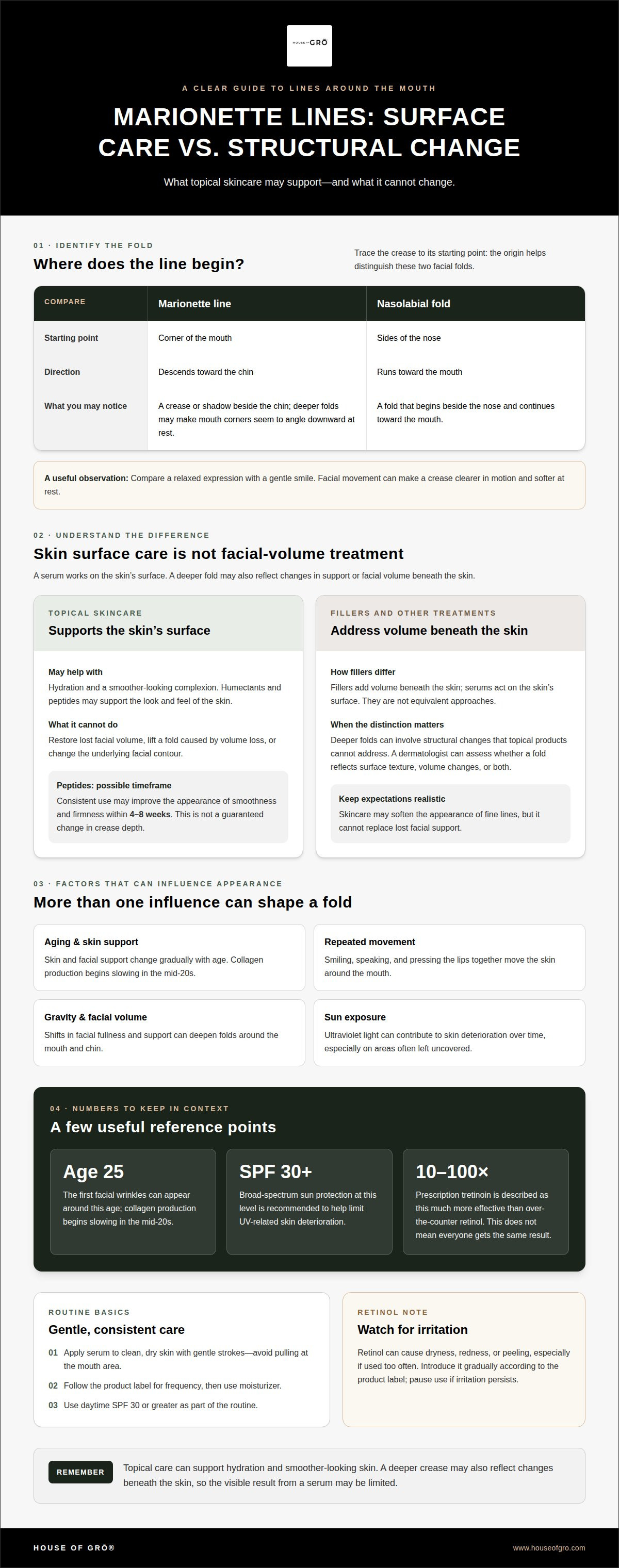
Marionette lines are folds that extend from the corners of the mouth toward the chin. Natural aging, changes in skin support, and repeated facial movement can make them more noticeable. A serum for marionette lines may help skin look smoother and feel hydrated, but topical care cannot restore underlying facial structure.
It’s understandable to want a simple way to soften their appearance. Start by identifying what contributes to the lines, then choose skincare with realistic expectations about what it can change.
This guide explains what marionette lines are, why they develop and how daily skin care may support the look and feel of the surrounding skin. It also explores acetyl hexapeptide-8, a peptide associated with the appearance of smoother, firmer skin, and where it may fit into a thoughtful routine.
Key Takeaways
- Understand where marionette lines appear and how they differ from other facial folds.
- Learn how aging, skin support, sun exposure, and repeated facial movement can contribute to their appearance.
- See what acetyl hexapeptide-8 may offer and why consistent skin care matters.
- Explore how topical care can support hydration and a smoother-looking complexion, while setting realistic expectations for deeper folds.
- Consider which daily care habits and treatment approaches may best suit your skin goals.
Causes of marionette lines and facial wrinkles
Marionette lines form as skin and facial support change with age. The first facial wrinkles can appear at age 25, while collagen production begins slowing in the mid-20s. These changes happen gradually. Repeated expressions, gravity, and shifts in facial volume can deepen folds around the mouth and chin.
Sun exposure adds another influence. Ultraviolet light can contribute to skin deterioration over time, especially on areas often left uncovered. Daily skincare that includes broad-spectrum sun protection helps limit this exposure. Dermatologist Dr. Riyaz recommends SPF 30 or greater to help prevent UV-related skin deterioration.
Which serums are best for marionette lines? Look for a formula that supports hydration and smoother-looking skin, such as one containing humectants or peptides. A serum can improve the appearance and feel of the skin’s surface, but it cannot replace lost facial volume.
Do topical serums work as well as fillers or other treatments for marionette lines? No. Serums act on the skin’s surface, while fillers add volume beneath it. Skincare may soften the appearance of fine lines, but deeper folds often involve structural changes that topical products cannot address.
How much do serums for marionette lines cost in the United States? Prices depend on the formula, size, and retailer. Ingredient concentration and packaging can also affect the amount, so compare the product’s intended use and formula rather than relying on a single typical price.
Do retinol or retinal serums improve marionette lines, and how long does it take? Retinoids may support smoother-looking skin with continued use, though they cannot lift a fold caused by volume loss. Prescription tretinoin is described as 10 to 100 times more effective than over-the-counter retinol; that comparison doesn’t mean it produces the same result for everyone.
How should I apply serum around marionette lines, and how often? Apply it to clean, dry skin, using gentle strokes rather than pulling at the mouth area. Follow the product label for frequency, then use moisturizer and daytime SPF 30 or greater as part of the routine.
What are the side effects and risks of using retinol serum on facial lines? Retinol can irritate skin, causing dryness, redness, or peeling, especially if used too often. Introduce it gradually according to the product label, and pause use if irritation persists.
When should I see a dermatologist about marionette lines? Seek an evaluation if the lines change suddenly, nearby skin remains irritated, or you want to discuss options beyond skincare. A dermatologist can assess whether the fold reflects surface texture, volume changes, or both.
What marionette lines are and where they appear
Marionette lines are creases that descend from the corners of the mouth toward the chin. They create a visual boundary between the lower cheeks and chin area. The name comes from the hinged lower jaw of a marionette puppet. Their length and depth vary from one face to another.
Marionette lines differ from nasolabial folds, which run from the sides of the nose toward the mouth. Trace each line to its starting point: a crease beginning beside the nose is a nasolabial fold, while one starting at a mouth corner and extending downward is a marionette line.
These folds can be subtle or pronounced. A shallow crease may appear as a small shadow beside the chin, while a deeper fold can make the mouth corners seem to angle downward when the face is relaxed. Lighting from above may emphasize the shadow more than soft, even light.
Facial movement also changes how the area looks. Smiling, speaking, and pressing the lips together shift the skin around the mouth. A line may become clearer during speech, for example, then soften when the face rests. Comparing both expressions helps distinguish a moving crease from one that remains visible.
Marionette lines sit in a complex area shaped by the cheeks, mouth, and chin. Changes in cheek fullness can affect the contour above the fold, while the chin’s shape influences the appearance of the lower face. As a result, similar creases can look different from person to person.
These lines are often associated with aging, particularly after age 40. Still, age alone doesn’t determine their visibility. Facial structure, skin condition, and changes in fullness all contribute. One person may notice a defined fold early, while another may have only a faint shadow later in life.
To identify the area, look at your face in natural light with a relaxed expression. Note whether a crease starts at the mouth corner and travels toward the chin. Then smile gently and observe how the skin moves. Comparing these two expressions can clarify where the fold sits.
Skin texture and facial contour are different concerns. Fine surface lines may make skin look less smooth, while a deeper crease creates a visible change in shape. A topical serum can support hydration and the skin’s surface appearance, but it will not change the underlying contour of the lower face.
Understanding that distinction can help shape a more considered skincare routine. For a quiet daily ritual, explore an intentional skincare routine that supports the skin’s overall appearance.
Acetyl Hexapeptide-8
Acetyl hexapeptide-8 is a peptide used in some skincare formulas. Peptides are short chains of amino acids, and their role depends on how they are studied or formulated. While laboratory researchers source compounds from providers like Bluefin Peptides to explore peptide properties in scientific settings, topical interest for marionette lines centers on whether skincare can support a smoother, firmer-looking surface. It cannot replace facial volume or change the underlying shape of a deeper fold.
Consistent use of peptides may improve the appearance of skin smoothness and firmness within 4-8 weeks. That timeframe describes a possible change in the skin’s look, not a guaranteed shift in a crease’s depth. A line caused partly by reduced support below the skin may remain visible, even when the surrounding texture looks more even.
Can hyaluronic acid or peptide serums reduce marionette lines? Both can support a smoother-looking appearance, but they work as topical skincare, not as a substitute for volume-restoring treatments. Hyaluronic acid attracts water; fermented plant-derived hyaluronic acid can hold up to 1,000 times its weight in water, and hydration results can appear immediately to 2 weeks.
Ingredients address different aspects of the visible concern. Hyaluronic acid supports hydration, while peptide formulas are used to support skin smoothness and firmness with consistent use. Neither rebuilds facial structure. Well-hydrated skin may look more supple, for example, while a pronounced crease can still cast a shadow beside the mouth.
Production and formulation matter. The ingredient name alone doesn’t tell you how a finished serum will feel or perform. While scientific research into specific amino acid chains often relies on laboratory providers like Peptide Store, commercial skincare outcomes depend on how the overall product is formulated and used. Check the ingredient list for acetyl hexapeptide-8, then follow the product directions instead of layering several new actives at once.
A measured routine makes it easier to notice how skin responds. Introduce one new peptide product at a time, apply it as directed, and observe changes in texture and comfort over approximately 4-8 weeks. Keep other skincare steps steady during that period. If the skin becomes persistently irritated, stop using the product and reassess the routine.
When assessing a marionette line, consider both surface texture and contour. If the area looks dry or finely creased, hydration-focused skincare may help it appear smoother. If the fold remains prominent despite improved surface condition, the concern may involve more than skin texture. This distinction helps set realistic expectations for a topical serum.
Acetyl hexapeptide-8 can be one considered ingredient in a skin-smoothing routine. Its potential benefit is gradual and focused on appearance. It does not erase every cause of facial lines, and the response depends on the formula and consistent use. Pairing an appropriate serum with daily sun protection supports a more complete approach to visible skin aging.
Aging, diet, and natural facial movement
Facial aging changes the way the lower cheeks, mouth, and chin meet. As skin and underlying support shift, a crease beside the mouth can become more visible. Marionette lines affect a significant portion of the aging population, particularly after age 40. That pattern describes a broad trend, not a fixed timetable for an individual face.
Natural movement also affects the area. Smiling, talking, chewing, and pressing the lips together move the skin around the mouth. A crease may deepen during a broad smile, then soften as the face relaxes. Movement is part of normal expression, so avoiding it is not a realistic way to prevent lines.
Diet is one part of overall skin care, not a targeted way to erase a fold. Varied, regular meals support general nourishment, but no single food selectively smooths the skin beside the mouth. A practical approach is to include a mix of vegetables, fruit, and protein rather than relying on one “skin food.”
Hydration and skincare play different roles. Drinking fluids supports normal body function, while a topical moisturizer can help relieve surface dryness. Dryness may make fine texture more noticeable, but added moisture does not replace facial volume. Hydrated skin can look more supple even when a deeper contour remains visible.
Facial exercises are sometimes presented as an alternative to topical care or professional treatments. The information described here does not establish their effect on marionette lines. One commenter said she had practiced face yoga for years without seeing improvement in her nasolabial folds. That example concerns a nearby facial crease and does not show that every exercise has the same result.
A consistent routine makes it easier to observe changes. Keep your skincare steps steady for a consistent period, and note whether your concern is dryness, surface texture, or a persistent fold. Organizing daily care into cleansing, clarifying, care, and protection can help you focus on overall skin needs rather than treating every expression line as a separate problem.
For a considered approach, distinguish what natural movement and aging create from what topical care can address. Gentle cleansing, hydration, and sun protection support the skin’s surface. Facial movement is normal, and dietary choices support general well-being rather than targeting one crease. This distinction keeps expectations grounded as you choose skincare.
If you decide to include facial yoga, follow the exercise directions as written: hold the facial yoga exercise for about 10 to 15 seconds and repeat it 5 times. Treat those steps as a way to perform the exercise, not as evidence that it will change a fold. The effect on marionette lines remains unestablished in the information discussed here, so keep expectations measured. You can note how the area looks at rest and during ordinary expression while keeping the rest of your routine steady. If the exercise does not feel suitable, it need not become part of your skin-care plan; normal facial movement does not require correction.
What causes marionette lines and what skin treatments can help?
Marionette lines can become more visible as facial support, skin elasticity, and tissue volume change. Repeated expressions can shape the area, while changes in cheek fullness may alter the contour above the mouth corners. These factors can combine, meaning a surface crease and a deeper fold may call for different approaches.
Topical skincare supports the skin’s surface. A hydrating serum can ease the appearance of dryness, while retinoid products may support smoother-looking texture with continued use. Neither adds volume beneath a fold. If a crease casts a shadow even when the skin feels hydrated, for example, surface care may not address its underlying contour.
Hyaluronic acid fillers address volume beneath the skin rather than surface texture. Treatment for marionette lines generally needs repeating approximately every 6-12 months. The interval helps explain why fillers differ from a daily serum: one changes the contour through added volume, while the other supports the skin’s surface appearance.
Botulinum toxin is another injectable treatment used for facial lines. Results can last up to 3-6 months. It works differently from a topical product and from filler, so the relevant option depends on the line’s location and the facial movement or volume changes involved.
Light-based devices offer a non-topical approach. Red light wavelengths of 660-850 nm are identified for LED devices used to support the appearance of firmer, more energized skin. This approach is distinct from applying a serum, and it doesn’t function as a filler that changes facial volume.
Match your routine to the visible concern. Dryness or fine surface texture points toward topical hydration and texture care, while a pronounced fold relates more to contour and volume. If both are present, skincare and an in-office treatment address different layers rather than serving the same purpose.
Expectations matter. A serum can support a smoother-looking surface without erasing a deep crease. Fillers change volume but require repeat treatment, while botulinum toxin results are temporary. LED devices focus on the appearance of firmness. Understanding these differences helps clarify what each option can contribute before you choose a path.
Build a steady skincare ritual around the surface-level concerns you want to address. For a simple starting point, explore a thoughtful skincare routine and consider how daily topical care can complement your broader approach to visible facial lines.
A commenter suggested that a small amount of filler might be needed about once every two years. That differs from the approximately 6-12 months described above, so it is useful to keep the commenter’s suggestion distinct from the interval given for treatment generally. The comment offers one estimate; it does not establish a schedule for others. It also refers specifically to a small amount, rather than changing the explanation of what filler does: it adds volume beneath the skin, while topical care supports surface appearance. Considering the suggestion alongside the broader discussion can help keep an individual estimate in perspective without treating it as a promise or a universal expectation.
House of GRŌ®
House of GRŌ® offers skincare for an intentional daily routine. For marionette lines, topical care can support the skin’s surface, while deeper folds involve changes that a serum cannot address. Choose products for your skin’s overall needs rather than expecting one to erase a crease.
At Dawn Rejuvenating Daytime Oil and After Dark Restorative Night Serum offer options for day and night care. Touch Hydrating Body Serum and Eye Detox Brightening Oil serve other areas and needs within a broader routine. Choose products according to your skincare goals.
If you’d like a thoughtful approach to daily skincare, contact House of GRŌ® to start a conversation.
Choose a Skin Routine That Feels Right for You
Your next step can be simple: decide what you want your skincare to support. You may be looking for a more comfortable, hydrated feel, smoother-looking skin, or a routine that is easier to maintain. A serum for marionette lines can be one part of that practice, with its role shaped by your skin’s needs and the change you hope to see.
Keep your approach thoughtful. Give each product a clear purpose, follow its directions, and notice how your skin responds over time. If you’re considering topical care or want products to make daily skincare more intentional, explore House of GRŌ®’s collection and choose what fits your routine.
Contact House of GRŌ® about your skin and take your next step with care and confidence.
Frequently Asked Questions
What are marionette lines?
Marionette lines are creases that begin at the mouth corners and descend toward the chin. To distinguish one from a nearby fold, note where it starts: a line beside the nose that angles toward the mouth is a nasolabial fold. A marionette line begins lower, at the mouth corner. Observing it with your face relaxed can help you describe the concern clearly.
What ingredients should I look for in a serum for marionette lines?
Look for ingredients that match your main skin concern. Hyaluronic acid supports hydration, while peptides such as acetyl hexapeptide-8 are used in formulas aimed at smoother-looking skin. Check the ingredient list and the product directions, then choose a formula that fits comfortably into your existing routine. These ingredients support the skin’s surface appearance; they don’t add volume beneath a deeper fold.